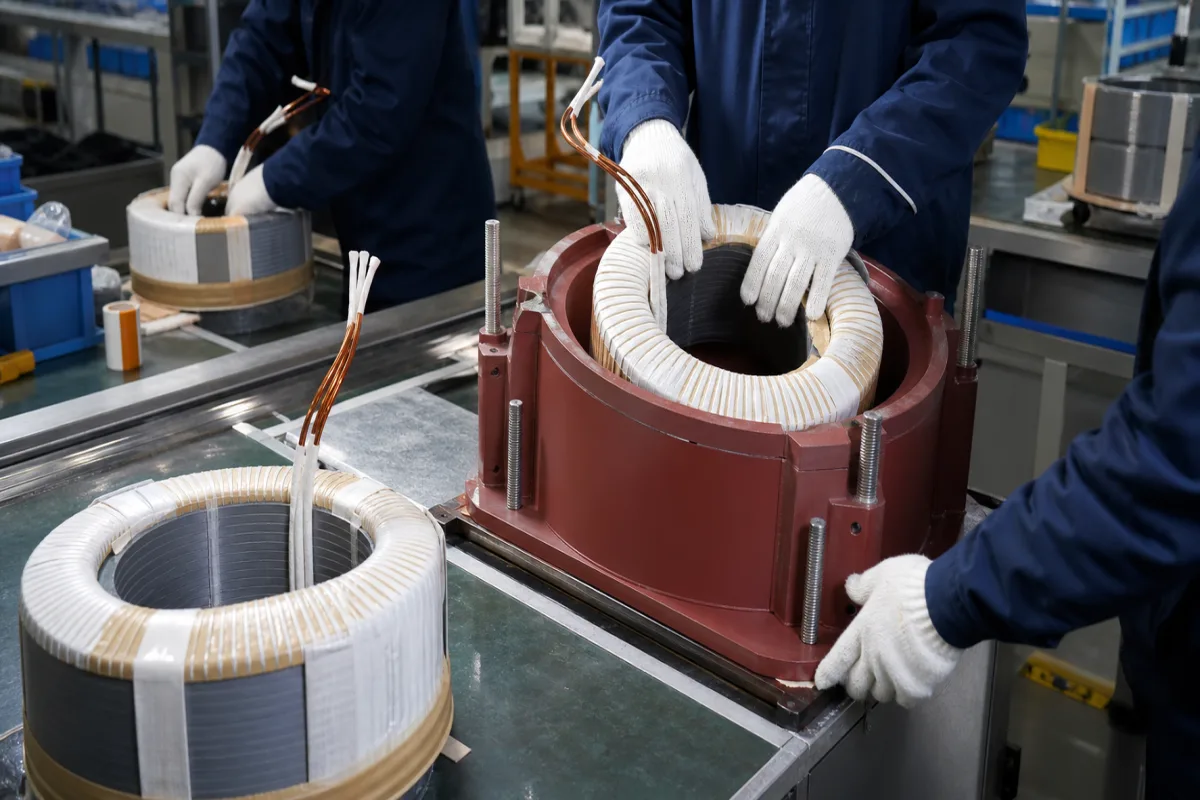
Current transformer core assembly (wound toroidal core and secondary winding for medium-voltage CTs)
Wound toroidal cores for current transformers · grain-oriented steel grades and annealing, nanocrystalline tape cores, cross-section and stacking factor
A current transformer core assembly is the magnetic heart of a CT: a toroidal core wound from thin magnetic strip, annealed, protected and then wound with the secondary turns before the whole assembly is cast or housed with the primary. Ask three things first: which strip material and grade the core is wound from, how the core is annealed and protected after winding, and what cross-section, stacking factor and mass the core has for the accuracy and burden required.
Wound toroidal cores and core-and-secondary assemblies for current transformers, mainly medium-voltage cast-resin types: grain-oriented silicon steel, nanocrystalline and other tape-wound cores. Complete current transformers are covered on the Current transformer page; power transformer cores, current sensors and instrument transformer testing are outside this page.
CNFX editorial research · Sources checked October 12, 2026 · 4 sources
Nippon Steel's ORIENTCORE range of grain-oriented electrical steel lists conventional grades from 0.23 to 0.35 mm thick with W17/50 iron loss of 1.10 to 1.55 W/kg and B8 induction of at least 1.80 T, and HI-B grades from 0.20 to 0.30 mm with 0.80 to 1.20 W/kg and B8 of at least 1.88 T, all at an assumed density of 7.65 kg/dm³ and lamination factors of 94.0 to 96.0% by thickness. It describes HI-B as having about 0.1 T higher B10 than conventional grades. [1]
Vacuumschmelze (VAC), in a brochure distributed by Allstar Magnetics, describes current transformers for electronic electricity meters based on its VITROPERM nanocrystalline alloys, with or without DC tolerance to IEC standards and with shielding against external magnetic fields, citing linearity, low temperature dependence and compact design, for single transformers up to 400 A. [2] Its VITROPERM 712 F flyer gives typical material data of 1.23 T saturation flux density, coercivity below 3 A/m, a Curie temperature above 600 °C and an upper operating temperature of 155 °C for the core material (130 °C in a plastic case). [3]
Editorial note: these material figures come from different tests (B8 is induction at 800 A/m, saturation flux density is the material's ceiling), so ask the core maker for the B-H curve and losses of the finished, annealed core at the flux densities your CT design uses, not only strip data.
Give the core maker the CT type and rating, accuracy class and burden or knee-point requirement, strip material and grade, core inner and outer diameter and height, cross-section and stacking factor, annealing and protection (case, coating, tape), secondary turns and wire if wound by the supplier, test data required and quantity.
02
Size the cross-section and keep annealing and protection in the order
Nippon Steel notes that its laser-irradiated HI-B∙LS grades (ZDKH) lose the laser effect if stress-relief annealing is applied, while its HI-B∙PM grades (ZDMH) withstand stress-relief annealing up to about 800 °C in a non-oxidizing atmosphere, so that they "can be widely used for various types of transformers". [1] For a wound toroid that is annealed after winding, the grade must keep its properties through that anneal.
Transmart lists instrument transformer cores among custom wound cores in nanocrystalline, amorphous, silicon steel and mumetal materials. [4] VAC's material flyer distinguishes the plastic case limit of 130 °C from the core material limit of 155 °C, so the protective case can set the temperature limit of the assembly. [3]
Editorial calculation: a toroid of 200 mm outer and 120 mm inner diameter and 60 mm height has a gross cross-section of (200 - 120) ÷ 2 × 60 = 2,400 mm² (24 cm²); at a 95% lamination factor the steel section is about 22.8 cm². Its mean path is π × 160 ≈ 503 mm, so its steel volume is about 2,400 × 503 × 0.95 ≈ 1.15 dm³ and its mass at 7.65 kg/dm³ about 8.8 kg; core dimensions here are an assumed example. [1]
03
Transmart wound instrument transformer cores
Transmart lists custom wound instrument transformer cores in nanocrystalline, amorphous, silicon steel and mumetal materials. Ask for the strip grade, annealing, finished-core test data and dimensions.
04
Strip core, anneal, case, secondary winding and shield
The anneal and the protective case are part of the core, not extras: some grades lose their treated properties if annealed, and the case can set the temperature limit.
Part
Role
Fix in the order
Wound strip core
Carries the flux; material sets losses and induction. [1][3]
Material, grade, thickness.
Annealing
Relieves winding stress; some grades lose their treatment. [1]
Atmosphere, temperature.
Core case or coating
Protects the annealed core; may limit temperature. [3]
Core area, saturation flux, losses and stacking factor for CT cores
Rows such as voltage class and short-time current belong to the finished CT; the core-specific rows are area, saturation flux, loss per kilogram and stacking factor.
Field
What it means and published values
Ask the supplier for
Rated primary voltage (kV)
System voltage of the finished CT.
For the CT, not the core.
Accuracy class (class)
Set by the finished CT design and core.
Class and burden.
Core cross-sectional area (cm²)
Example: 24 cm² gross for a 200/120 × 60 mm toroid (editorial). [1]
Gross and net area.
Saturation flux density (T)
Example: 1.23 T nanocrystalline; B8 ≥1.80-1.88 T for GO grades. [3][1]
Explore company information and manufacturing capabilities, then discuss the scope of your project with a relevant supplier.
Share this page
Compiled and source-reviewed by the CNFX editorial team.
Each manufacturer above links to the page on that company's own website where the product is listed, with the date we checked it. How we source and review
· Page last updated 12 October 2026
Buyer questions
Which steel grades are used for wound CT cores?
Nippon Steel lists grain-oriented grades from 0.20 to 0.35 mm with W17/50 losses of 0.80 to 1.55 W/kg; the choice for a CT is the core maker's and the designer's. [1]
Does annealing affect the core steel?
Nippon Steel states annealing removes the laser domain-refining effect of its ZDKH grades, while ZDMH grades withstand annealing up to about 800 °C. [1]
What does nanocrystalline material offer for CT cores?
VAC cites linearity, low temperature dependence and compact design for VITROPERM-based meter CTs, with 1.23 T saturation for one alloy. [2][3]
How is the core cross-section worked out?
Half the difference of outer and inner diameters times height, then times the stacking factor for the net steel area (editorial calculation). [1]
Sources and what still needs a direct check
Sources checked 2026-10-12. Nippon Steel publishes its grain-oriented steel grades; VAC's brochure and flyer (distributed by Allstar Magnetics) describe its nanocrystalline cores and meter CTs; Transmart describes its own cores.