Strukturierte Fertigungsdaten · 2026

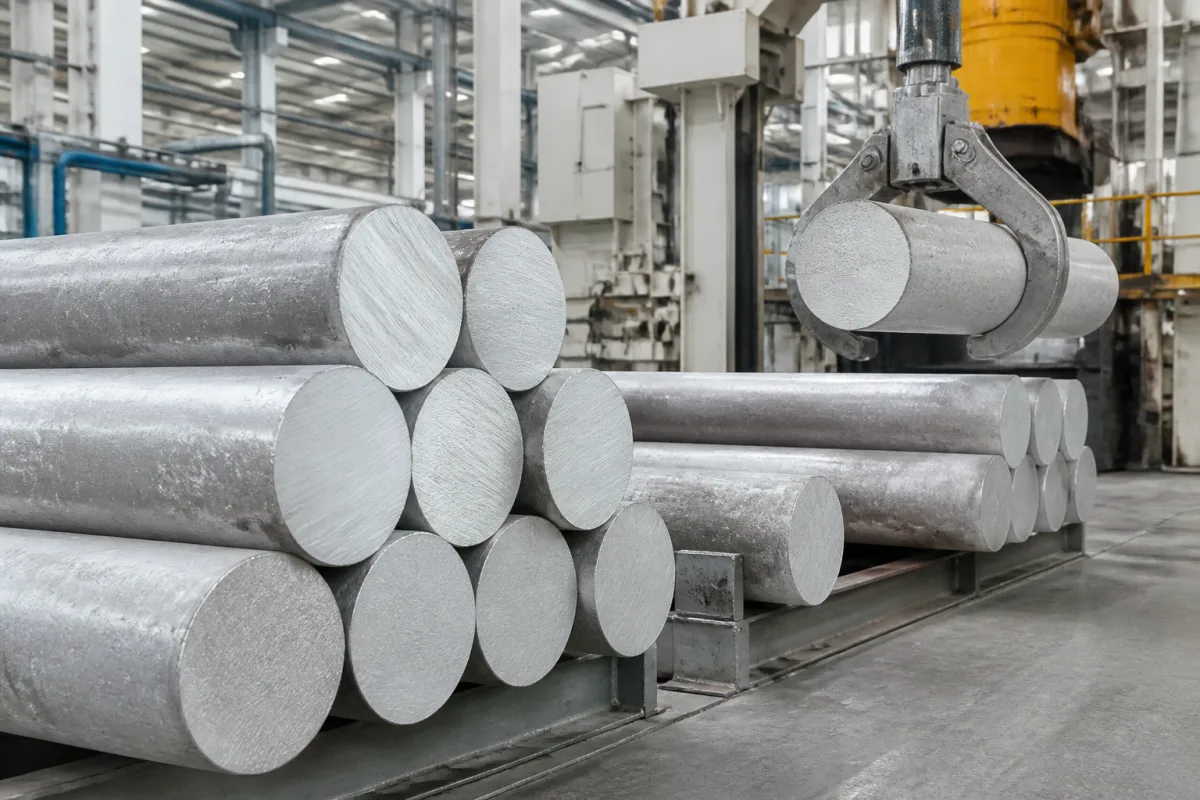
High-Purity Magnesium Alloy Billet

Auf Basis strukturierter CNFX-Herstellerprofile wird High-Purity Magnesium Alloy Billet im Bereich Nichteisenmetallproduktion anhand von Chemische Zusammensetzung Reinheit bis Zugfestigkeit eingeordnet.

Technische Definition und Kernbaugruppe

Ein typisches High-Purity Magnesium Alloy Billet wird durch die Baugruppe aus Legierungsmatrix und Kornfeinungszusätze beschrieben. Für industrielle Anwendungen werden Materialauswahl, Fertigungsprozess und Prüfbarkeit gemeinsam bewertet.

Semi-finished magnesium alloy casting for further processing in non-ferrous metal production

Technische Definition

High-purity magnesium alloy billet is a semi-finished industrial material produced through direct chill casting or continuous casting processes. It serves as the primary feedstock for extrusion, forging, and rolling operations in the non-ferrous metals industry. This material offers excellent strength-to-weight ratio, corrosion resistance, and machinability for aerospace, automotive, and electronics applications. The controlled microstructure and chemical composition ensure consistent mechanical properties in downstream manufacturing processes.

Funktionsprinzip

Molten magnesium alloy is solidified into standardized cross-sectional shapes through controlled cooling in casting equipment, creating homogeneous semi-finished products ready for secondary processing.

Technische Parameter

Chemische Zusammensetzung Reinheit
Mindestmagnesiumgehalt in Prozent%
Zugfestigkeit
Mindest-ZugfestigkeitMegapascal
Streckgrenze
Mindeststreckgrenze bei 0,2 % DehnungMPa
Dehnung
Mindestdehnung bei Bruch%
Korngröße
Maximaler mittlerer Korndurchmesserµm
Oberflächenrauheit
Maximaler OberflächenrauheitswertRa

Hauptmaterialien

Magnesium (Mg) Aluminum (Al) Zinc (Zn) Manganese (Mn)

Komponenten / BOM

Legierungsmatrix
Primäres Strukturmaterial zur Bereitstellung mechanischer Eigenschaften
Material: Magnesiumbasislegierung
Kornfeinungszusätze
Steuert die Mikrostrukturbildung während der Erstarrung
Material: Zirkonium- oder kohlenstoffbasierte Verbindungen
Oberflächenoxidschicht
Natürliche Schutzschicht gegen Korrosion
Material: Magnesiumoxid (MgO)

FMEA · Fehleranalyse

Ursache → Fehlermodus → Engineering-Maßnahme

Insufficient mold preheat below 200°C Premature solidification causing cold shuts and incomplete filling Integrated induction heating system maintaining 350±10°C mold temperature with PID control
Atmospheric oxygen concentration exceeding 0.5% in casting chamber Surface oxidation layer formation exceeding 50 μm thickness Argon inert gas shielding with <0.1% O₂ monitoring and automated purge system

Technische Bewertung

Betriebsbereich
Betriebsbereich
350-450°C casting temperature, 0.5-2.0 MPa mold pressure, 0.1-0.5 m/s casting speed
Belastungs- und Ausfallgrenzen
Solidification cracking at 0.8% volumetric shrinkage, hot tearing at 1.2% strain, oxidation ignition at 470°C in air
Magnesium's high thermal expansion coefficient (26×10⁻⁶/K) causes solidification shrinkage stress exceeding yield strength (80-120 MPa), while low ignition temperature (470°C) enables exothermic oxidation (ΔH = -601 kJ/mol)
Fertigungskontext
High-Purity Magnesium Alloy Billet wird innerhalb von Nichteisenmetallproduktion nach Material, Prozessfenster und Prüfanforderungen bewertet.

Weitere Produktbezeichnungen

magnesium extrusion billet Mg alloy casting stock non-ferrous metal feedstock

Taxonomie und Suchbegriffe

Suchbegriffe, Aliase und technische Bezeichnungen für diesen CNFX Datensatz.

Industrielles Ökosystem und Lieferkette

Eignung und Auslegungsdaten

Betriebsgrenzen
Traglast:Atmospheric to 10 bar (processing environment)
other spec:Slurry concentration: ≤30% solids by weight, Flow rate: ≤5 m/s in processing fluids
Einsatztemperatur:Ambient to 450°C (continuous), 500°C (peak)
Montage- und Anwendungskompatibilität
Aerospace structural componentsAutomotive lightweight partsBiomedical implant manufacturing
Nicht geeignet: Marine/saltwater environments (high chloride corrosion)
Auslegungsdaten
  • Required final part dimensions (mm)
  • Target alloy composition (Mg-X-Y-Z%)
  • Annual production volume (tons/year)

Zuverlässigkeits- und Risikoanalyse

Ausfallmodus und Ursache
Stress corrosion cracking
Cause: High-purity magnesium alloys are susceptible to SCC in chloride-containing environments due to their hexagonal close-packed structure and low corrosion resistance, leading to brittle fracture under tensile stress.
Galvanic corrosion
Cause: When magnesium alloy billets contact dissimilar metals (e.g., steel, aluminum) in electrolyte-rich environments, accelerated localized corrosion occurs due to magnesium's highly anodic position in the galvanic series.
Wartungsindikatoren
  • White powdery deposits or localized pitting on billet surfaces indicating active corrosion
  • Audible cracking or popping sounds during thermal cycling or mechanical loading suggesting crack propagation
Technische Hinweise
  • Implement strict environmental controls including humidity below 40% and chloride concentration monitoring in storage/processing areas
  • Apply protective coatings (e.g., chromate conversion, anodized layers) and ensure proper electrical isolation from dissimilar metals using non-conductive spacers

Compliance & Manufacturing Standards

Reference Standards
ASTM B107/B107M-13: Standard Specification for Magnesium-Alloy Extruded Bars, Rods, Profiles, Tubes, and WireISO 3116:2019: Magnesium and magnesium alloys - Wrought magnesium alloysDIN EN 1753:1997: Magnesium and magnesium alloys - Magnesium alloy ingots and castings - Chemical composition
Manufacturing Precision
  • Diameter: +/-0.5mm
  • Straightness: 1mm per 1000mm length
Quality Inspection
  • Spectrochemical Analysis for alloy composition verification
  • Ultrasonic Testing for internal defects detection

Hersteller, die dieses Produkt fertigen

Herstellerprofile mit passender Produktionsfähigkeit in China.

Die Herstellerliste dient der Vorrecherche und Einordnung von Fertigungskapazitäten. Sie ist keine Zertifizierung, kein Ranking und keine Transaktionsgarantie.

Beispielhafte Bewertungskriterien aus Einkaufsprozessen

Keine Kundenbewertung und keine Echtzeitdaten. Die Werte zeigen typische Prüfkriterien in RFQ- und Lieferantenbewertungsprozessen.

Technische Dokumentation
4/5
Fertigungsfähigkeit
4/5
Prüfbarkeit
5/5
Lieferantentransparenz
3/5

Die Kriterien dienen als Orientierung für technische Einkaufsprüfungen. Konkrete Kunden, Länder, Bewertungsdaten oder Live-Nachfragen werden nur angezeigt, wenn entsprechende belastbare Daten vorliegen.

Häufige Fragen

What are the key applications for high-purity magnesium alloy billets in non-ferrous metal production?

High-purity magnesium alloy billets are primarily used as semi-finished products for extrusion, forging, and machining operations in aerospace, automotive, and electronics manufacturing, where lightweight structural components with specific mechanical properties are required.

How does the chemical composition affect the performance of magnesium alloy billets?

The precise balance of magnesium (Mg), aluminum (Al), zinc (Zn), and manganese (Mn) determines critical properties including tensile strength, corrosion resistance, and workability. Aluminum enhances strength, zinc improves castability, and manganese increases corrosion resistance while maintaining purity standards.

What quality control measures ensure consistent billet specifications?

Our billets undergo rigorous testing for chemical composition purity, grain size uniformity (measured in μm), surface roughness (Ra), and mechanical properties including tensile strength (MPa) and yield strength (MPa), with documentation provided for each production batch.

Kann ich Hersteller direkt kontaktieren?

CNFX ist ein offenes Verzeichnis, keine Handelsplattform und kein Beschaffungsagent. Herstellerprofile und Formulare helfen bei der Vorbereitung des direkten Kontakts.

CNFX Industrial Index v2.6.05 · Nichteisenmetallproduktion

Datenbasis

CNFX-Herstellerprofile, technische Klassifikation, öffentlich verfügbare Produktinformationen und fortlaufende Plausibilitätsprüfung.

Vorläufige technische Einordnung
Diese Seite dient der strukturierten Vorbereitung von Recherche, RFQ und Lieferantenbewertung. Sie ersetzt keine Lieferantenqualifizierung, keine Normenprüfung und keine technische Freigabe durch den Käufer.

Beschaffungsinformationen anfragen für High-Purity Magnesium Alloy Billet

Informationen zu Einsatzbereich, Spezifikationsgrenzen, Lieferantentypen und RFQ-Vorbereitung anfragen.

Ihre Geschäftsdaten werden nur zur Bearbeitung dieser Anfrage verwendet.

Vielen Dank. Ihre Anfrage wurde gesendet.
Vielen Dank. Ihre Anfrage wurde empfangen.

Fertigung für High-Purity Magnesium Alloy Billet?

Herstellerprofile mit passender Produkt- und Prozesskompetenz vergleichen.

Herstellerprofil anlegen Kontakt
Vorheriges Produkt
High-Purity Copper Cathode
Nächstes Produkt
High-Purity Zinc Anode Slab