Vibration motors for handheld and wearable products · Eccentric rotating mass (ERM) cylinder and coin motors versus linear resonant actuators, eccentric mass, radius and speed against vibration force, rated and start voltage, current under load, drive circuits and braking
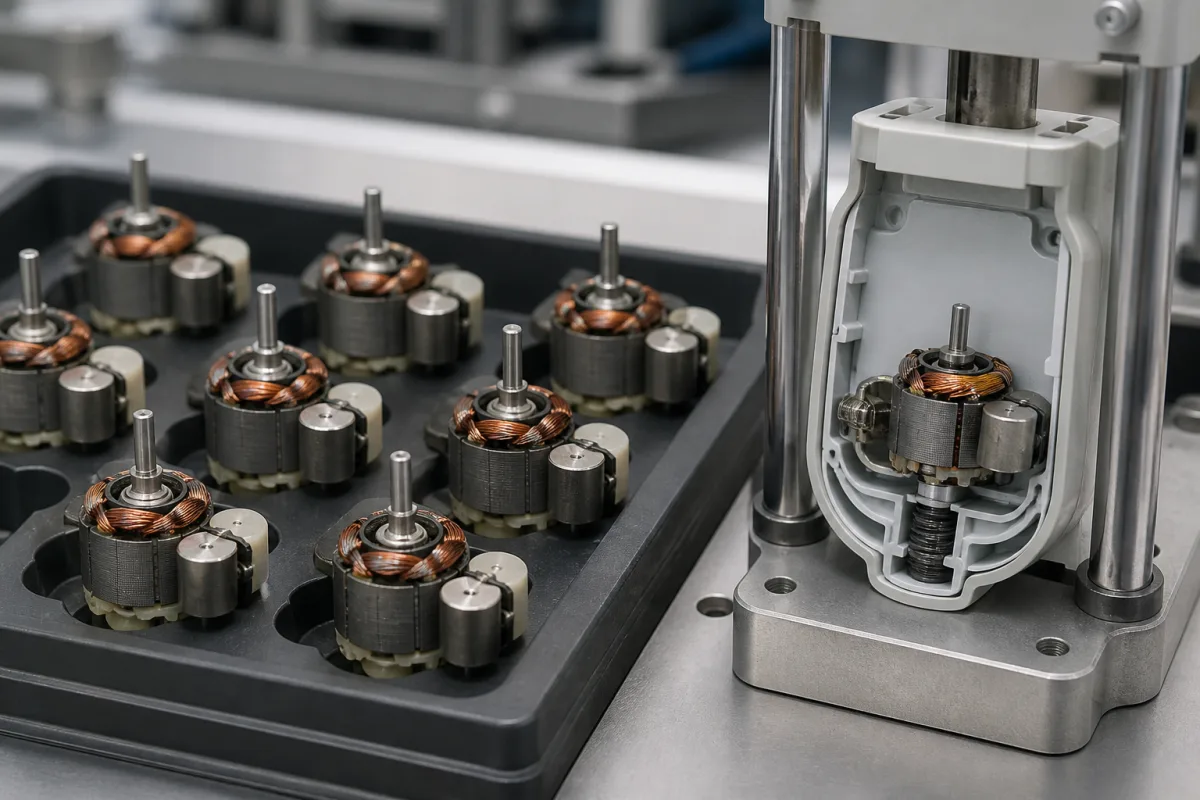
A vibration motor is a small DC motor with an off-centre (eccentric) mass on its shaft, or a linear resonant actuator with a spring-mounted magnet, that turns electrical input into felt vibration for alerts, haptic feedback and massage-type devices; the motor core is the winding, magnet and shaft assembly inside it. Ask three things first: what vibration amplitude and frequency the product must deliver in its housing, which form factor (cylinder ERM, coin ERM or linear resonant actuator) fits the space and battery, and what rated and start voltage, current and drive circuit the electronics provide.
Miniature vibration motors for consumer, medical, wellness and industrial handheld devices: cylindrical and coin eccentric rotating mass (ERM) motors and their cores, and linear resonant actuators (LRA) where compared. Industrial vibrator motors for feeders and screens (see vibrating feeder), voice-coil actuators for positioning (see voice coil motor) and finished devices are outside this page except where compared.
CNFX editorial research · Sources checked October 12, 2026 · 4 sources
Precision Microdrives' Application Bulletin AB-004 describes the ERM, or pager motor, as a DC motor with an offset mass on its shaft whose rotating, unbalanced centripetal force displaces the motor repeatedly, felt as vibration. It models the motor in its product as driven harmonic vibration — a mass, spring and damper excited by a force F₀ = m·r·ω², where m is the eccentric mass, r its distance from the shaft and ω the angular speed — so vibration strength depends on the eccentric mass, its radius and the speed, and on the stiffness, damping and mass of whatever the motor is built into. The maker therefore quotes nominal vibration in G (acceleration relative to 9.8 m/s²) on a 100 g mass as a practical comparison. [1]
Its ERM product page says its small range suits handheld equipment of about 25–200 g, is based on motors up to about 6 mm diameter with 1.5–3 V rated voltage for single or double battery cells, uses brushed coreless designs with NdFeB magnets, says connections are "most commonly made with flying leads", and that coin motors are also ERMs with the eccentric mass inside a low-profile case. [3]
Bulletin AB-003 explains that a linear resonant actuator (LRA) moves a magnet and mass on a spring with a voice coil, so it needs an AC drive signal at its resonant frequency, with output falling off sharply away from it; its C10-100 example resonates at 175 Hz with little amplitude above 220 Hz, and an ERM cannot be swapped for an LRA without changing the drive. [2]
Editorial calculation: an eccentric mass of an assumed 0.5 g at 1 mm radius spinning at 12,000 rpm (ω ≈ 1,257 rad/s) gives F₀ ≈ 0.0005 × 0.001 × 1,257² ≈ 0.79 N; raising the speed by 20% raises the force by about 44% (1.2²). Measure the actual vibration in your housing, as the bulletin notes the product's mass and mounting change it. [1]
Give the supplier the required vibration amplitude (G, and on what test mass or in your housing) and frequency, motor type (cylinder ERM, coin ERM, LRA), maximum size, supply voltage range and battery type, rated and start voltage, allowed current, lead length and connector, mounting (bracket, adhesive, overmould), duty cycle and life, noise limit, sealing or ingress needs, and quantities.
02
Set voltage, current and drive circuit
AB-004 explains that an ERM driven from a constant DC voltage at its rated voltage runs at constant speed, frequency and amplitude; it works over a voltage range but the maker quotes a start voltage that must be met for the motor to start every time. Raising voltage raises frequency proportionally and force with the square of speed. Back EMF is proportional to speed (V = R·I + K_E·ω) and current to torque, so a loosely held motor, which loses more vibration energy, draws more current than one clamped tightly. Drives range from a single transistor or dedicated driver IC to an H-bridge that reverses polarity for active braking, shortening stop time for haptic effects. [1]
Editorial note: ask for the speed, current and vibration against voltage curves at your battery's full and low voltage, and check start-up at the lowest voltage and temperature the product will see.
03
Read a coin-motor selection table: size, speed, current and G
Vybronics' coin vibration motor page tabulates brush-type ERM coin motors and explains when to choose other types: brush coin motors suit low-cost products with simple alerts at light to moderate duty, brushless (BLDC) coin motors suit very long life and high MTBF at higher cost, and LRAs suit crisp haptic feedback with fast rise and fall times. Its table lists, for example, the VC0625B001L at 6.0 mm diameter and 2.5 mm thick, rated 2.5 V (2.0–3.5 V), 100 mA maximum and 42 mA in the column Vybronics labels “typical”, at least 10,000 rpm (167 Hz) and 0.30 Grms measured on a 50 g mass; the VC0834B011F at 8.0 × 3.4 mm, 3.0 V (2.7–3.3 V), 85 mA maximum and 61 mA (Vybronics “typical”), 13,500 rpm (225 Hz) and 0.70 Grms; and the VC1020B111F at 10.0 × 2.1 mm with the same 3 V, 13,500 rpm and 0.70 Grms. The table gives maximum response times of 90 ms to rise and 50 ms to fall to 50% of power for these brush motors. Motors can be supplied with connectors, spring contacts, FPC or bare pads, and with foam pads or adhesive tape. [4]
Editorial calculation: the vibration frequency is speed ÷ 60, so 13,500 rpm gives 225 Hz and 10,000 rpm 167 Hz, as the table shows; at 3.0 V and the 61 mA Vybronics lists as “typical”, the 8 mm motor draws about 0.18 W. A 90 ms rise time means a 100 ms pulse barely reaches half power, which is why short haptic clicks are given to LRAs. Ask for the G value with its test mass, since the 6 mm motor is rated on 50 g and others on 100 g. [4][1][2]
Two coin-motor makers: one with LRA and SMD types, one with 8–10 mm 3 V parts
One listed maker shows coin ERMs next to LRA, coreless and SMD types; the other lists 8–10 mm, 3 V flat motors with start voltage, speed and current, the same columns as the Vybronics table above. [4]
05
Winding, NdFeB magnet, eccentric mass, coin housing and driver
Motor type, G on a stated test mass, start voltage and current for a vibration motor order
A G figure means little without the test mass it was measured on (Vybronics rates its 6 mm motor on 50 g, Precision Microdrives quotes on 100 g), so the vibration row asks for both. [4][1]
2 companies list this product among what they make. Company figures are quoted from each
company's own website; every card states where the relationship came from.
Leader Microelectronics (Huizhou) Co., Ltd.
Manufacturing site to be confirmed for the order
Lists eccentric rotating mass coin vibration motors, alongside LRA, coreless and SMD vibration motors.
Explore company information and manufacturing capabilities, then discuss the scope of your project with a relevant supplier.
Share this page
Compiled and source-reviewed by the CNFX editorial team.
Each manufacturer above links to the page on that company's own website where the product is listed, with the date we checked it. How we source and review
· Page last updated 13 October 2026
Buyer questions
What sets the strength of a vibration motor?
The eccentric mass, its distance from the shaft and the speed: the force is m·r·ω², and the device's mass and mounting change what is felt. [1]
Can an LRA replace an ERM vibration motor directly?
Not directly; an LRA needs an AC drive at its resonant frequency, while an ERM runs on DC. [2]
Why does a vibration motor draw more current when held loosely?
More vibration energy is taken out of the system, so the motor needs more torque and current to keep spinning. [1]
How fast does a coin vibration motor start and stop?
One maker's brush coin motors list up to 90 ms to rise and 50 ms to fall to 50% of power; it recommends LRAs where fast rise and fall are needed for haptic feedback. [4]
Sources and what still needs a direct check
Sources checked 2026-10-12. The Precision Microdrives bulletins explain one maker's view of ERM and LRA behaviour and its own ranges; ratings for your device must come from the supplier's data sheet and tests in your housing.