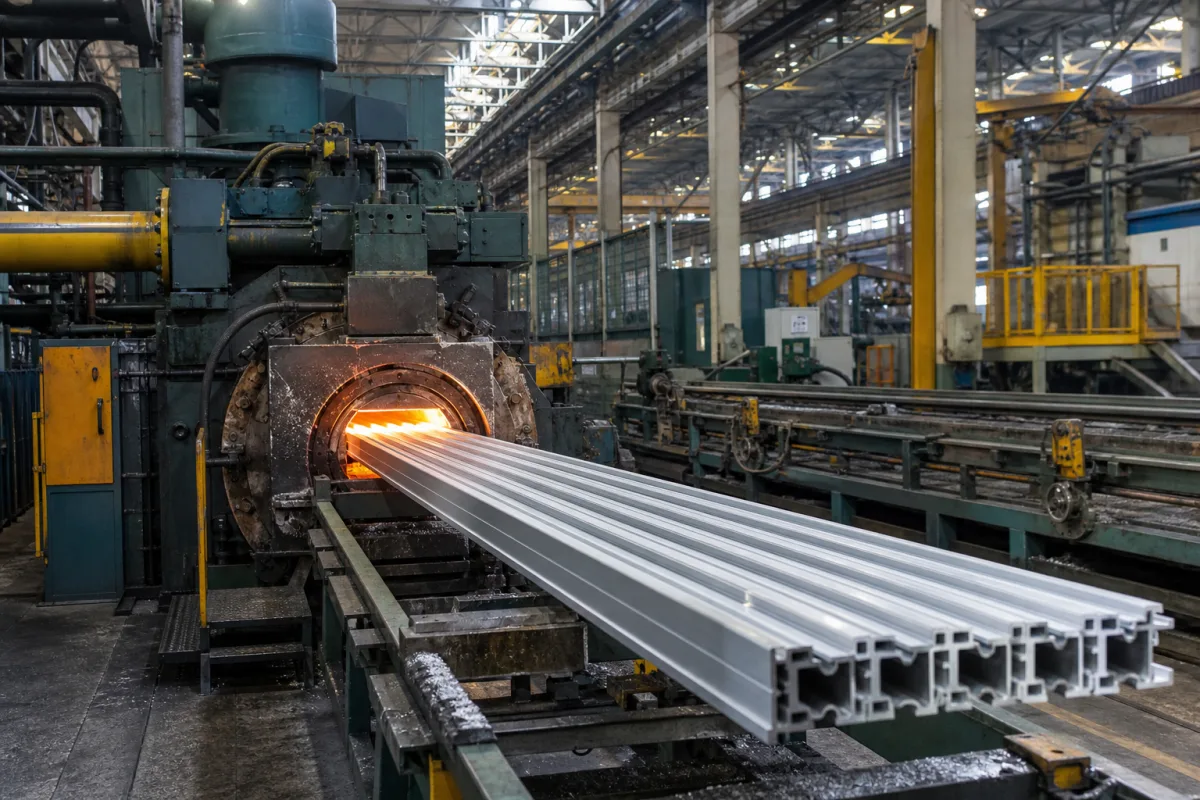
Aluminium profile extrusion line: puller, quench, cooling, stretcher and saw after the press
Aluminium extrusion line after the press · puller, quench, run-out and cooling tables, stretcher and saw, stretch and temperature before stretching
An aluminium profile extrusion line is the chain of equipment that takes the hot profile from the press die to cut lengths ready for ageing: a puller that leads it out, a quench, lead-out and run-out conveyors, a cooling table, a stretcher that straightens it, and a saw. Ask three things first: what profile weight per metre and maximum length the handling is designed for, how the quench and cooling bring the profile to the temperature the stretcher needs, and what stretch the line is set to give for your alloy and temper.
The handling and finishing equipment of an aluminium profile extrusion line after the die: pullers, quench, lead-out and run-out conveyors, cooling tables, stretchers and finish saws, ordered as one line. The press itself (main cylinder, container, billet size and force) is covered on the Aluminium extrusion press page; extrusion dies, billet casting and anodising lines are outside this page.
CNFX editorial research · Sources checked October 12, 2026 · 3 sources
Aluminium International Today's report on a Granco Clark system for Indalum in Mexico shows the order of the stations. The line was designed for extrusions of 25 kg/m and up to 50 m long: a "Flying Cut" double puller leads the hot extrusion through a 20 m lead-out conveyor towards a 50 m run-out table, cutting without interrupting the extrusion cycle, while pulling it through a progressive high-pressure quench capable of water spray, high-velocity air and mist, designed to stabilise the shape first and then quench to the required metallurgical properties and exit temperature. Profiles then pass to a belt cooling table, a 150 T segmented cam jaw stretcher, the saw in-feed conveyor and an extrusion cutting system, and are packed for ageing; heating and handling are run by a supervisory computer system. [1]
AlCircle's report on equipment ordered by Kawneer adds detail on the run-out: a 500 lb double puller with two heads on a common rail and a cutting saw on the first head, giving flying cut, fixed cut and double-length operation; a lowering idle-roll run-out conveyor with rollers covered in high-temperature needled felt and PBO over Kevlar; multi-speed transfer belts that penetrate the run-out conveyor so that, when the run-out table lowers, the extrusions are transferred to the first cooling station; and under-table cooling fans in the lead-out and run-out. The same report describes a billet taper quench ordered by UACJ to allow isothermal extrusion while keeping extrusion speed through the cycle. [2]
Editorial calculation: a full 50 m length of a 25 kg/m profile weighs 50 × 25 = 1,250 kg, so the puller, run-out rollers and transfer belts are sized for that load at the line's design maximum; give the supplier your heaviest profile in kg/m and longest length, not only the press size. [1]
Give the supplier the press size and die exit position, alloys and tempers, heaviest profile (kg/m) and largest cross-section, maximum and minimum lengths, extrusion speed, quench media and exit temperature, cooling table length, stretcher force and stretch control, saw cut lengths and tolerance, packing for ageing, controls, and site layout.
02
Set the stretch and the temperature before stretching
Aluminium Guide, summarising extrusion technology references, states that profiles must be cooled to below 50 °C, or to 40 °C, before they are moved to the stretcher, because stretching too hot causes bending, twisting and poor ageing performance when the internal stress cannot be fully removed. It also notes that stretchers are sized to give stretching force for the largest profile produced, from its cross-sectional area multiplied by the yield stress of the alloy. [3]
The same page gives two different stretch figures, so confirm the target with your temper specification and the supplier: one cited source says stretch should be about 1% and must not exceed 2%, while another considers 0.5% residual stretch optimal; it also quotes EN 515 designations Tx510 and Tx511 for extrusions stretched to 1% to 3% permanent set after solution heat treatment or cooling from extrusion, with stretch below 1% not given an extra designation. Too much stretch, it says, can leave sizes deviating between head, middle and tail and areas of low elongation and high hardness. [3]
Editorial calculation: a 25 kg/m profile has a cross-section of about 25 ÷ 2,700 = 0.00926 m², or 9,260 mm², taking an assumed density of 2,700 kg/m³; at an assumed yield stress of 100 MPa after quench, stretching it needs about 9,260 × 100 = 926,000 N, roughly 926 kN or 94 tonnes-force, within the 150 T stretcher of the line described above. Use your own alloy's yield stress after quench and largest section. [3][1]
03
Autech run-out equipment and Huanan presses: who covers which stations
Guangdong Autech lists an aluminium extrusion production line range including an aluminium stretcher, cooling bed, profile conveying system and saw with gauge systems; Huanan Heavy Industry lists hydraulic aluminium extrusion presses from 600 MT to 7500 MT. Ask each which stations from puller to saw are in the quoted scope.
04
Puller, quench, cooling table, stretcher and saw in run-out order
Every station after the die has a job tied to the profile's temperature: quench while hot, cool on the table, stretch only once cold enough, then saw.
Station
Role
Fix in the order
Puller (single or double)
Leads the profile out; flying or fixed cut. [1][2]
Pull force, heads, cut modes.
Quench
Water spray, air or mist to set shape and properties. [1]
Media, length, exit temperature.
Lead-out and run-out conveyors
Carry the hot profile on heat-resistant rollers. [2]
Length, roller covering.
Transfer belts and cooling table
Move profiles across while they cool, with fans. [2]
Length, fans, belt speed.
Stretcher
Straightens by stretching; force from area × yield stress. [1][3]
Cooling length, pre-stretch temperature and stretch percentage for the run-out
The rows with published values are the ones that limit throughput after the press: how long the cooling path is, how cool the profile must be before stretching and how far it is stretched.
Explore company information and manufacturing capabilities, then discuss the scope of your project with a relevant supplier.
Share this page
Compiled and source-reviewed by the CNFX editorial team.
Each manufacturer above links to the page on that company's own website where the product is listed, with the date we checked it. How we source and review
· Page last updated 13 October 2026
Buyer questions
What does an aluminium extrusion line include after the press?
One reported Granco Clark line has a flying-cut double puller, a 20 m lead-out, a 50 m run-out table with quench, a belt cooling table, a 150 T stretcher and an extrusion cutting system. [1]
How much are aluminium extrusions stretched?
Sources differ: one guide gives about 1% and not over 2%, another 0.5% as optimal, and EN 515 Tx510/Tx511 tempers cover 1% to 3% permanent set. [3]
How cool must a profile be before stretching?
Aluminium Guide states below 50 °C, or to 40 °C, before moving it to the stretcher. [3]
What is a double puller?
AlCircle describes two puller heads on a common rail with a saw on the first head, giving flying cut, fixed cut and double-length operation. [2]
Sources and what still needs a direct check
Sources checked 2026-10-12. Aluminium International Today and AlCircle are trade publications reporting Granco Clark equipment orders; Aluminium Guide is an educational site summarising extrusion references and EN 515. Equipment figures apply to the lines described.