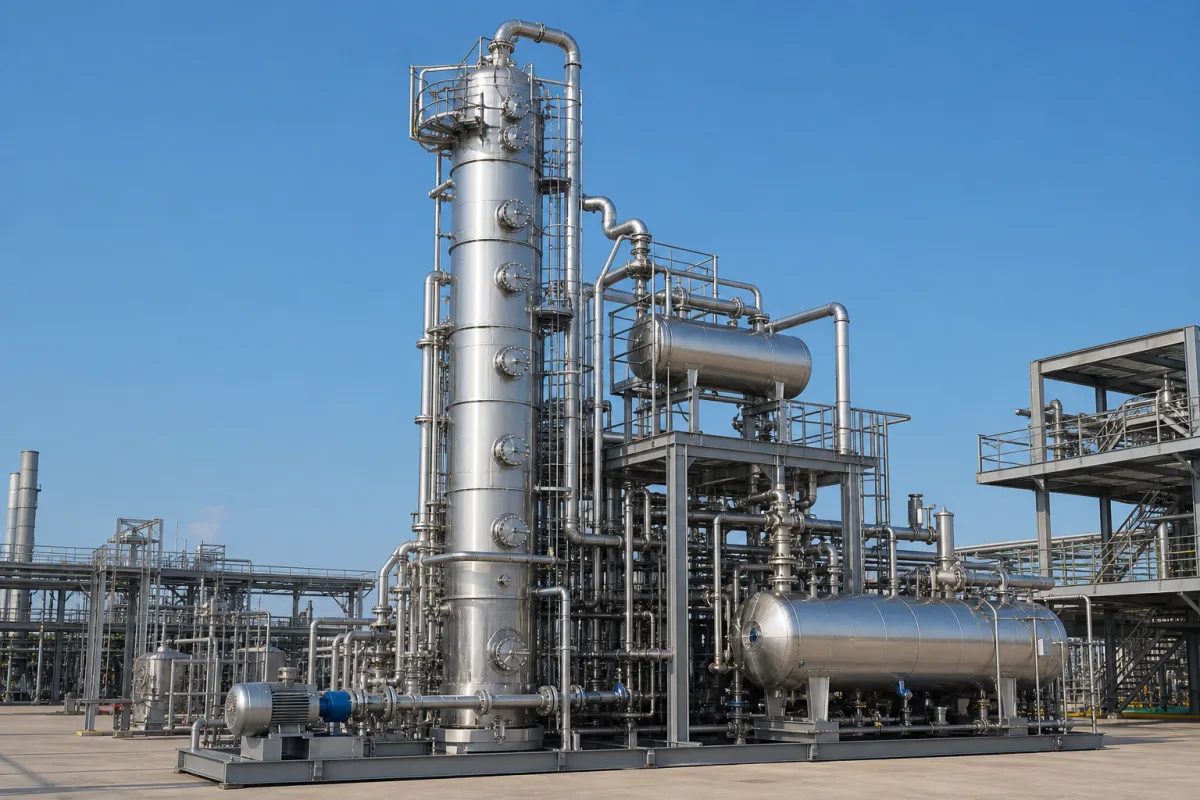
Skid-mounted chemical distillation system for solvent recovery and purification
Packaged distillation plant on a steel frame · column spools and skid splits sized to the delivery route, vacuum steps that hold bottoms below a fouling temperature, shop testing before shipment
A chemical distillation column system, bought as a package, is the column together with everything that makes it run: reboiler and heat source, overhead condenser, reflux drum, pumps, interconnecting piping, instruments and the control system, assembled inside a structural steel frame in a fabrication shop and shipped as one or more modules. What sets it apart from buying a column alone is that the shipping route, the skid split, the test method and the start-up sequence are fixed in the design, together with the separation itself.
Packaged, skid- or module-mounted continuous and batch distillation systems for chemical solvent recovery and product purification, supplied with column, heat exchangers, drums, pumps, piping, instrumentation and controls in a structural frame. This page is about how such plants are packaged, shipped, tested and run step by step. The distillation column itself, its trays or packing, HETP-based height sizing and column energy choices are covered on the Distillation column page; choosing the solvent recovery train (dewatering, evaporation, rectification, membrane or extraction hybrids) is covered on the Continuous solvent recovery and purification system page; cartridge and basket filter skids for solvents are covered on the Solvent filtration skid for solvent recovery page, and HTST pasteurisers on the Continuous-flow (HTST) pasteurisation system page. Wiped-film and short-path units, beverage stills and laboratory glass columns are outside this page.
CNFX editorial research · Sources checked October 12, 2026 · 6 sources
Cutting the column into spools and the plant into skids that fit the delivery path
On a packaged system the column height and the plant layout are set by how the modules travel and where they land, not only by the number of stages.
Koch Modular describes its modular systems as complete process units built in a module shop: columns, reactors, drums, decanters, heat exchangers, pumps and other equipment mounted within a structural steel frame that serves as the shipping support and as the access structure for operation and maintenance. Piping, field instruments and wiring are completed in the frame, and tracing, insulation, lighting, the control system, safety showers and fire protection can also be installed before shipment. [4]
For a Fortune 500 specialty chemical client recovering toxic and flammable solvents from a production waste stream, EPIC Systems built a road-shippable continuous distillation tower divided into two 40-foot sections for transport and on-site assembly. [1] On a two-column ethanol unit installed along a route with fixed doorways, overhead piping and conduits and 90° turns, EPIC instead built two self-contained skids that work as one unit; each column is made of five spools, and an independent finite element analysis confirmed that each skid would bear the stresses of the installation path. [3][2]
Inter-skid connections on that unit were assembled and hydro-tested in the fabrication shop, then disconnected for the journey and mated again on site; the designers kept the number of connections between skids as low as possible. [3] Editorial calculation: two 40-foot sections make an 80-foot (about 24 m) tower before any skirt or overhead piping is added.
Send the supplier the route survey with it: doorway and corridor widths, turn radii, overhead clearances, crane access, final floor area and height limit. Ask how the column will be split into spools or sections, how many inter-skid connections there will be, and whether a structural analysis for transport and lifting is included.
02
Atmospheric and vacuum steps that keep bottoms below a fouling or decomposition temperature
Koch Modular's catalyst-solvent project ran five distillation steps across two systems, and the choice of atmospheric or vacuum for each step follows the temperature limit of the heavy product.
Koch Modular kept column and reboiler temperatures below a set limit to reduce fouling, and because TiCl4 hydrolyses in contact with water or humid air, the system was designed against water and air ingress and its integrity was tested pneumatically with air instead of the usual hydraulic test with water. [5]
EPIC's two-column ethanol unit runs both columns under vacuum at 4.5 psia, heated by a hot-oil system able to reach operating temperatures near 400 °F, and recovers heat from the outgoing solvent to preheat the incoming feed; the product is 91% ethanol. [2] The Chemical Processing article on the same unit gives the column rating as 15 psig at 250 °F. [3] The two figures describe different things (a vacuum operating point and a design rating, and a heating-medium temperature against a vessel rating), so ask the supplier to state both the design pressure and temperature of each vessel and the operating point.
Koch Modular's solvent recovery example runs semi-continuously to bring isopropyl alcohol near its azeotropic concentration from an aqueous pharmaceutical stream, then continuously to dry the IPA by azeotropic distillation with isopropyl ether as entrainer. [6] Editorial calculation: 4.5 psia is about 31% of standard atmospheric pressure (14.7 psia).
System and step
Pressure
Product and specification
System A, step 1 (hexane with 7.4 wt% silicone oil)
Shop testing, delivery schedule and on-site hook-up of a packaged unit
Because the plant is assembled and tested before it ships, the purchase order fixes test methods and schedule milestones that a field-built column would leave to site.
The EPIC ethanol project took four and a half months from first enquiry to start-up: eight weeks for engineering, design and drawings, eight weeks for fabrication and assembly, one week of testing in EPIC's shop, one week for delivery and installation and one week of on-site operator training. Installation and start-up took a few days because the system was tested before shipment. [3] Editorial calculation: 8 + 8 + 1 + 1 + 1 = 19 weeks.
Koch Modular gives a delivery schedule of 7 to 8 months from purchase order for a complete modular unit in stainless or carbon steel, including engineering and design, and quotes such systems at firm lump-sum prices rather than time and materials. [4]
Agree in writing which tests are done in the shop (hydrostatic or pneumatic, leak test under vacuum, instrument loop checks, control system test), which connections are broken for shipment and re-made on site, and who supplies start-up assistance and operator training.
04
Data for a packaged distillation system quotation
Paste it into your enquiry below or into an email to a maker, then replace every bracket.
Feed: [components and wt%; flow; temperature; water or air sensitivity]
Products: [purity of each distillate and bottoms; impurity limits]
Operation: [continuous, batch or semi-continuous; steps; vacuum or pressure]
Temperature limits: [maximum bottoms or reboiler temperature]
Utilities: [steam, hot oil or electric heating; cooling water; vacuum]
Site: [indoor or outdoor; floor area; height; delivery route]
Design codes: [vessel, piping, electrical area classification]
Testing and documents: [shop tests; FAT; manuals; training]
Explore company information and manufacturing capabilities, then discuss the scope of your project with a relevant supplier.
Share this page
Compiled and source-reviewed by the CNFX editorial team.
Each manufacturer above links to the page on that company's own website where the product is listed, with the date we checked it. How we source and review
· Page last updated 13 October 2026
Buyer questions
How is a tall distillation column shipped on a skid?
In sections or spools: EPIC divided one solvent recovery tower into two 40-foot sections and built each column of a two-column ethanol unit from five spools on two skids. [1][3]
Why do solvent recovery skids use vacuum steps?
To limit temperature: Koch Modular's second hexane recovery step ran under vacuum to keep silicone-oil bottoms below 149 °C. [5]
How long does a modular distillation unit take to deliver?
Koch Modular gives 7 to 8 months from purchase order; one EPIC ethanol unit went from enquiry to start-up in four and a half months. [4][3]
Sources and what still needs a direct check
Sources checked 2026-10-12. EPIC Systems and Koch Modular describe distillation modules they built; the Chemical Processing article was written by an EPIC engineer about the ethanol project. Figures apply to those projects.