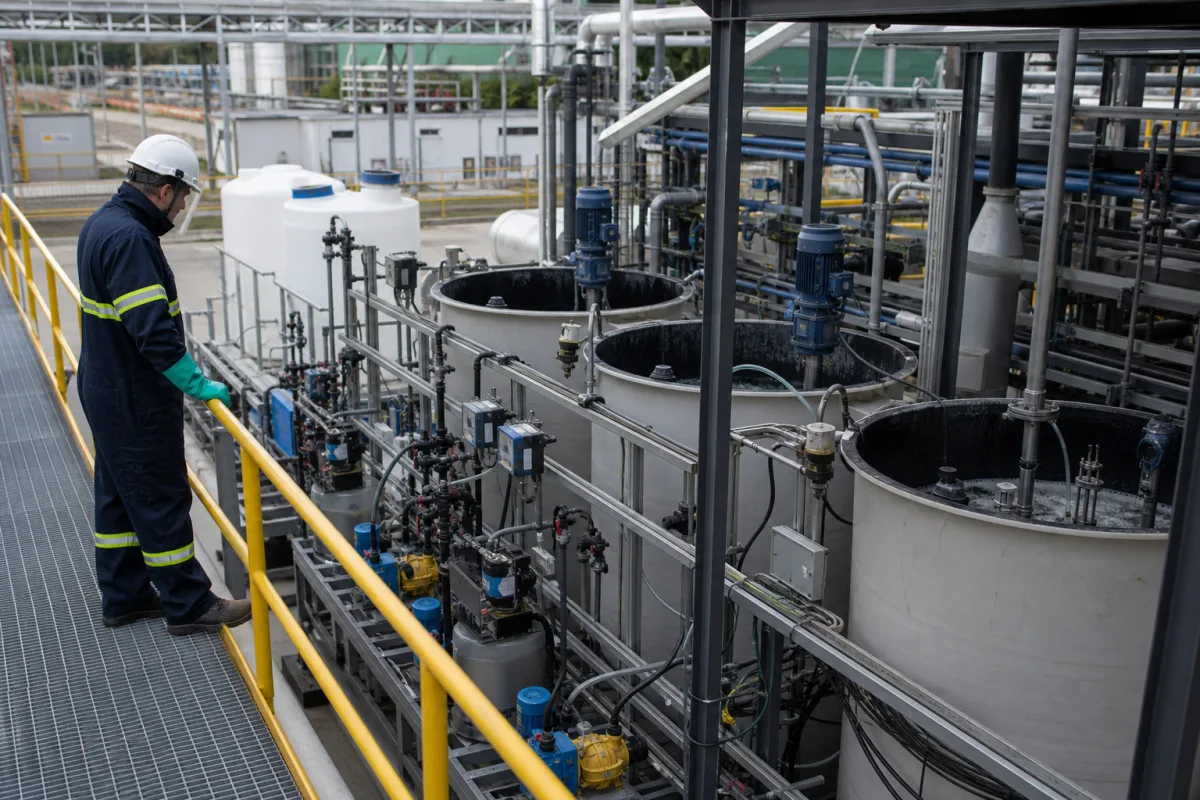
pH neutralization systems · Continuous or batch treatment of acidic or alkaline process and waste streams in two or three staged tanks with reagent dosing, mixing, pH control and recording, sized by flow, stage count and tank volume, with containment and alarms
An industrial neutralization system adjusts the pH of acidic or alkaline process or waste streams by dosing a reagent into mixed tanks under pH control, so the outlet meets discharge or downstream limits. Ask three things first: what flow, composition and pH range the inlet has, how many stages and what tank volume the control needs, and which reagents, materials, recording and alarms the site requires.
Continuous and batch pH neutralization systems with reaction tanks, reagent dosing, mixing, pH measurement and control for chemical process and waste streams. pH sensors alone (see pH electrode), chemical dosing pumps, wastewater biological treatment and scrubbers are outside this page.
CNFX editorial research · Sources checked October 12, 2026 · 5 sources
Modutek describes its acid neutralization systems as monitoring the pH of the incoming stream, dosing a reagent to bring it within limits and releasing water only when it meets discharge requirements, in continuous-flow or batch form, the choice depending on how large and steady the flow is. It builds self-contained systems from 5 to 500 gpm; two-stage systems handle normal applications, and three-stage systems are for the toughest conditions where one pass cannot reach the required pH. [1]
Faanes and Skogestad (NTNU, IFAC ADCHEM 2000) write: “Mainly for control reasons, the neutralization is usually performed in several steps with gradual change in the concentration.” They treat the tanks as installed primarily to smooth disturbances the control system cannot handle, show that time delays from transport, mixing, reaction and instrumentation limit the achievable response and so set the required volume, and recommend identical tank sizes, with total volume derived from the disturbance and a mixing and measurement delay they put at about 10 s or more. [2]
Editorial calculation: 5–500 gpm is about 1.1–114 m³/h, and Modutek's 100 gpm unitized limit is about 23 m³/h. [1]
Give the supplier the inlet flow (average, peak, and whether steady), inlet pH range and acid or base composition, buffering, temperature, solids, the target outlet pH band and discharge permit limits, reagents available, continuous or batch operation, number of stages, indoor or outdoor installation, materials and containment requirements, and recording and alarm needs.
02
Set control, materials, recording and limits
Modutek states its systems run automatically without operator intervention for routine treatment, use microprocessor pH control, and record discharge pH continuously on a digital chart recorder as evidence that limits are met. Safety features include high and low pH monitoring in the final chamber, a liquid sensor in the double containment, low-level reagent tank alarms and remote alarm relays. Systems from 5 to 100 gpm use half-inch-thick thermo-welded polypropylene; larger skid-mounted systems use polyethylene, fibreglass or lined steel. [1]
US rule 40 CFR 261.22 classes a waste as corrosive if it is aqueous with a pH at or below 2 or at or above 12.5 by EPA Method 9040C, or if it is a liquid that corrodes SAE 1020 steel faster than 6.35 mm (0.250 in) per year at 55 °C. Check local sewer and permit limits, which set the outlet pH band the system must hold. [3]
Editorial calculation: half an inch is 12.7 mm. [1]
03
Match standard module sizes, stages and batch volumes to the flow
Wastech, a maker of pH neutralization systems, states that its systems adjust acidic or alkaline wastewater to a neutral range “typically between 6 and 9” before discharge. Its OMEGA Continuous Series modules come in 10, 20, 30 and 50 gpm sizes, with single-, two- and three-stage designs for extreme waste and higher flows up to 1,000 gpm possible; its OMEGA Batch Series handles batches up to 2,000 gallons; custom multi-stage OMEGA systems serve applications up to 200 gpm; and small automated packages for laboratories range from 2-gallon batches to 3 gpm continuous systems. It lists chemical-feed day tanks, an effluent pH monitor tank, low-level switches on chemical tanks and secondary-contained tanks with leak alarms as parts of the scope. [4] Digital Analysis groups its pH adjustment systems by flow: its pHASE batch systems for continuous flows of 0–60 gpm, labTREAT continuous systems for 0–300 gpm and batchTREAT systems for 0–10,000 gpm. [5]
Use these ranges with the stage and tank sizing guidance and the corrosivity limits above: Wastech offers two- and three-stage systems for extreme waste conditions, so state the incoming pH range when asking for a stage count. [1][2][3]
Editorial calculation: 50 gpm is about 11.4 m³/h; a 2,000-gallon batch is about 7.6 m³, which at 10 gpm inflow fills in about 200 minutes.
Maker and line
Flow or volume
Configuration
Wastech OMEGA Continuous
10, 20, 30, 50 gpm modules; up to 1,000 gpm
1, 2 or 3 stages
Wastech OMEGA Batch
Up to 2,000 gal per batch
Batch
Wastech lab packages
2 gal batch to 3 gpm
Batch or continuous
Digital Analysis pHASE
0–60 gpm
Batch system for continuous flow
Digital Analysis labTREAT
0–300 gpm
Continuous flow-through
Digital Analysis batchTREAT
0–10,000 gpm
Batch platform
Give the supplier the peak and average flow, the incoming pH range and buffering, the discharge pH limit, and whether flow is continuous or intermittent, and ask for the number of stages, tank volumes and reagent consumption it proposes.
04
Design flow, stages, reagent use, control and containment to ask any bidder for
Ask any supplier for design flow and turndown, number of stages and tank volumes, mixer and dosing pump sizing, reagent consumption estimate, pH sensor type and cleaning, control and recording system, wetted materials, containment, alarms, footprint and installation scope.
The tank row is sized by control, not by hold-up alone: Faanes and Skogestad treat the tanks as there to smooth disturbances the control loop cannot handle and recommend identical tanks sized from the loop's delays. [2]
Part
Role
Fix in the order
Reaction tanks (stages)
Hold and mix the stream while pH is adjusted. [1][2]
Flow, outlet pH band, tank volumes, wetted materials and module size for a neutralization order
Seven of the fourteen rows have no published value; the outlet pH band comes from your permit, with US corrosivity starting at pH 2 or below and 12.5 or above. [3]
Explore company information and manufacturing capabilities, then discuss the scope of your project with a relevant supplier.
Share this page
Compiled and source-reviewed by the CNFX editorial team.
Each manufacturer above links to the page on that company's own website where the product is listed, with the date we checked it. How we source and review
· Page last updated 13 October 2026
Buyer questions
Why are neutralization systems built in stages?
Faanes and Skogestad (NTNU) write: “Mainly for control reasons, the neutralization is usually performed in several steps with gradual change in the concentration.” [2]
When are two or three stages used?
Modutek uses two stages for normal applications and three for the toughest conditions. [1]
What pH makes waste corrosive under US rules?
40 CFR 261.22: aqueous waste at pH 2 or below, or 12.5 or above. [3]
What sizes do pH neutralization systems come in?
Wastech offers continuous modules of 10, 20, 30 and 50 gpm (up to 1,000 gpm custom) and batch systems up to 2,000 gallons; Digital Analysis lists lines from 0–60 gpm up to 0–10,000 gpm. [4][5]
Sources and what still needs a direct check
Sources checked 2026-10-12. Modutek, Wastech and Digital Analysis make neutralization systems and describe their own ranges; NTNU researchers published design guidance; the US eCFR defines corrosive waste.