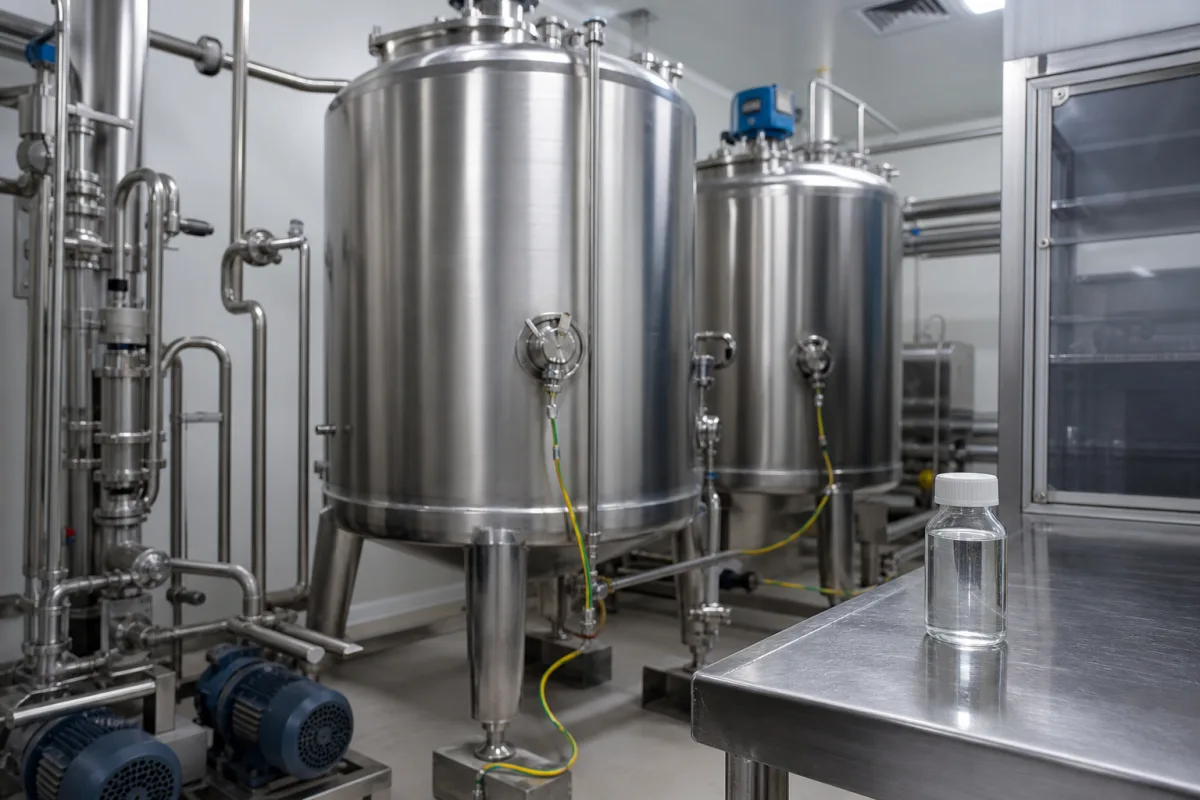
Food-grade ethanol solution (neutral spirits for spirit drinks)
Neutral spirits and ethyl alcohol of agricultural origin for spirit drinks · EU minimum strength and residue limits (methanol, aldehydes, esters, higher alcohols, acidity, dry extract, furfural), US neutral spirits and vodka rules, origin, and lot certificates
Food-grade ethanol for beverages is highly rectified alcohol, called neutral spirits in the US and ethyl alcohol of agricultural origin in the EU, used as the base for vodka, gin, liqueurs and other spirit drinks. Its legal definition fixes the raw material, minimum strength and impurity limits. Ask three things first: which market's definition the product must meet, what agricultural raw material it is made from, and how strength and residues are certified for each lot.
Neutral spirits and ethyl alcohol of agricultural origin supplied in bulk for blending spirit drinks and other alcoholic beverages. Denatured and industrial ethanol, fuel ethanol, pharmaceutical ethanol grades, finished vodka and other spirit drinks are outside this page except where compared.
CNFX editorial research · Sources checked October 11, 2026 · 5 sources
EU Regulation (EU) 2019/787 on spirit drinks, Article 5, defines ethyl alcohol of agricultural origin as a liquid obtained exclusively from products listed in Annex I to the Treaty (agricultural products), with no detectable taste other than that of its raw materials and a minimum alcoholic strength of 96.0% by volume. Article 6 requires the ethyl alcohol and distillates used in spirit drinks to be exclusively of agricultural origin, and alcoholic beverages must not contain alcohol of synthetic or other non-agricultural origin. [1]
In the US, 27 CFR 5.142 defines neutral spirits or alcohol as distilled spirits distilled from any suitable material at or above 95% alcohol by volume (190° proof), and if bottled, at not less than 40% by volume. Vodka is neutral spirits that may be treated with up to 2 g/L of sugar and 1 g/L of citric acid; grain spirits are neutral spirits from a fermented grain mash stored in oak barrels. [2]
Editorial note: name the market and regulation the alcohol must meet in your order; an alcohol meeting the US 95% minimum may not meet the EU 96.0% minimum.
Give the supplier the destination market and regulation, raw material (grain, molasses, grape, other agricultural origin), minimum strength, residue limits and the methods used to test them, sensory requirements, lot size and transport (tanker, IBC, drums), certificates of analysis and origin, excise and customs status, and storage and handling arrangements for a flammable liquid.
02
Set strength and residue limits per lot
Regulation 2019/787 Article 5 sets maximum residues per hectolitre of 100% vol alcohol: total acidity (as acetic acid) 1.5 g; esters (as ethyl acetate) 1.3 g; aldehydes (as acetaldehyde) 0.5 g; higher alcohols (as 2-methyl-1-propanol) 0.5 g; methanol 30 g; dry extract 1.5 g; volatile nitrogen bases (as nitrogen) 0.1 g; and furfural not detectable. [1]
Editorial calculation: the limits are per 100 litres of pure alcohol, so in alcohol at 96.0% vol the methanol limit of 30 g/hl equals 30 × 0.96 ÷ 100 ≈ 0.29 g per litre of product, and the aldehyde limit of 0.5 g/hl equals about 0.0048 g per litre; ask the supplier to report results on the same basis. [1]
Editorial note: agree how strength is measured and at what temperature, and which laboratory and methods produce the certificate for each lot.
03
Agree how strength is gauged on delivery
The US TTB Gauging Manual, 27 CFR Part 30, defines proof as the ethyl alcohol content of a liquid at 60 °F stated as twice the percent of ethyl alcohol by volume, and proof spirits as liquid containing half its volume of ethyl alcohol of specific gravity 0.7939 in vacuum at 60 °F referred to water at 60 °F. Proof is determined to the nearest tenth of a degree. [3]
Section 30.23 sets the sampling and reading practice: agitate bulk spirits so the sample represents the whole quantity, rinse the cylinder with the spirits to bring cylinder and thermometer to their temperature, read the hydrometer to the nearest 0.05 degree and the thermometer to the nearest 0.1 degree, apply instrument corrections, take the true proof from Table 1, and verify with a second sample. Under § 30.31, spirits with more than 600 mg of solids per 100 mL are gauged on true proof after laboratory distillation and restoration to the original volume and temperature, or by an equally accurate laboratory method. [3]
Editorial calculation: the 95% by volume minimum in 27 CFR 5.142 is 190 proof on this definition, and the EU's 96.0% vol minimum would be 192 proof on the same basis; because US proof is defined at 60 °F (15.6 °C), ask that each certificate and the contract state the reference temperature at which strength was measured. [3][2][1]
04
Check the food-additive rules when the ethanol is not for a spirit drink
The spirit-drink definitions above apply when the ethanol becomes an alcoholic beverage. Food-grade ethanol bought as a food ingredient or processing aid falls under food-additive rules instead. In the US, FDA's 21 CFR 184.1293 affirms ethyl alcohol (C2H5OH) as "generally recognized as safe" (GRAS) for a named use: the ingredient must meet the Food Chemicals Codex specifications (4th ed., 1996, p. 136), and it may be used as an antimicrobial agent on pizza crusts before final baking at levels not exceeding 2.0 percent by product weight. The section states that it was issued before a general evaluation of the ingredient, to affirm that specific use. [4]
At international level, the Joint FAO/WHO Expert Committee on Food Additives (JECFA) lists ethanol as JECFA No. 41 and FEMA No. 2419, with the functional classes extraction solvent, carrier solvent and flavouring agent. Its acceptable daily intake is "limited by GMP" for use as a solvent (1970), and at its 46th meeting in 1996 the Committee concluded that ethanol posed no safety concern at current intake when ethyl esters are used as flavouring agents. JECFA's specification reference is Compendium Addendum 8 (FNP 52 Add.8, 2000). [5]
Editorial note: if one lot may go either to beverage blending or to food use, name both sets of requirements in the order and ask the supplier for a certificate of analysis that reports against each. [4][5][1][2]
Editorial calculation: at the 2.0 percent limit, a 400 g pizza crust could carry up to 400 × 0.02 = 8 g of ethyl alcohol before baking. [4]
Ask for methanol, acidity and dry extract results in g per hectolitre of 100% vol alcohol, the basis of the EU limits, so they can be read straight against Regulation 2019/787. [1]
Explore company information and manufacturing capabilities, then discuss the scope of your project with a relevant supplier.
Share this page
Compiled and source-reviewed by the CNFX editorial team.
Each manufacturer above links to the page on that company's own website where the product is listed, with the date we checked it. How we source and review
· Page last updated 13 October 2026
Buyer questions
What strength must ethanol for EU spirit drinks have?
At least 96.0% vol, made only from agricultural products (Regulation 2019/787, Article 5). [1]
What is the EU methanol limit for ethyl alcohol of agricultural origin?
30 g per hectolitre of 100% vol alcohol, about 0.29 g per litre at 96% vol. [1]
What are neutral spirits in the US?
Distilled spirits distilled at or above 95% alcohol by volume (190 proof) (27 CFR 5.142). [2]
How is the strength of bulk neutral spirits gauged in the US?
27 CFR Part 30 defines proof at 60 °F as twice the % alcohol by volume, read with precision hydrometer and thermometer (to 0.05 and 0.1 degree) and determined to the nearest 0.1 proof. [3]
Is food-grade ethanol approved as a food additive in the US?
FDA's 21 CFR 184.1293 affirms ethyl alcohol meeting Food Chemicals Codex specifications as GRAS for use as an antimicrobial agent on pizza crusts before baking, at no more than 2.0% by product weight. [4]
Sources and what still needs a direct check
Sources checked 2026-10-11. Regulation (EU) 2019/787 is EU law on spirit drinks; 27 CFR 5.142 is a US federal labelling standard of identity; 27 CFR Part 30 is the US gauging manual for measuring proof; 21 CFR 184.1293 is an FDA food-ingredient rule; JECFA is the joint FAO/WHO expert committee on food additives. Other markets have their own rules.