Industry-Verified Manufacturing Data (2026)

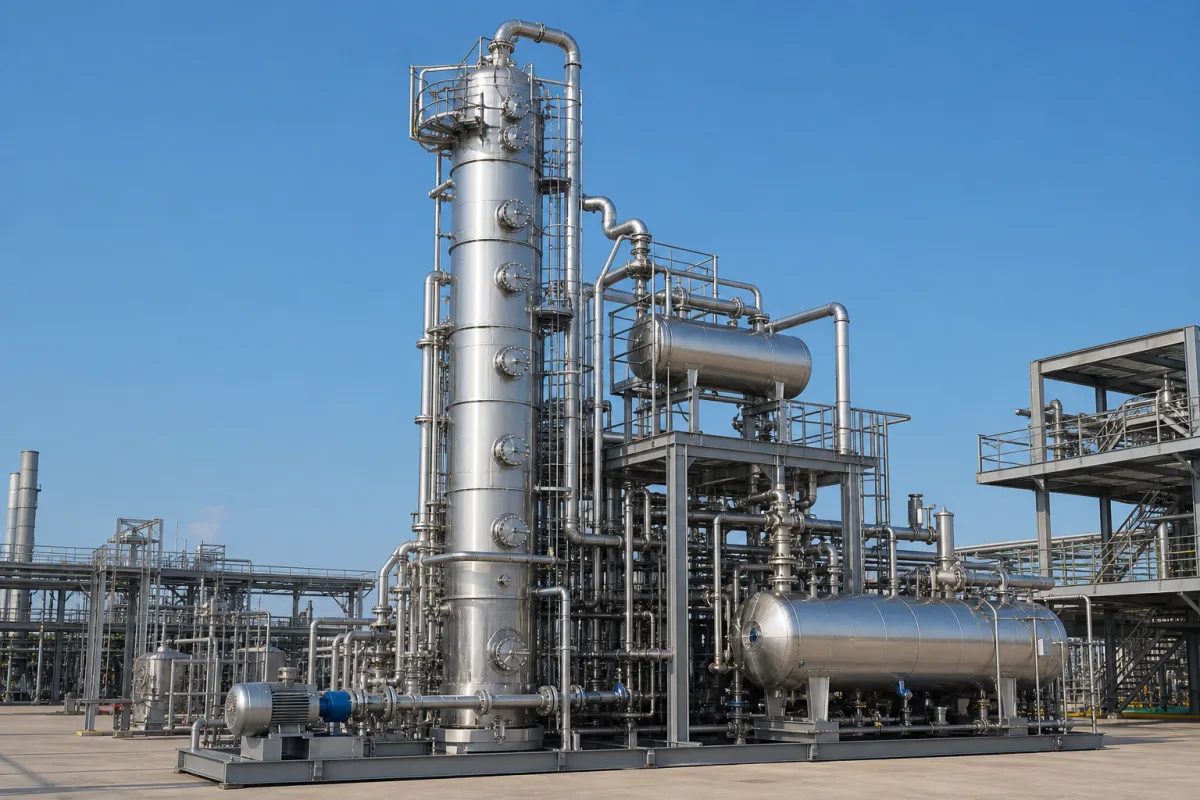
Chemical Distillation Column System

Based on aggregated insights from multiple verified factory profiles within the CNFX directory, the standard Chemical Distillation Column System used in the Chemical Manufacturing sector typically supports operational capacities ranging from standard industrial configurations to heavy-duty production requirements.

Technical Definition & Core Assembly

A canonical Chemical Distillation Column System is characterized by the integration of Fractionating Column and Reboiler. In industrial production environments, manufacturers listed on CNFX commonly emphasize stainless steel 316L construction to support stable, high-cycle operation across diverse manufacturing scenarios.

Integrated system for separating chemical mixtures through controlled boiling and condensation

Product Specifications

Technical details and manufacturing context for Chemical Distillation Column System

Definition
A complete distillation system for basic chemical manufacturing that separates liquid mixtures based on differences in volatility. The system includes multiple coordinated components such as columns, reboilers, condensers, and control modules. It enables continuous or batch separation of chemical compounds through precise temperature and pressure control. These systems are fundamental in petrochemical, pharmaceutical, and specialty chemical production.
Working Principle
Liquid mixture is heated to create vapor, which rises through fractionating columns where components condense at different heights based on boiling points, with continuous separation achieved through reflux and product draw-off.
Common Materials
stainless steel 316L, carbon steel, ceramic packing, copper-nickel alloy
Technical Parameters
  • Maximum processing capacity (kg/h) Per Request
  • Purity separation capability (%) Per Request
Components / BOM
  • Fractionating Column
    Primary separation vessel with internal packing/trays
    Material: Stainless Steel
  • Reboiler
    Heats bottom liquid to create vapor
    Material: Carbon Steel
  • Condenser
    Cools vapor to liquid for collection
    Material: Copper-Nickel Alloy
  • Reflux Drum
    Collects condensed liquid for reflux distribution
    Material: Stainless Steel
  • Control Panel
    Monitors and regulates temperature, pressure, flow
    Material: Aluminum/Steel
Engineering Reasoning
0.1-10 bar absolute pressure, 50-400°C temperature
Vapor velocity exceeding 0.8 m/s causing flooding, or pressure drop exceeding 0.5 bar/m causing weeping
Design Rationale: Flooding occurs when vapor momentum overcomes liquid gravitational force (Froude number > 0.8), weeping results from insufficient vapor pressure to support liquid on trays (ΔP < 0.3 bar/m)
Risk Mitigation (FMEA)
Trigger Thermal stress from 100°C/hour temperature ramp exceeding material yield strength
Mode: Tower shell circumferential cracking at weld seams
Strategy: Install expansion joints with 15 mm movement capacity and implement 25°C/hour maximum heating rate control
Trigger Corrosion rate exceeding 0.5 mm/year from chloride concentration > 25 ppm
Mode: Perforation of 316L stainless steel trays causing liquid bypass
Strategy: Apply 3 mm Hastelloy C-276 cladding on tray surfaces and maintain chloride < 10 ppm through feed pretreatment

Industry Taxonomies & Aliases

Commonly used trade names and technical identifiers for Chemical Distillation Column System.

Industrial Ecosystem & Supply Chain DNA

Complementary Systems
Downstream Applications
Specialized Tooling

Application Fit & Sizing Matrix

Operational Limits
pressure: Vacuum to 50 bar
flow rate: Up to 1000 m³/h
temperature: -50°C to 400°C
slurry concentration: Up to 40% solids by weight
Media Compatibility
✓ Hydrocarbon mixtures ✓ Aqueous-organic solutions ✓ Pharmaceutical intermediates
Unsuitable: Highly corrosive halogenated compounds
Sizing Data Required
  • Feed composition and flow rate
  • Desired separation purity
  • Available utilities (steam, cooling water)

Reliability & Engineering Risk Analysis

Failure Mode & Root Cause
Corrosion-induced thinning
Cause: Chemical attack from process fluids (e.g., acids, chlorides) at elevated temperatures, leading to wall thinning and eventual leaks or structural failure.
Fouling and scaling
Cause: Accumulation of deposits (e.g., salts, polymers, coke) on trays, packing, or heat transfer surfaces, reducing efficiency and causing flow restrictions or hot spots.
Maintenance Indicators
  • Unusual pressure drop across the column or trays, indicating potential blockages or flooding.
  • Visible leaks, discoloration, or bulging on the column shell, suggesting corrosion or overpressure.
Engineering Tips
  • Implement a corrosion monitoring program using ultrasonic thickness testing and corrosion coupons to track material degradation and schedule proactive replacements.
  • Optimize feed pre-treatment (e.g., desalting, filtration) and control operating parameters (temperature, pH) to minimize fouling and scaling, combined with regular chemical cleaning or mechanical de-scaling.

Compliance & Manufacturing Standards

Reference Standards
ISO 9001:2015 - Quality management systems ASME B31.3 - Process Piping ATEX Directive 2014/34/EU - Equipment for explosive atmospheres
Manufacturing Precision
  • Column vertical alignment: +/- 0.5 mm per meter height
  • Tray levelness: 0.2 mm maximum deviation across diameter
Quality Inspection
  • Hydrostatic pressure test at 1.5x design pressure
  • Material verification via PMI (Positive Material Identification) testing

Factories Producing Chemical Distillation Column System

Verified manufacturers with capability to produce this product in China

✓ 98% Supplier Capability Match Found

S Sourcing Manager from Singapore Feb 21, 2026
★★★★★
"Testing the Chemical Distillation Column System now; the Column Height (m) results are within 1% of the laboratory datasheet."
Technical Specifications Verified
P Procurement Specialist from Germany Feb 18, 2026
★★★★☆
"Impressive build quality. Especially the Column Height (m) is very stable during long-term operation. (Delivery took slightly longer than expected, but technical support was excellent.)"
Technical Specifications Verified
T Technical Director from Brazil Feb 15, 2026
★★★★★
"As a professional in the Chemical Manufacturing sector, I confirm this Chemical Distillation Column System meets all ISO standards."
Technical Specifications Verified
Verification Protocol

“Feedback is collected from verified sourcing managers during RFQ (Request for Quote) and factory evaluation processes on CNFX. These reports represent historical performance data and technical audit summaries from our B2B manufacturing network.”

19 sourcing managers are analyzing this specification now. Last inquiry for Chemical Distillation Column System from Mexico (30m ago).

Supply Chain Commonly Integrated Components

Process Analytics

Real-time monitoring and analysis system for pharmaceutical manufacturing processes

Explore Specs →
Dust Containment System

A safety and environmental control system designed to capture, contain, and prevent the escape of airborne pharmaceutical powder particles during blending operations.

Explore Specs →
Feed Tank & Pump

A combined unit consisting of a storage tank and pump for feeding solvent into an automated recovery and purification system.

Explore Specs →
Pre-Filtration Unit

A filtration component that removes coarse particulates and contaminants from solvents prior to main purification processes

Explore Specs →

Frequently Asked Questions

What materials are used in the construction of this distillation column system?

Our system is constructed with premium materials including stainless steel 316L for corrosion resistance, carbon steel for structural components, ceramic packing for efficient separation, and copper-nickel alloy for specific heat exchange applications.

What are the key components included in the distillation column system?

The complete system includes a fractionating column, condenser for vapor condensation, reboiler for controlled boiling, reflux drum for liquid management, and an integrated control panel for precise operation monitoring and adjustment.

What temperature and pressure ranges can this distillation system handle?

The system operates within a customizable temperature range (typically -50°C to 400°C) and pressure range (vacuum to 50 bar), designed to accommodate various chemical separation processes in basic chemical manufacturing applications.

Can I contact factories directly on CNFX?

CNFX is an open directory, not a transaction platform. Each factory profile provides direct contact information and production details to help you initiate direct inquiries with Chinese suppliers.

Get Quote for Chemical Distillation Column System

Request technical pricing, lead times, or customized specifications for Chemical Distillation Column System directly from verified manufacturing units.

Your business information is encrypted and only shared with verified Chemical Distillation Column System suppliers.

Thank you! Your message has been sent. We'll respond within 1–3 business days.

Need to Manufacture Chemical Distillation Column System?

Connect with verified factories specializing in this product category

Add Your Factory Contact Us
Previous Product
Central Control System (WMS)
Next Product
Chemical Dosing Pumps