Industry-Verified Manufacturing Data (2026)

Industrial Grade Polyvinyl Alcohol Binder Powder

Based on aggregated insights from multiple verified factory profiles within the CNFX directory, the standard Industrial Grade Polyvinyl Alcohol Binder Powder used in the Chemical Manufacturing sector typically supports operational capacities ranging from standard industrial configurations to heavy-duty production requirements.

Technical Definition & Core Assembly

A canonical Industrial Grade Polyvinyl Alcohol Binder Powder is characterized by the integration of Polyvinyl Alcohol Polymer Chain and Residual Acetate Groups. In industrial production environments, manufacturers listed on CNFX commonly emphasize Polyvinyl acetate construction to support stable, high-cycle operation across diverse manufacturing scenarios.

Water-soluble polymer powder used as industrial adhesive and binder base.

Product Specifications

Technical details and manufacturing context for Industrial Grade Polyvinyl Alcohol Binder Powder

Definition
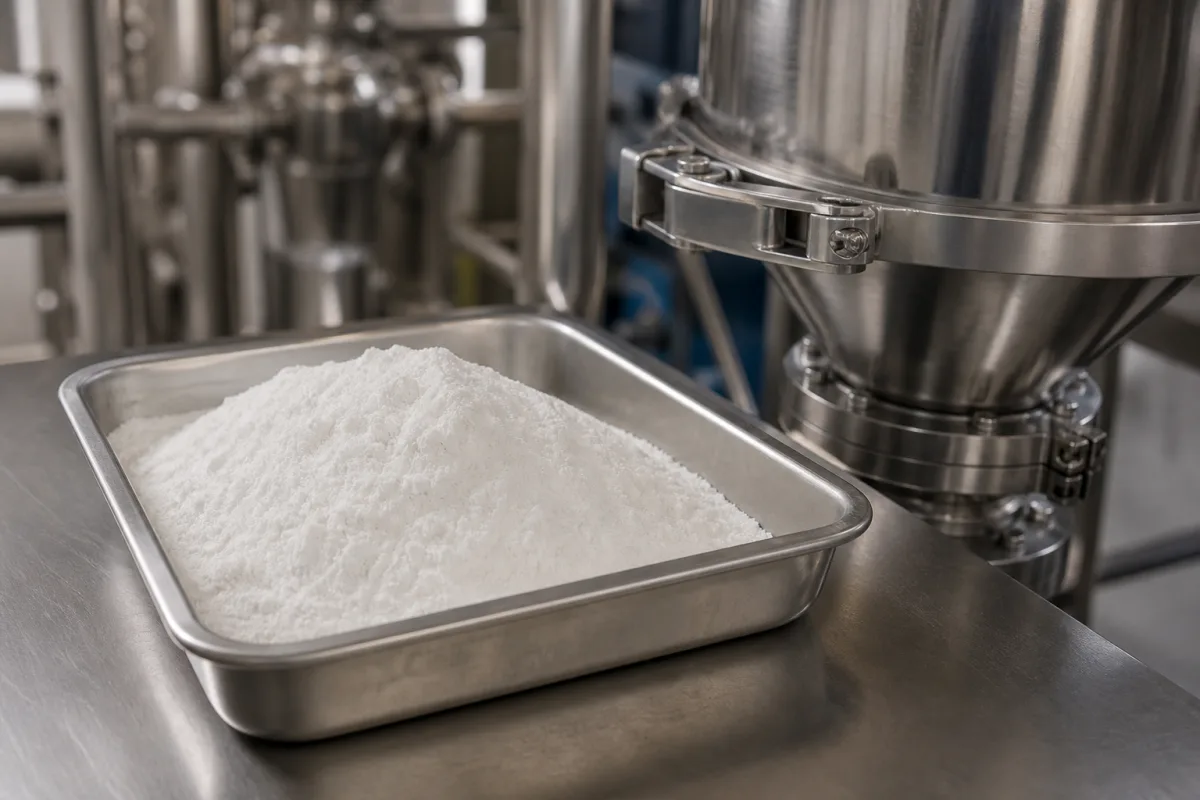
Industrial Grade Polyvinyl Alcohol (PVA) Binder Powder is a synthetic polymer material manufactured through alcoholysis of polyvinyl acetate. It serves as a critical raw material in B2B supply chains for producing water-based adhesives, coatings, and binding agents across multiple industries. The powder dissolves readily in water to form viscous solutions with excellent film-forming, adhesive, and barrier properties. Its industrial utility lies in providing a clean, non-toxic binding alternative to solvent-based systems, making it essential for manufacturers of paper products, textiles, construction materials, and packaging.
Working Principle
Forms hydrogen bonds with water molecules to create viscous adhesive solutions that dry to form strong, flexible films.
Common Materials
Polyvinyl acetate, Sodium hydroxide, Methanol
Technical Parameters
  • 4% aqueous solution viscosity at 20°C (mPa·s) Standard Spec
  • Percentage of acetate groups converted to alcohol groups (%) Standard Spec
Components / BOM
  • Polyvinyl Alcohol Polymer Chain
    Primary binding and film-forming component
    Material: Partially hydrolyzed polyvinyl acetate
  • Residual Acetate Groups
    Control solubility and hydrophobicity characteristics
    Material: Unhydrolyzed vinyl acetate units
  • Moisture Content
    Affects powder flow and storage stability
    Material: Absorbed water molecules
Engineering Reasoning
15-85°C, 0-95% relative humidity, 0.5-25 MPa compressive stress
Glass transition temperature at 85°C, 95% relative humidity saturation, 25 MPa compressive yield stress
Design Rationale: Hydrogen bond dissociation at 85°C, hygroscopic plasticization at 95% RH, polymer chain slippage at 25 MPa
Risk Mitigation (FMEA)
Trigger Ambient temperature exceeding 85°C
Mode: Polymer chain disentanglement and adhesive strength reduction to <1 MPa
Strategy: Install thermoelectric cooling system with PID control maintaining 65±5°C
Trigger Relative humidity exceeding 95% for >30 minutes
Mode: Complete dissolution and viscosity reduction to <10 cP
Strategy: Implement desiccant wheel dehumidification maintaining 60±5% RH

Industry Taxonomies & Aliases

Commonly used trade names and technical identifiers for Industrial Grade Polyvinyl Alcohol Binder Powder.

Industrial Ecosystem & Supply Chain DNA

Complementary Systems
Downstream Applications
Specialized Tooling

Application Fit & Sizing Matrix

Operational Limits
pressure: Atmospheric to 5 bar (typical mixing/dissolving pressure)
temperature: 5°C to 40°C (optimal dissolution range), storage: -10°C to 30°C
dissolution time: 15-60 minutes depending on temperature and agitation
slurry concentration: 5% to 20% w/v (typical working range), up to 30% for high-viscosity applications
Media Compatibility
✓ Paper coating formulations ✓ Textile sizing applications ✓ Ceramic green body binding
Unsuitable: Strong acid environments (pH < 3) causing hydrolysis and loss of binding properties
Sizing Data Required
  • Required dry binder concentration in final product (%)
  • Total slurry volume or batch size (L)
  • Desired viscosity range of final mixture (cP)

Reliability & Engineering Risk Analysis

Failure Mode & Root Cause
Moisture Absorption and Caking
Cause: Exposure to high humidity environments leading to clumping, reduced flowability, and compromised binding properties due to hygroscopic nature of PVA
Thermal Degradation
Cause: Exceeding recommended storage or processing temperatures (typically above 200°C) causing molecular breakdown, loss of viscosity, and reduced adhesive strength
Maintenance Indicators
  • Visible clumping or solidification in storage containers indicating moisture ingress
  • Abnormal dust generation during handling suggesting particle degradation or contamination
Engineering Tips
  • Implement climate-controlled storage with humidity below 50% RH and maintain temperature between 15-25°C to prevent moisture absorption
  • Use sealed, moisture-barrier containers with desiccant packs and establish first-in-first-out (FIFO) inventory management to prevent aging

Compliance & Manufacturing Standards

Reference Standards
ISO 15023:2017 - Plastics - Polyvinyl alcohol (PVAL) materials - Determination of viscosity number and K-value ASTM D1439-85(2021) - Standard Test Methods for Sodium Carboxymethylcellulose DIN EN ISO 1628-1:2021 - Plastics - Determination of the viscosity of polymers in dilute solution using capillary viscometers - Part 1: General principles
Manufacturing Precision
  • Particle Size Distribution: 90% within 80-200 mesh
  • Moisture Content: ≤ 5.0% by weight
Quality Inspection
  • Viscosity Test (Brookfield viscometer at specified concentration)
  • Ash Content Test (residue after combustion at 800°C)

Factories Producing Industrial Grade Polyvinyl Alcohol Binder Powder

Verified manufacturers with capability to produce this product in China

✓ 98% Supplier Capability Match Found

T Technical Director from Singapore Jan 15, 2026
★★★★★
"Great transparency on the Industrial Grade Polyvinyl Alcohol Binder Powder components. Essential for our Chemical Manufacturing supply chain."
Technical Specifications Verified
P Project Engineer from Germany Jan 12, 2026
★★★★☆
"The Industrial Grade Polyvinyl Alcohol Binder Powder we sourced perfectly fits our Chemical Manufacturing production line requirements. (Delivery took slightly longer than expected, but technical support was excellent.)"
Technical Specifications Verified
S Sourcing Manager from Brazil Jan 09, 2026
★★★★★
"Found 46+ suppliers for Industrial Grade Polyvinyl Alcohol Binder Powder on CNFX, but this spec remains the most cost-effective."
Technical Specifications Verified
Verification Protocol

“Feedback is collected from verified sourcing managers during RFQ (Request for Quote) and factory evaluation processes on CNFX. These reports represent historical performance data and technical audit summaries from our B2B manufacturing network.”

9 sourcing managers are analyzing this specification now. Last inquiry for Industrial Grade Polyvinyl Alcohol Binder Powder from Turkey (1h ago).

Supply Chain Commonly Integrated Components

Temperature Control Unit

A precision thermal management component that regulates and maintains specific temperature conditions within a continuous flow pharmaceutical reactor system.

Explore Specs →
Process Analytics

Real-time monitoring and analysis system for pharmaceutical manufacturing processes

Explore Specs →
Dust Containment System

A safety and environmental control system designed to capture, contain, and prevent the escape of airborne pharmaceutical powder particles during blending operations.

Explore Specs →
Feed Tank & Pump

A combined unit consisting of a storage tank and pump for feeding solvent into an automated recovery and purification system.

Explore Specs →

Frequently Asked Questions

What is the primary application of industrial grade polyvinyl alcohol binder powder?

This PVA binder powder serves as a water-soluble adhesive and binder base in chemical manufacturing, particularly for creating industrial adhesives, coatings, and binding agents where controlled solubility and purity are required.

How does the degree of hydrolysis affect the properties of PVA binder powder?

The degree of hydrolysis determines solubility and chemical resistance. Higher hydrolysis (typically 87-99%) increases water solubility and reduces residual acetate groups, making it suitable for applications requiring rapid dissolution and strong binding properties.

What are the key specifications to consider when selecting this binder powder?

Critical specifications include degree of hydrolysis (affects solubility), viscosity (4% solution), particle size (D50 for dispersion), pH value, and volatile content. These parameters ensure consistent performance in industrial adhesive formulations.

Can I contact factories directly on CNFX?

CNFX is an open directory, not a transaction platform. Each factory profile provides direct contact information and production details to help you initiate direct inquiries with Chinese suppliers.

Get Quote for Industrial Grade Polyvinyl Alcohol Binder Powder

Request technical pricing, lead times, or customized specifications for Industrial Grade Polyvinyl Alcohol Binder Powder directly from verified manufacturing units.

Your business information is encrypted and only shared with verified Industrial Grade Polyvinyl Alcohol Binder Powder suppliers.

Thank you! Your message has been sent. We'll respond within 1–3 business days.

Need to Manufacture Industrial Grade Polyvinyl Alcohol Binder Powder?

Connect with verified factories specializing in this product category

Add Your Factory Contact Us
Previous Product
Industrial Grade Polyurethane Foam Catalyst
Next Product
Industrial Grade Sodium Hydroxide Flake