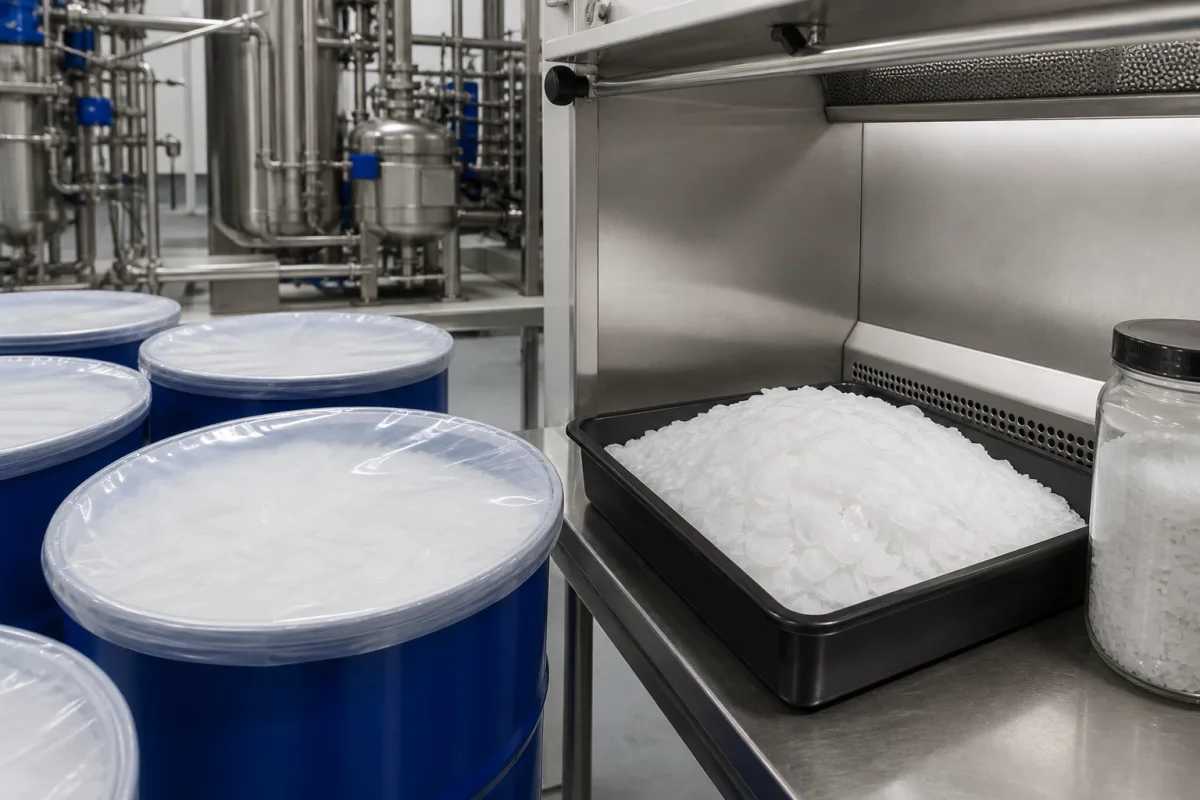
Anhydrous caustic soda flakes for industrial use · How flakes are made from 50% caustic, grades and packages, dissolving safely (heat of solution), workplace exposure limit, UN1823 transport class, and lot certificates
Sodium hydroxide flake, or caustic soda flake, is the anhydrous solid form of caustic soda, made by concentrating the 50% solution from chlor-alkali electrolysis and solidifying it into flakes. It is used where solid caustic is easier to ship or dose than solution. Ask three things first: which grade and analysis you need, what package and handling system you will use, and how you will dissolve it safely given its large heat of solution.
Anhydrous sodium hydroxide in flake form (and comparable beads, compounders and fused solid) for industrial use. Caustic soda solutions, food- and pharmaceutical-grade sodium hydroxide specifications, potassium hydroxide and dissolving equipment are outside this page except where compared.
CNFX editorial research · Sources checked October 11, 2026 · 4 sources
OxyChem's Caustic Soda Handbook explains that caustic soda is produced by electrolysing sodium chloride brine in mercury, diaphragm or membrane cells, with chlorine and hydrogen as co-products, and that the anhydrous forms are obtained by further concentrating 50% caustic soda. Flake caustic soda is made by passing molten caustic soda over cooled flaking rolls to form flakes of uniform thickness, which can be milled and screened into products of controlled particle size. Anhydrous caustic soda is marketed as beads, flakes, compounders and solid castings, which have the same chemical composition and differ only in particle size and shape. [1]
The handbook lists flake packages of 500-lb and 100-lb drums, 50-lb bags and 1,600-lb mini bulk bags, and gives relative dissolving times at 5% concentration and 50°F with stirring of 44 s for No. 2 flake and 41 s for No. 4 flake, against 20 s for compounders and 15 s for beads. [1]
Editorial calculation: a 50-lb bag is about 22.7 kg and a 1,600-lb bulk bag about 726 kg (1 lb = 0.4536 kg); match the package to your dosing and lifting arrangements. [1]
Give the supplier the grade and analysis required (NaOH, sodium carbonate, chloride, iron and other impurities), the production cell type if it matters for your process, flake or other form and particle size, package type and size, monthly quantity, certificate of analysis contents, storage conditions at your site, dissolving method, and transport and import documents.
02
Handle, store and dissolve flakes safely
The handbook warns that anhydrous caustic soda has a very high heat of solution: it must always be added slowly to the water surface with constant stirring, never water to caustic, starting with lukewarm water at 80–100°F, never hot or cold, because rapid addition, poor agitation or hot or cold liquid can cause dangerous boiling, spattering or a violent eruption. Solutions may need cooling while dissolving so temperatures do not exceed material of construction limits. [1]
OSHA's Table Z-1 (29 CFR 1910.1000) sets a permissible exposure limit for sodium hydroxide (CAS 1310-73-2) of 2 mg/m³. [2] The US hazardous materials table (49 CFR 172.101) lists sodium hydroxide, solid as UN1823, hazard class 8, packing group II, with quantity limits of 15 kg per package for passenger aircraft or rail car and 50 kg for cargo aircraft only. [3]
Editorial calculation: 80–100°F is about 27–38°C, the starting water temperature range the handbook gives for dissolving. [1]
03
Check the physical properties and hazard data on the safety card
The International Chemical Safety Card for sodium hydroxide (ICSC 0360, May 2010), published by the ILO and WHO, describes it as a white hygroscopic solid in various forms, with CAS 1310-73-2, UN 1823 and EC number 215-185-5. It gives the physical data in the table below, which are the values to compare with a supplier's certificate or safety data sheet. [4]
The card states that the solution in water is a strong base that reacts violently with acid and is corrosive to aluminium, tin, lead and zinc, producing hydrogen, and that contact with moisture or water may generate enough heat to ignite combustible materials. It lists storage separated from food and feedstuffs, strong acids and metals, dry, well closed, in the original container and in an area without drain or sewer access. Its note repeats the dissolving rule: never pour water into the substance; add it slowly to the water. [4]
Editorial calculation: 318°C is about 604°F, and 109 g per 100 mL at 20°C is about 1,090 g/L, which is the value to put in the solubility field. The 2.1 g/cm³ density is the solid's own density; the bulk density of a bag of flakes is lower because of the voids between flakes, so ask the supplier for a measured bulk density for hopper sizing. [4]
Form, cell process, package, dissolving method, exposure limit and UN number on a flake order
The package and dissolving rows decide handling on site: OxyChem packs flake in 100- and 500-lb drums, 50-lb bags and 1,600-lb bulk bags, and every form is added slowly to water at 80–100°F. [1]
Assay, carbonate, chloride, iron, bulk density and package size for caustic flake
No reviewed source sets assay or impurity limits for industrial flake, so the NaOH, carbonate, chloride and iron rows come from the supplier's certificate; melting point and solubility come from ICSC 0360. [4]
Explore company information and manufacturing capabilities, then discuss the scope of your project with a relevant supplier.
Share this page
Compiled and source-reviewed by the CNFX editorial team.
Each manufacturer above links to the page on that company's own website where the product is listed, with the date we checked it. How we source and review
· Page last updated 13 October 2026
Buyer questions
How are caustic soda flakes made?
Molten caustic soda from concentrated 50% solution is passed over cooled flaking rolls to form flakes (OxyChem handbook). [1]
How should caustic soda flakes be dissolved?
Add the flakes slowly to lukewarm (80–100°F) water with constant stirring, never water to caustic. [1]
What is the US exposure limit and transport class?
OSHA PEL 2 mg/m³; DOT lists sodium hydroxide, solid as UN1823, Class 8, packing group II. [2][3]
What melting point and solubility should a caustic soda flake data sheet show?
The ILO/WHO safety card ICSC 0360 gives a melting point of 318°C, a boiling point of 1388°C, a density of 2.1 g/cm³ and a solubility of 109 g/100 mL in water at 20°C. [4]
Sources and what still needs a direct check
Sources checked 2026-10-11. The handbook is one producer's technical guide; 29 CFR 1910.1000 and 49 CFR 172.101 are US federal regulations; ICSC 0360 is the ILO/WHO International Chemical Safety Card with physical and hazard data. Other countries' limits and transport rules may differ.