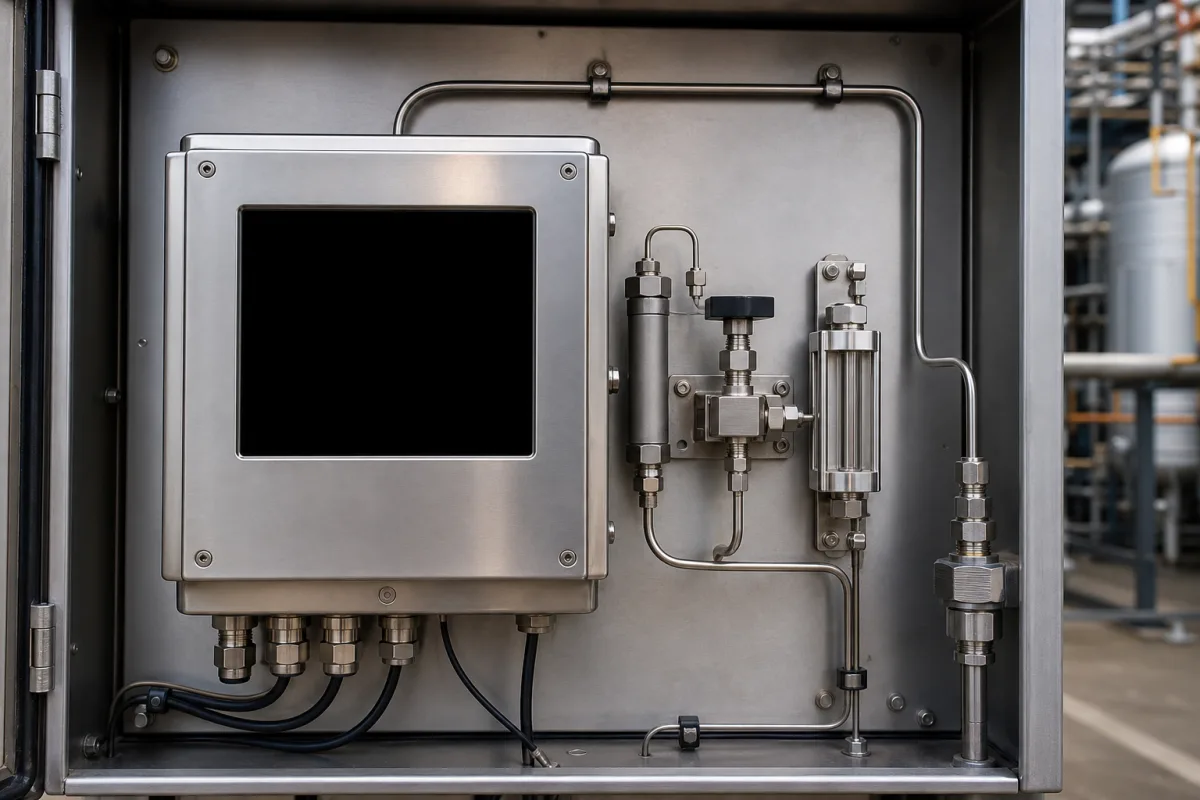
Gas analysis · Inerting limits, alarm and shutdown levels, sensor technologies and sample systems
An oxygen analyzer measures oxygen in a gas, from percent levels down to ppm, to keep inerted vessels below their explosion limit or to check gas purity. Ask three things first: the oxygen limit and alarm levels it must protect, the background gas and contaminants, and the sample system that delivers gas to the sensor.
Gas-phase oxygen analyzers for process inerting, blanketing and gas purity checks, fixed and portable. Dissolved oxygen analyzers for water, instruments that measure oxygen inside metals or powders, and personal gas detectors are outside this page.
CNFX editorial research · Sources checked October 12, 2026 · 4 sources
An IChemE paper on inerting sets four levels: the limiting oxygen concentration (LOC) at operating temperature and pressure, the maximum permissible oxygen concentration (MPOC) used as the automatic shutdown level, a first alarm level and normal operating conditions. It is usual to subtract 2 percentage points from the LOC to give the MPOC, sometimes more depending on how fast oxygen can rise. Where the LOC is below 5% and the plant is continuously monitored, the plant should not operate above 60% of the LOC; without continuous monitoring the limit is 60%, or 40% if the LOC is below 5%. [1]
Linde's inerting white paper says the LOC must be determined by experiment and lists, with nitrogen as the inert gas, 6.9 vol.% for ethylene, 9.0% for benzene and 10.0% for hexane; LOC values with carbon dioxide can be up to 25% higher. [2]
Editorial calculation: with a 2-point margin, the MPOC would be 4.9% for ethylene, 7.0% for benzene and 8.0% for hexane under nitrogen. The analyzer range and accuracy must resolve the alarm and shutdown levels set below these values. [1][2]
Give the supplier the gas or vapour being inerted, inert gas, LOC basis and test conditions, shutdown and alarm levels, range, background gas and contaminants, sample pressure and temperature, number of sample points, area classification and output signals.
02
Choose the sensor technology for the gas
Panametrics' white paper compares sensors used for purge and blanket applications: paramagnetic sensors are not consumed ("With proper care, the sensor will last for many years"), but liquid carry-over can damage them, and the sensor "typically is used for percent oxygen measurements"; galvanic fuel cells are lower cost and background-gas insensitive but are consumed ("Typical life time for the sensor is a couple of years"); non-depleting electrochemical sensors give stable, fast ppm or percent measurement where liquid carry-over is very unlikely. [3]
Zirconium oxide sensors are the fastest responding and measure from percent to sub-ppm, but they operate hot and combust hydrocarbons with available oxygen, reading falsely low; Panametrics limits them to gas where hydrocarbons are orders of magnitude below the oxygen, such as glove boxes or nitrogen before injection. [3]
The sample system must deliver a continuous flow without changing the sample, and remove condensed hydrocarbon liquids before the sensor. [3] The IChemE paper adds that the analyzer should preferably sample from multiple parts of the plant, at points not close to inert-gas inlets or outlets, alarm on lost or reduced sample flow, and not show a fault as a safe reading, for example a zero on power loss. [1]
03
Know the oxygen limits for entering an inerted vessel
An inerted vessel becomes a hazard to people once it is opened for entry. OSHA's permit-required confined spaces rule (29 CFR 1910.146) defines an oxygen-deficient atmosphere as less than 19.5 percent oxygen by volume and an oxygen-enriched atmosphere as more than 23.5 percent, and counts an oxygen concentration below 19.5 or above 23.5 percent, flammable gas above 10 percent of its lower flammable limit, or toxic concentrations above published exposure limits as a hazardous atmosphere. When testing for atmospheric hazards, the rule requires testing first for oxygen, then for combustible gases and vapours, then for toxic gases, and monitoring during entry as needed to confirm that acceptable entry conditions are maintained. [4]
The inerting limits above keep oxygen low enough to prevent combustion inside the process; the confined-space limits apply once people enter, so the same vessel may need an analyzer range covering both a few percent and normal air. [1][2][3]
Editorial calculation: normal air holds about 20.9% oxygen, so the 19.5% limit is a drop of 1.4 percentage points; an analyzer with ±1% of full-scale accuracy on a 0–25% range has ±0.25 percentage points uncertainty at that point.
29 CFR 1910.146 point
Value
Oxygen-deficient atmosphere
< 19.5% O₂ by volume
Oxygen-enriched atmosphere
> 23.5% O₂ by volume
Flammable gas hazard
> 10% of lower flammable limit
Test order
Oxygen first, then combustible, then toxic
During entry
Test or monitor to confirm acceptable conditions
If the vessel will be entered after inerting, ask for an analyzer range that covers both the process limit and the 19.5–23.5% entry band, and its accuracy at 19.5%.
04
Compare what suppliers offer
Suppliers linked to this page list gas oxygen analyzers; each card links to the page reviewed.
Chang AI lists electrochemical oxygen analyzers with other gas analyzers; Yongan lists zirconia oxygen analyzers with gas detection systems; BCST lists fixed and portable oxygen analyzers; AmcareMed and Canta list oxygen analyzers for oxygen generators and concentrators.
05
Trace the analyzer components
This is a functional reference built from the sources cited; it is not one maker's parts list.
Part
Role
Fix in the order
Sensor cell
Paramagnetic, galvanic, non-depleting electrochemical or zirconia. [3]
Zero and span checks; purge nitrogen may serve as zero. [3]
Calibration gases and method.
06
Fill the specification fields with values for your process
An oxygen analyzer quotation needs values for your gas and limits. The table explains each field, gives published values where a reviewed source states them, and says what to obtain from the supplier.
Field
What it means and published values
Ask the supplier for
Measurement range (% O2)
Must resolve alarm and shutdown levels below the LOC. [1]
Range and resolution.
Accuracy (% O2)
Part of the 2-point margin with lags and delays. [1]
Explore company information and manufacturing capabilities, then discuss the scope of your project with a relevant supplier.
Share this page
Compiled and source-reviewed by the CNFX editorial team.
Published product pages show what a company offers, not tested performance. Confirm the legal seller, factory and scope for your order. How we source and review
· Page last updated 13 October 2026
Buyer questions
How far below the LOC should oxygen shutdown be set?
The IChemE paper says it is usual to subtract 2 percentage points from the LOC for the shutdown level, sometimes more depending on how fast oxygen can rise. [1]
Can a zirconia analyzer be used in a hydrocarbon blanket?
Panametrics says zirconia sensors combust hydrocarbons and read falsely low, so they suit gas where hydrocarbons are far below the oxygen level. [3]
How long do oxygen sensors last?
Panametrics says of galvanic cells: "Typical life time for the sensor is a couple of years"; of paramagnetic sensors, which are not consumed: "With proper care, the sensor will last for many years." [3]
What oxygen level is safe for entering a vessel?
OSHA's 29 CFR 1910.146 defines oxygen-deficient as below 19.5% and oxygen-enriched as above 23.5% by volume, and requires testing for oxygen first before entry. [4]
Sources and what still needs a direct check
Sources checked 2026-10-12. The IChemE paper is a symposium paper on managing inerting systems. Linde is an industrial gas supplier and Panametrics (Baker Hughes) an analyzer maker; their white papers are their own.