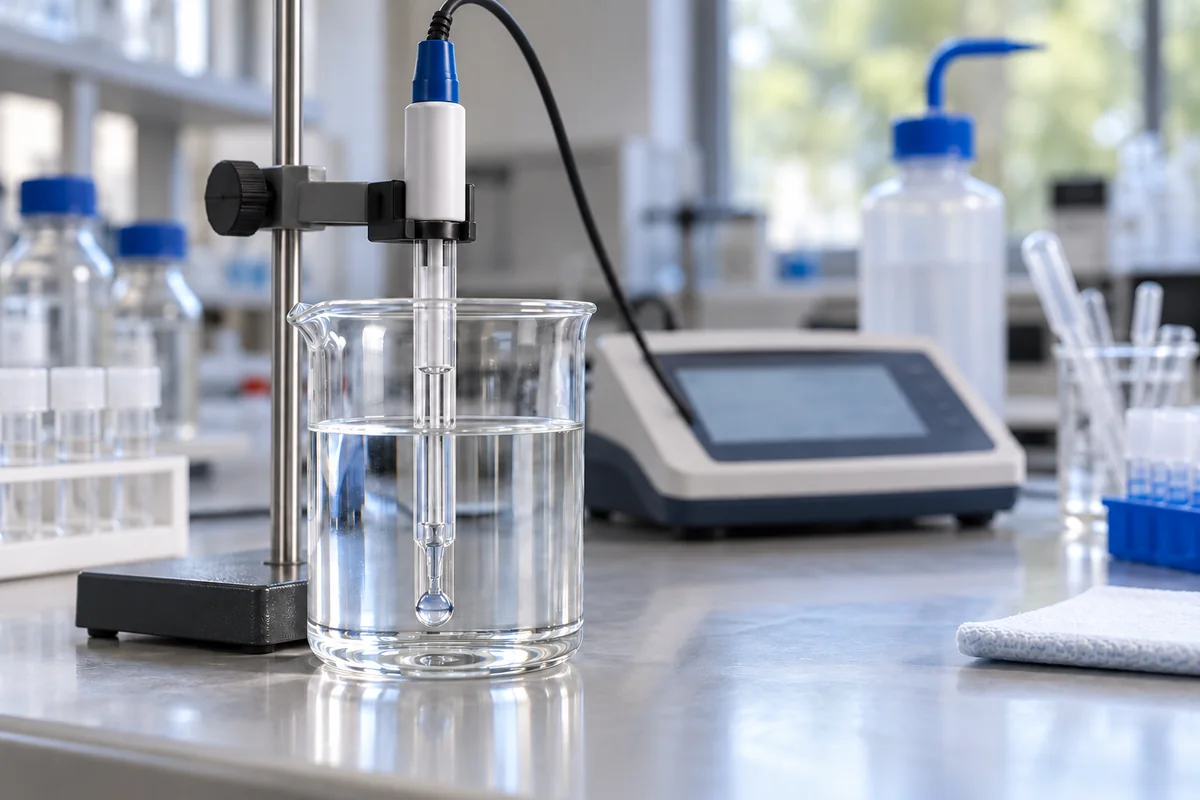
Glass pH electrodes and sensors · Calibration with bracketing buffers, slope and zero point, temperature compensation, sodium error and coatings, and pressure and temperature ratings
A pH electrode measures hydrogen-ion activity through the voltage between a pH-sensitive glass membrane and a reference electrode, either as two separate electrodes or combined in one body. Settle three things before ordering: the calibration and temperature compensation that will keep it accurate, the sample's chemistry (sodium, coatings, solids) that the glass and junction must tolerate, and the temperature, pressure, mounting and connector of the installation.
Laboratory and online glass pH electrodes and combination pH sensors, with or without integrated temperature sensors. pH meters and transmitters sold alone, ORP and ion-selective electrodes, conductivity cells and buffer solutions are outside this page; conductivity cells have their own page.
CNFX editorial research · Sources checked October 12, 2026 · 4 sources
Calibrate with bracketing buffers and compensate temperature
US EPA Method 9040C, pH electrometric measurement, measures pH with a glass electrode and a reference electrode or a combination electrode, calibrated with standard solutions of known pH. Each instrument–electrode system must be calibrated at two or more points that bracket the expected sample pH and are about three pH units or more apart, with adjustments repeated until readings are within 0.05 pH of the buffer values. [1]
The method attributes temperature effects to two sources: the change in electrode output with temperature, controlled by temperature compensation or by calibrating at sample temperature, and the real change of the sample's pH with temperature, which cannot be corrected and is handled by reporting pH with temperature. If the sample differs from the buffers by more than 2 °C the reading must be corrected. Readings on successive portions should agree within 0.1 pH. [1]
It recommends NIST primary standard buffers where extreme accuracy is needed (replaced at least monthly) and NIST-traceable commercial secondary buffers for routine use. [1] Linked makers specify online electrodes with slope of at least 96%, zero point E0 = pH 7 ± 0.3 and accuracy of ±0.1 pH, some with integrated NTC (10 k or 2.252 k), Pt100 or Pt1000 temperature sensors. [2][3]
Editorial calculation: the theoretical (Nernst) slope at 25 °C is RT·ln10/F ≈ 8.314 × 298.15 × 2.303 ÷ 96,485 ≈ 59.2 mV per pH. A slope of at least 96% therefore means at least about 56.8 mV per pH. Track the slope and zero point at each calibration to see when the electrode is ageing.
Give the supplier the sample (water, wastewater, process liquid; sodium, solids, oils, fluorides), temperature and pressure range, flow and installation (immersion, insertion, flow-through), mounting thread, cable length and connector, temperature sensor type, the transmitter it must connect to, and calibration and cleaning access.
02
Match the electrode to sample chemistry, temperature and pressure
EPA Method 9040C notes that "the glass electrode, in general, is not subject to solution interferences from color, turbidity, colloidal matter, oxidants, reductants, or moderate (<0.1 molar solution) salinity", that sodium error above pH 10 can be reduced with a low-sodium-error electrode, and that oily or particulate coatings impair response and should be removed by wiping or detergent washing, rinsing, and if needed a 1:10 hydrochloric acid treatment. [1]
A linked maker lists a high-temperature analogue glass electrode with Ag/AgCl reference, KCl gel electrolyte and double salt bridge, 0–14 pH, rated for continuous use at 0–100 °C up to 6 bar and for 100–135 °C at up to 3 bar for less than 60 minutes at a time, in a 12 mm diameter by 120 mm body with PG13.5 thread. [4]
Another lists an online electrode with a solid dielectric and a large PTFE liquid junction intended to resist blocking, a PTFE housing with ¾ in NPT threads top and bottom, and low-noise cable for signal lengths over 20 m; and a glass electrode with PG13.5 thread, gel or solid electrolyte and optional stainless, PPS or PTFE sheaths. [2][3]
Editorial note: high-temperature ratings can come with time limits, as in the 135 °C example above; if the process runs hot continuously, choose an electrode rated for continuous duty at that temperature.
03
Compare what suppliers offer
Suppliers linked to this page list pH electrodes; each card links to the page reviewed.
The listings reviewed cover laboratory and online glass electrodes, antimony and digital pH sensors, high-temperature and low-temperature versions and water-quality instruments; ask each for slope, zero point, junction type, temperature and pressure ratings and the temperature sensor fitted.
04
Trace what each part of the electrode controls
This is a functional reference built from the sources cited; it is not one maker's specification.
Fill the specification fields with values for your sample
A pH electrode quotation needs values for your sample and installation. The table explains each field, gives published values where a reviewed source states them, and says what to obtain from the supplier.
Explore company information and manufacturing capabilities, then discuss the scope of your project with a relevant supplier.
Share this page
Compiled and source-reviewed by the CNFX editorial team.
Published product pages show what a company offers, not tested performance. Confirm the legal seller, maker and ratings for your order. How we source and review
· Page last updated 13 October 2026
Buyer questions
How many buffers are needed to calibrate a pH electrode?
EPA Method 9040C requires at least two that bracket the sample and are about three pH units apart. [1]
When must pH readings be temperature-corrected?
EPA Method 9040C requires correction when the sample differs from the buffers by more than 2 °C. [1]
What causes errors at high pH?
EPA Method 9040C cites sodium error above pH 10, reduced by a low-sodium-error electrode. [1]
What slope should a good pH electrode have?
Linked makers specify slope of at least 96% with zero point pH 7 ± 0.3. [2]
Sources and what still needs a direct check
Sources checked 2026-10-12. US EPA Method 9040C sets the electrometric pH procedure; BOQU and Delfino are linked makers publishing electrode specifications.