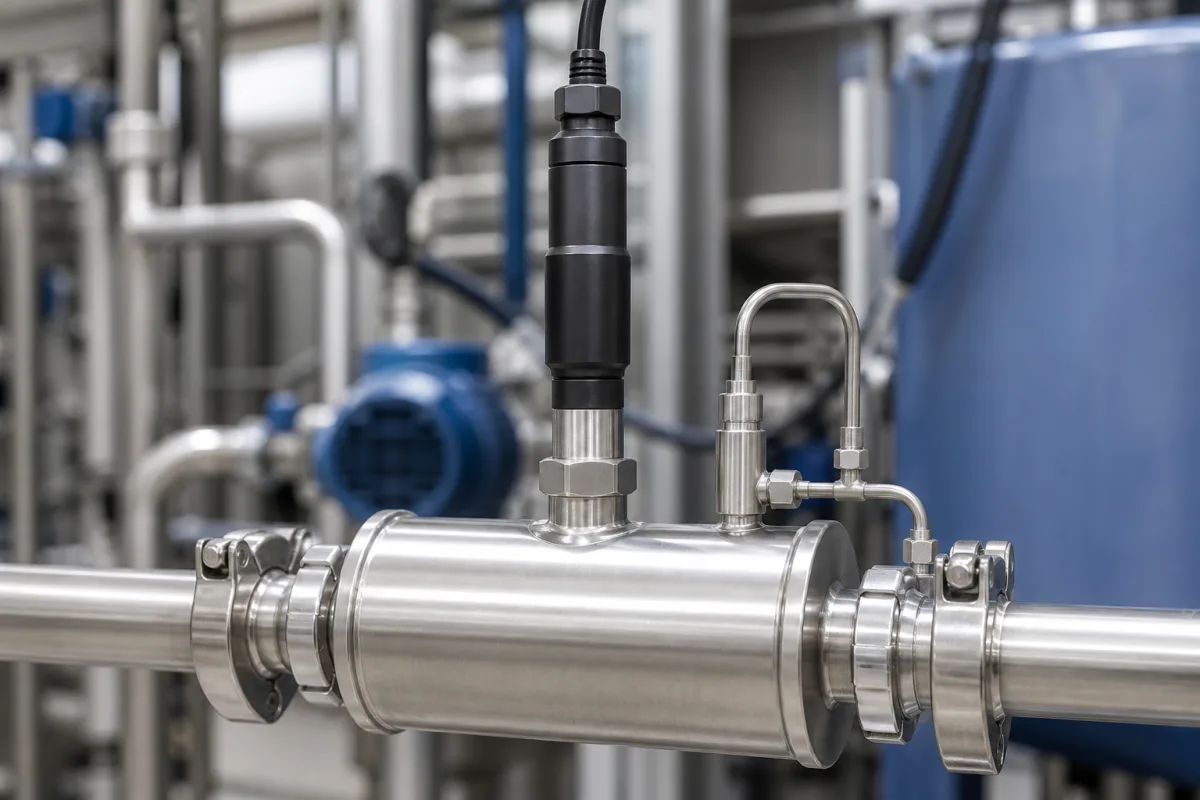
The sensor in the illustration sits in a sanitary flow-through body on a water treatment skid, with a second small sensor tapped into the same body. On ordinary process liquids a pH probe and a conductivity cell are separate, routine measurements. On demineralised water, condensate and boiler feed the two meet: the conductivity reading says how few ions there are, and few ions is exactly what makes the pH reading drift, wander with flow and pick up noise.
Covers online pH measurement paired with conductivity on high-purity and low-conductivity water (demineraliser outlet, polisher outlet, condensate, boiler feed): reference junction and glass electrode behaviour at low ionic strength, streaming potentials and grounding, CO2 uptake, stainless flow-through chambers and flow rate, Nernst and pure-water dissociation temperature corrections, and transmitter amplifier design. pH electrodes for ordinary samples are on pH electrode; conductivity cell constants, ranges and calibration are on Conductivity cells.
CNFX editorial research · Sources checked October 12, 2026 · 3 sources
Yokogawa's application note on high-purity water pH lists the four areas that low ionic strength upsets: reference electrode stability, glass electrode response, electrical noise and temperature compensation.
Hach's application note for its 8362 pure-water pH system adds inconsistent flow rate, variable pressure, variable temperature and liquid junction contamination to the list, alongside electrostatic discharge.
This is where the conductivity reading earns its place beside the pH probe: Hach's trial ran the same system on boiler feed water at 7 µS at 20 °C (expected pH 9.2 with hydrazine) and then on a demineraliser polishing outlet at 0.06 µS at 20 °C (expected pH 6.5 to 7.0). The lower the conductivity, the more the measures below matter.
Problem
What happens (Yokogawa unless noted)
Reference junction
Huge ion concentration difference between fill solution and water creates a diffusion potential of up to 20–40 mV (about 0.5 pH); any change in it reads as false pH drift. Fill solution depletes faster
Glass electrode
Few ions slow the glass response; alkali from the glass can dissolve, so at low flow the reading runs high
Streaming potential
Pure water (0.055 µS/cm, 18.2 MΩ·cm at 25 °C) builds static charge flowing past non-conducting parts; stray currents mimic pH or add noise
CO2 pickup
Very low buffering: absorbing CO2 from air lowers pH, as far as about 6.2; grab samples to a lab meter should be avoided
Ground loops
Single-ended amplifiers pass leakage current through the reference, causing offset and shortening its life; a differential amplifier sends it through the solution ground instead
Yokogawa says a low-impedance, well-shielded and grounded electrode can reduce streaming-potential errors to a minimal value, under about ±0.05 pH. Ask the supplier which of the five problems its sensor, holder and transmitter each address.
02
The flow cell and the flow
All three makers put the electrodes in a stainless steel flow-through chamber. Yokogawa recommends stainless to prevent static build-up and because plastics are not completely gas-tight against CO2. Hach's chamber is airtight and electropolished, grounds the sample at the point of measurement, keeps bubbles and particles off the electrode, and places the temperature sensor close to the pH electrode. Honeywell's HPW7000 combines a stainless chamber with a flowing reference electrode and an integral temperature sensor and solution ground, with a keyed cover so electrodes return to the same position after calibration.
Flow must be steady and the sample never stagnant. Yokogawa gives constant flows of 50 to 150 ml as giving the best results (the note states no time unit) and a sample temperature preferably constant within 20 to 30 °C, with no air entering the stream. Hach rates its system at less than 0.05 pH variation between 5 and 15 L/h, which is about 83 to 250 ml/min (Editorial calculation).
System
Stated performance
Hach 8362
±0.05 pH in ammonia-conditioned water; ±0.1 pH in ultra-pure water; <0.05 pH change over 5–15 L/h; probe 0–80 °C, 6 bar max
Honeywell HPW7000
pH 4–10; conductivity >0.055 µmho; demonstrated at 18 MΩ·cm; accuracy ±0.1 pH, noise <0.1 pH; stability ±0.1 pH per week; assembly 10–45 °C, electrodes 10–80 °C; downstream back pressure −10 to +1 in W.C.
Ask for the flow range over which the stated accuracy holds, the chamber material, how the solution ground is made, and the back-pressure limit at the outlet.
03
Two temperature corrections
Yokogawa separates two temperature effects; a standard automatic temperature compensator handles only the first.
The Nernstian electrode correction accounts for the glass electrode's output rising with temperature at constant pH; it is minimal near pH 7 and grows linearly above and below. The second, the equilibrium or dissociation-constant correction, accounts for the water's own pH changing with temperature. For pure water Yokogawa gives 0.172 pH per 10 °C: pH 6.61 at 50 °C and 7.47 at 0 °C. Hach's controller offers seven user-selectable temperature compensation algorithms to ASTM standards.
Sample temperature
pH of pure water (Yokogawa)
0 °C
7.47
50 °C
6.61
20–30 °C window
Changes by about 0.17 pH across the window (Editorial calculation from 0.172 pH/10 °C)
Without the dissociation correction, a sample that warms by 10 °C reads about 0.17 pH lower with no change in water quality (Editorial calculation). Ask whether the transmitter applies a pure-water or ammonia-conditioned dissociation curve and which ASTM method it follows.
04
What to state for a pure-water pH and conductivity point
Paste it into your enquiry below or into an email to a maker, then replace every bracket.
Give the sampling point (demineraliser, polisher, condensate, boiler feed), expected conductivity and pH, treatment chemical (ammonia, amines, hydrazine), sample temperature and pressure, available flow and drain back-pressure. Ask for electrode type and reference design, chamber material and grounding, flow range for stated accuracy, Nernst and dissociation temperature compensation options, transmitter amplifier type, accuracy in ultra-pure versus conditioned water, and calibration method without removing the sensor.
2 companies list this product among what they make. Company figures are quoted from each
company's own website; every card states where the relationship came from.
Shanghai BOQU Instrument Co., Ltd.
TBC
BOQU's site lists online conductivity meters, industrial pH/ORP meters, pH/ORP and conductivity sensors and online sodium analysers among its water quality instruments; ask whether its pH sensors and holders are rated for low-conductivity water.
Delfino's site lists online pH/ORP and conductivity controllers, glass, refillable and plastic pH electrodes and online pH sensors; ask for a low-conductivity electrode and flow cell.
Explore company information and manufacturing capabilities, then discuss the scope of your project with a relevant supplier.
Share this page
Compiled and source-reviewed by the CNFX editorial team.
Each manufacturer above links to the page on that company's own website where the product is listed, with the date we checked it. How we source and review
· Page last updated 13 October 2026
Buyer questions
Why does pH drift on demineralised water?
Yokogawa cites reference junction potentials of 20–40 mV (about 0.5 pH) from the ion gradient, slow glass response, streaming potentials and CO2 pickup. [1]
What flow cell should be used?
Stainless, airtight and grounded at the measuring point, with steady flow; Hach rates its 8362 at under 0.05 pH change between 5 and 15 L/h. [2][1]
Is standard temperature compensation enough?
No: Yokogawa says pure water also needs a dissociation correction of 0.172 pH per 10 °C on top of the Nernst correction. [1]
What accuracy is realistic?
Hach states ±0.1 pH in ultra-pure water and ±0.05 pH in ammonia-conditioned water; Honeywell states ±0.1 pH with ±0.1 pH per week stability. [2][3]
Sources and what still needs a direct check
Sources checked 2026-10-12. Three analyser makers: an application note, an application note with trial data, and a product specification.