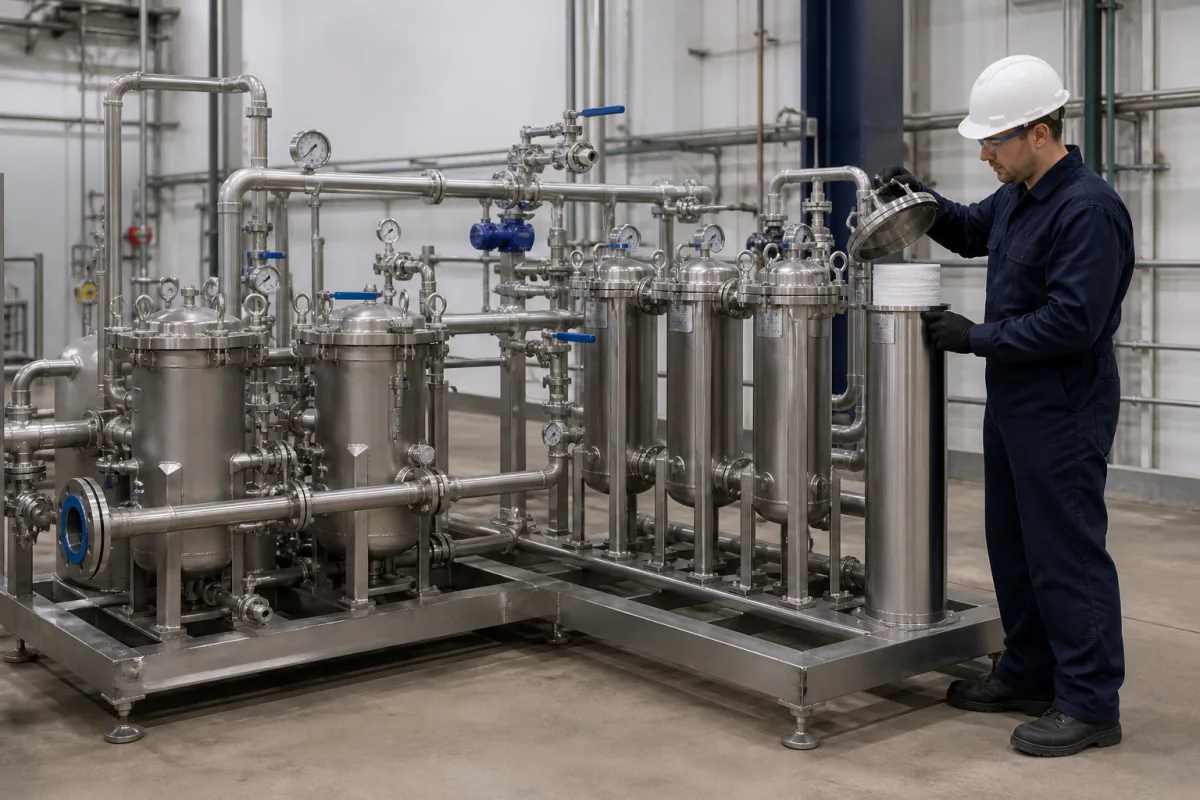
Pre-filtration unit: the bag-filter roughing stage that protects fine cartridge or membrane filters in chemical processing
Bag-filter roughing stage for process liquids and solvents · nominal versus absolute bag ratings, size 1 and size 2 bags, change-out pressure and media chemistry ahead of fine cartridges
Ahead of a fine cartridge, a membrane filter, a purification column or a solvent recovery step, a chemical plant can install a coarser stage that takes out the larger solids so the fine filter downstream carries a smaller load. In the bag-filter form shown here, that stage is one or more pressure housings holding filter bags in perforated baskets, with a gauge on each housing and a drain, and it is specified by the rating and efficiency of the bag, the bag size and flow per housing, the pressure drop at which the bag is changed, and the bag material's resistance to the liquid.
Bag-type pre-filtration stages for chemical process liquids and solvents: single and multi-bag housings, inner baskets for two-stage filtering in one vessel, needle-felt, microfibre and mesh bags, and the relation between the roughing stage and the fine filter after it. Complete solvent filtration skids with flash-point classification, PTFE membrane cartridges and the choice between cartridge housings and basket filters are covered on the Solvent filtration skid for solvent recovery page. Pressure vessels for granular media and activated carbon filtration are covered on the Pressure filter vessels for media filtration page; Y-type and basket pipeline strainers on the Pipeline strainer page; machine-tool coolant bag carts and self-cleaning drum filters, and ballast water filter cartridges, each have their own pages and are outside this one.
CNFX editorial research · Sources checked October 13, 2026 · 5 sources
Nominal 60–70% needle felt upstream, absolute bags up to 99.98% where the fine filter starts
Allied Filter Systems rates its needle-felt bags, which capture particles through the depth of the felt, from 0.5 to 200 microns at a nominal efficiency of 60–70%. Its microfibre bags are absolute-rated from 0.6 to 25 microns at up to 99.98% efficiency, and woven monofilament mesh bags give an absolute rating from 1 to 1,500 microns by surface sieving. Across its range it gives retention efficiencies from 60% to 99.98%. [1]
Allied describes needle felt as a cost-effective medium with a high solid-holding capacity for both rigid and deformable, gelatinous particles. Editorial note: that is the role of the front stage in a pre-filtration unit, with a tighter absolute bag or cartridge after it removing what passes. Allied also makes multi-layer felt bags with two or three layers, choosing the micron ratings of the pre-filtration and final filtration layers to suit the process, so that both stages sit in one bag; it names paints, coatings, chemicals and foodstuff as example uses. Its Allipure absolute bags, rated 0.6 to 5 microns, are stated at 99.98% (beta 5000) at the rated size. [1]
Rosedale's NCO bag housings accept bags or cartridges rated from 0.5 µm absolute to 100 µm nominal, so one housing design can serve as the roughing stage or as the polishing stage depending on the element. [3]
Editorial calculation: a beta ratio of 5,000 means one particle at the rated size passes for every 5,000 that arrive, so efficiency is 1 − 1/5,000 = 99.98%. A 60% nominal bag passes 40 of every 100 particles at its rating; the absolute stage after it passes 0.02 of every 100, a factor of 2,000 less. [1]
State for each stage the micron rating, whether it is nominal or absolute, the efficiency at that rating, and the test basis behind it; ask whether the bag is sewn or welded.
02
Clean pressure drop of 2–3 psid and a change-out signal at 15 psid on each housing
Rosedale Products writes that the main sign a filter bag needs replacing is a rise in differential pressure across the housing. It sizes filters so that the clean pressure drop is 2–3 psid and treats a bag filter as dirty at 15 psid, adding that the value depends on the degree of filtration, viscosity and the system. [2]
Editorial calculation: 2–3 psid is about 0.14–0.21 bar and 15 psid about 1.03 bar, so a bag sized this way can load until its pressure drop is five to seven times its clean value before it is changed. [2]
Clean pressure drop varies with bag construction. For its 500 Series oil-absorbing bags, Allied gives a clean differential pressure of 0.025 bar at 6 m³/h for size 1 and 0.05 bar at 12 m³/h for size 2, with dirt holding of 0.5 kg and 1 kg. [1] Editorial note: in a two-stage unit each housing needs its own gauge pair or differential gauge, because a rising drop across the roughing stage and a rising drop across the fine stage call for different actions.
Ask for the clean pressure drop of each stage at your flow and viscosity, the recommended change-out pressure, and the housing's rated pressure.
03
Size 1 and size 2 bags: 0.25 and 0.50 m² of media and the flow each housing can pass
Allied lists four standard bag sizes. Its flow figures depend on media type, micron rating and the fluid, and its dimensions are nominal. [1]
Hayward gives maximum flow rates of 90 GPM for a size 1 bag and 180 GPM for a size 2, for 7-inch bags of 16 and 32 inches, with ratings from 1 to 800 microns. [5] Editorial calculation: 180 US gallons per minute is about 40.9 m³/h, in line with Allied's 40 m³/h for size 2. [5][1]
Rosedale rates its NCO housing, which takes size 1 or size 2 bags, at 150 psi and up to 100 GPM. [3] Allied's high-capacity bags, which sit in a basket with an inner core so liquid passes through both the outer surface and the core, add 70% filtration area over a standard bag of the same size. [1]
Rosedale also fits smaller inner baskets or bags inside the main basket to give two-stage cleaning in one vessel, in the same materials and ratings as the outer baskets. [4]
Bag media against acids, alkalis, solvents and oxidants, and their temperature limits
For a solvent or chemical pre-filter, Allied's compatibility table decides which felt or mesh can be used at all. [1]
The ratings in the table are Allied's. Editorial note: a polypropylene bag rated Good for solvents is limited to 93 °C, so a hot solvent stream may push the choice to polyester, Nomex or PTFE even before efficiency is considered; check the specific solvent with the bag maker. [1]
Explore company information and manufacturing capabilities, then discuss the scope of your project with a relevant supplier.
Share this page
Compiled and source-reviewed by the CNFX editorial team.
Each manufacturer above links to the page on that company's own website where the product is listed, with the date we checked it. How we source and review
· Page last updated 13 October 2026
Buyer questions
What is the difference between a nominal and an absolute filter bag?
Allied rates needle-felt bags at 60–70% nominal efficiency and absolute-rated microfibre bags at up to 99.98%. [1]
When should a filter bag be changed?
Rosedale sizes for 2–3 psid clean and treats a bag as dirty at 15 psid, depending on filtration degree, viscosity and the system. [2]
How much flow can a size 2 bag take?
Allied lists up to 40 m³/h and Hayward 180 GPM, both depending on media and fluid. [1][5]
Which bag material suits hot solvents?
Allied rates polyester, nylon, Nomex and PTFE Excellent for solvents, with maximum temperatures of 140, 110, 200 and 260 °C. [1]
Sources and what still needs a direct check
Sources checked 2026-10-13. Allied Filter Systems' filter bag brochure (UK), three Rosedale Products pages on housings, bag change-out and two-stage baskets (US), and Hayward Flow Control's filter bag page. All are maker statements about their own products.