Isolator and RABS transfer · Alpha and beta assemblies, interlock and ring of concern, beta sterilisation, port size and seals
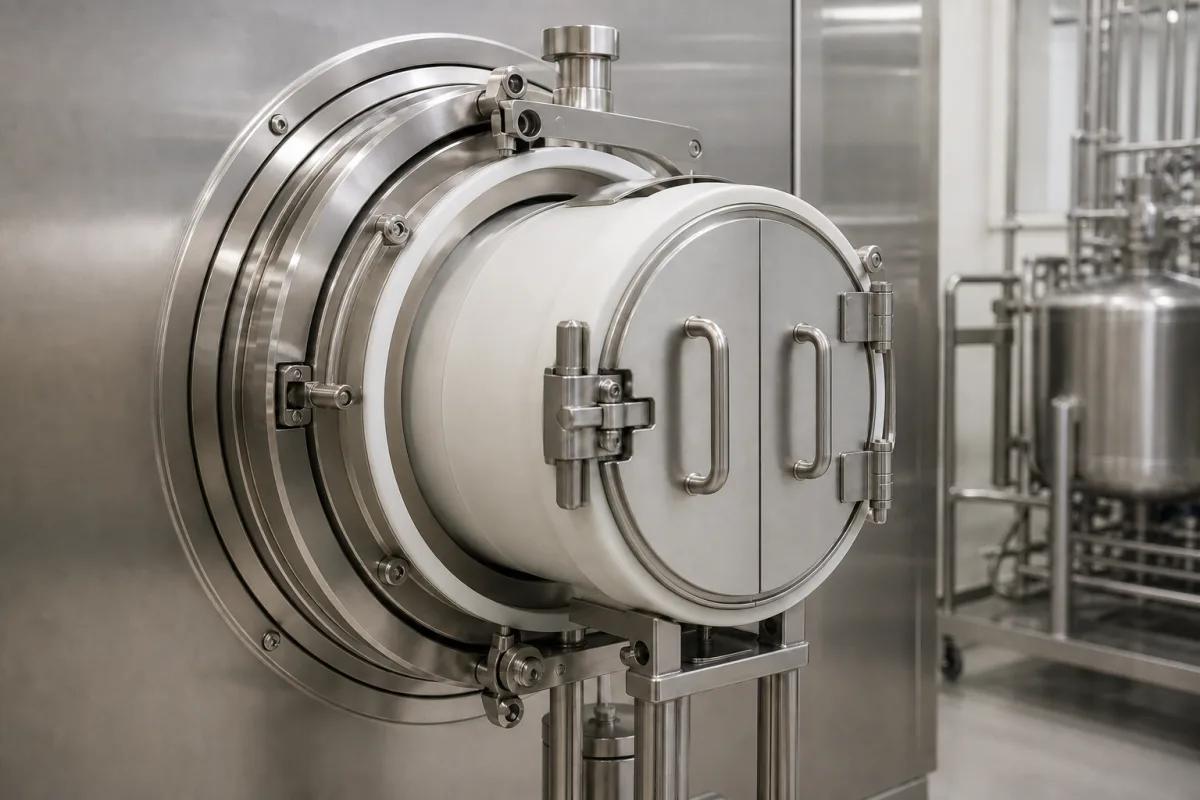
A rapid transfer port (RTP) is a double-door transfer system for aseptic or contained enclosures: an alpha port with its own door is fixed in the wall of an isolator or RABS, and a mobile beta container or bag with its own door docks onto it so that both doors open together as one, letting items pass without opening the enclosure. Ask three things first: how the alpha–beta docking and interlock work and how the ring of concern is protected, how the beta container and its load are sterilised before docking, and which port size and seal material suit the largest item and the decontamination agent.
Alpha ports, beta containers and beta bags for transfer into and out of isolators, RABS and containment enclosures, for solids, components and liquids. Pass boxes, airlocks, split butterfly valves and complete isolators are outside this page.
CNFX editorial research · Sources checked October 12, 2026 · 5 sources
Check alpha–beta docking, interlock and the ring of concern
EU GMP Annex 1 (2022) defines a rapid transfer system or port as a system used for transferring items into RABS or isolators that minimises the risk to the critical zone, for example a rapid transfer container with an alpha/beta port, and lists RTPs among the integrated transfer ports operators use. [1] A trade article on the design explains that the alpha assembly is mounted in the isolator wall and the beta assembly is mobile; “Each has a door, seal and, often, an interlock function”, and the interlock helps protect against the alpha door opening when a beta assembly is not fully docked. [2]
The same article identifies the area of concern (ring of concern), where the alpha door and the beta assembly meet, as a point that could become contaminated after repeated use with insufficient cleaning, and where transferred items could graze it. It lists covering the sealing surfaces with contained transfer funnels or sleeves, user procedures for periodic cleaning, and alpha ports allowing heat sterilisation of the sealing surfaces as mitigations. [2]
Manufacturing Chemist traces the RTP to the DPTE (double door for leaktight transfer) developed in France in the 1960s for nuclear containment, with an alpha part of door, flange and lip seal on the chamber wall and a beta part of door, lip seal, flange and container. [3] AVM describes its port as docking by a manual 60° rotation, after which the two doors disengage from their housings and lock together, with a lip seal giving an airtight connection. [4]
Give the supplier the enclosure (isolator, RABS, glovebox), wall thickness and material, the largest item to transfer and its weight, solids, components or liquids, how often transfers occur, the decontamination agent and cycle used on the enclosure, how the beta container or bag will be sterilised, containment level needed, and whether the beta must be compatible with existing alpha ports.
02
Plan how the beta side and its load are sterilised
Annex 1 states that transfer of equipment and materials into cleanrooms and critical zones is one of the greatest potential sources of contamination; where items cannot be sterilised on transfer, a validated procedure such as rapid transfer systems for isolators should be used, and the use of rapid transfer port technology should be considered for transfer of items sterilised in sealed packaging into grade A. [1]
Annex 1 also requires isolator interior bio-decontamination to be automated, validated and to include a sporicidal agent, for example in gaseous or vaporised form, and its contamination control strategy for isolators considers transfer mechanisms used. [1] Fenggu describes loading its beta transfer container in a lower-grade area, closing it with the operating tool, sterilising it offline with a pulsed-vacuum cycle through a sterilising filter, and then docking it to the alpha port on a RABS or isolator. [5] The trade article notes autoclavable beta containers, liquid transfer through a beta flange first sterilised on a steam-in-place docking plate, and single-use beta bags. [2]
Editorial note: the beta container, its filter and its seals must survive the chosen sterilisation cycle, and the container must fit the sterilizer chamber; Fenggu says port diameter, container dimensions, seal material and sterilisation must be confirmed against the load and sterilizer chamber. [5]
03
Choose port size and seal material
Fenggu lists nominal port sizes of 105, 190, 270 and 350 mm, a 316L stainless-steel body, fluoroelastomer seals as standard with silicone optional, and a documented OEB5 sealing level. [5] AVM lists 105, 190, 270, 350 and 460 mm in its product range, 316L product-contact parts, FKM or silicone seals stated to FDA 21 CFR 177.2600, Ra < 0.4 µm contact surfaces, sealing classification up to OEB4, and tabulates flange, effective and wall-opening diameters for each size. [4]
AVM also offers a 190 mm beta solution for compatibility evaluation with existing 190 mm alpha ports from other makers. [4] Editorial note: the clear passage of a port is smaller than its nominal size, so check the largest item against the effective diameter and the beta container's internal dimensions, and confirm compatibility with existing alpha ports by test before relying on a mixed-make system.
04
Alpha ports, steel and polyethylene beta containers, and beta bags from AVM and Fenggu
Listings include alpha ports with stainless-steel and polyethylene beta containers and beta bags, and RTP systems supplied with isolators and RABS; ask each for interlock design, containment test data and sterilisation compatibility of the beta side.
05
Alpha port, beta container or bag, lip seals, interlock, beta sterilising filter and accessories
Containment rests on two rows: the interlock, which the trade article credits with stopping the alpha door opening without full docking, and the lip seals that both halves carry in the DPTE design. [2][3]
Port diameter, leak rate, temperature and humidity limits, materials, finish and cycle life for an RTP order
The reviewed maker pages give size, material and surface finish but no leak rate or cycle life; ask for the containment test behind the stated OEB level (OEB5 at Fenggu, up to OEB4 at AVM). [5][4]
2 companies list this product among what they make. Company figures are quoted from each
company's own website; every card states where the relationship came from.
AVM Extraordinary Intelligent Control (Zhejiang) Co., Ltd
Manufacturing site to be confirmed for the order
Lists rapid transfer ports from 105 to 460 mm with stainless-steel and polyethylene beta containers and beta bags.
Explore company information and manufacturing capabilities, then discuss the scope of your project with a relevant supplier.
Share this page
Compiled and source-reviewed by the CNFX editorial team.
Each manufacturer above links to the page on that company's own website where the product is listed, with the date we checked it. How we source and review
· Page last updated 13 October 2026
Buyer questions
What is a rapid transfer port?
EU GMP Annex 1 defines it as a system for transferring items into RABS or isolators that minimises risk to the critical zone, for example a container with an alpha/beta port. [1]
What is the ring of concern?
Per a trade article, it is where the alpha door and beta assembly meet, which can become contaminated with insufficient cleaning; covers, cleaning procedures and heat-sterilisable sealing surfaces are mitigations. [2]
What RTP sizes are available?
Fenggu lists 105, 190, 270 and 350 mm; AVM also lists 460 mm. [5][4]
Sources and what still needs a direct check
Sources checked 2026-10-12. EU GMP Annex 1 is the European regulator's guidance for sterile manufacture. The trade articles and maker pages describe RTP design and products.