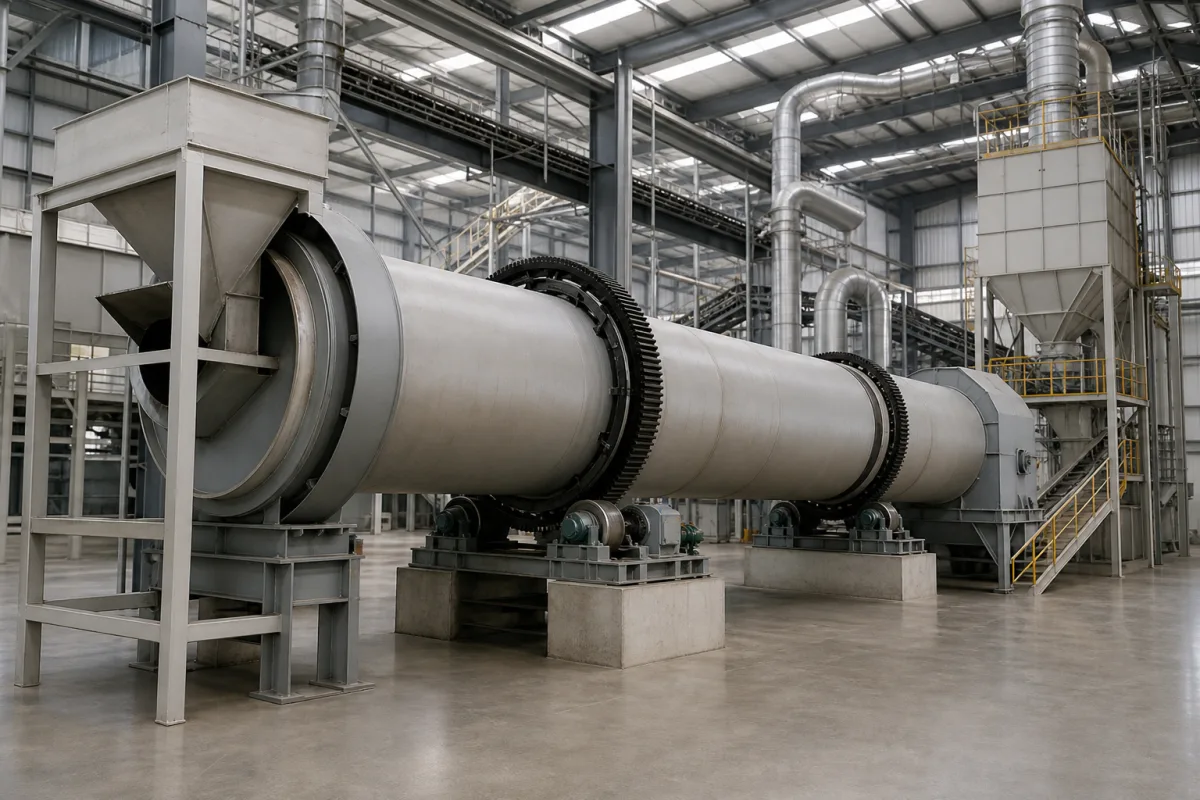
Rotary drum granulators and ammoniator-granulators for phosphate and compound fertilizers · Inclined open-ended drum with retaining rings and internal scraper, rolling recycle bed, slurry distributor pipes and ammonia sparger, dryer, screens and recycle loop, and scrubbing of off-gases
A rotary drum granulator turns fertilizer slurry, melts or powders into granules by rolling them on a bed of recycled fines in a slowly turning, slightly inclined cylinder; in an ammoniator-granulator, ammonia is also fed under the bed to complete neutralisation. The drum is the heart of a loop with a dryer, cooler, screens, crusher and scrubbers. Ask three things first: which formulations and production rate it must handle, how liquids and ammonia are introduced into the bed, and how the recycle loop and off-gas scrubbing are sized around it.
Rotary drum granulators and ammoniator-granulators for phosphate and compound (NPK) fertilizers, including drum shell, tyres and drive, retaining rings, scrapers, slurry distributors and ammonia spargers, and their interfaces with reactors, dryers, coolers, screens and scrubbers. Urea prilling and granulation (see modular urea granulation and prilling system), pugmills, pan granulators and blending plants are outside this page except where compared.
CNFX editorial research · Sources checked October 12, 2026 · 4 sources
US EPA's AP-42 Section 8.5.3 (Ammonium Phosphate) states that ammoniation-granulation plants use either a pugmill or a rotary drum ammoniator, and that about 95% of US plants use a rotary drum mixer developed and patented by the Tennessee Valley Authority (TVA). The basic rotary drum ammoniator-granulator is a slightly inclined open-end rotary cylinder with retaining rings at each end and a scraper or cutter mounted inside the shell, in which a rolling bed of recycled solids is maintained. [1]
In the TVA process described, phosphoric acid mixed with sulfuric acid and scrubber liquor is partly neutralised in a brick-lined reactor with all of the phosphoric acid and about 70% of the ammonia; the resulting ammonium phosphate slurry with 22% water goes through steam-traced lines to the ammoniator-granulator, where it is distributed on the bed and the remaining ammonia, about 30%, is sparged underneath. Granulation, by agglomeration and by coating particles with slurry, takes place in the drum and is completed in the dryer. [1]
AP-42 Section 8.5.2 (Triple Superphosphates) gives the same basic drum description for granular triple superphosphate, with a rolling bed of dry material and slurry introduced through distributor pipes set lengthwise in the drum under the bed. It contrasts the pugmill, a U-shaped trough with twin counter-rotating shafts carrying blades or paddles, of which only one was operating in the US at the time. [2]
Editorial note: the reviewed sources describe ammonium phosphate and triple superphosphate granulation. For other compound (NPK) formulations, ask the supplier for references on the same formulations, including how steam, ammonia or acid feeds and recycle ratio are set.
A Jacobs Engineering paper on granulation plant revamps (Bowness and Ivell, IFA Technical Conference, Chennai, 2002) says granulator speed spreads the liquid evenly over the rolling bed, and low speeds give more oversize and less round granules. Jacobs reports that older plants in its experience were designed at about 30–35% of critical speed, and raising it to at least 40% of critical gave useful gains in throughput and granulation, at the cost of higher power draw. Once speed and slope are set, residence time is controlled by the discharge weir height. [3]
Editorial calculation: critical speed, where the shell's centrifugal force equals gravity, is about 42.3 ÷ √D rpm for a drum of inside diameter D in metres. For a 4 m drum that is about 21.2 rpm, so 30–35% is about 6.3–7.4 rpm and 40% about 8.5 rpm. The drum size is an assumed example. [3]
Give the supplier the formulations and grades to be produced, production rate per grade, raw materials and their form (slurry, melt, powders), ammonia and acid feeds, reactor arrangement, target granule size range, recycle ratio expectations, drum diameter and length if a building limit applies, materials of construction and lining, scraper type, drive and tyre arrangement, and the dryer, cooler, screen, crusher and scrubber equipment it must match.
02
Size the dryer, screen and recycle loop and the scrubbers
AP-42 8.5.3 says moist ammonium phosphate granules go to a rotary concurrent dryer and then a cooler; cooled granules pass a double-deck screen, product is 1 to 4 mm, and oversize granules are crushed, mixed with undersize and recycled to the ammoniator-granulator. Ammonia-rich off-gases from the granulator pass through a wet scrubber, and dryer and cooler gases pass through cyclones and wet scrubbers. [1]
It lists the reactor and ammoniator-granulator as sources of gaseous ammonia, gaseous fluorides such as hydrogen fluoride and silicon tetrafluoride, and particulate ammonium phosphates, and says "These 2 exhaust streams are generally combined and passed through primary and secondary scrubbers"; primary scrubbers use raw materials mixed with acid and secondary scrubbers use pond water. [1] For granular triple superphosphate, AP-42 8.5.2 describes drying, screening with oversize crushed and undersize recycled, cooling in a countercurrent rotary drum, and curing for 3 to 5 days before shipping. [2]
Editorial note: because the recycle passes through the drum again, size the drum, dryer and screens on total flow including recycle, not on product rate alone, and ask the supplier for the recycle ratio its design assumes for each grade.
The same paper notes that once the recycle loop is de-bottlenecked, the product rate is set by the recycle ratio: the lower the ratio, the higher the product rate. For the rotary dryer that follows, it gives 15–25% of critical speed for good cascading and slopes of 2.5–3.5°. [3]
03
Give the supplier the data a drum is sized from
FEECO International, a maker of granulation drums, gives capacities from 500 lb/h to more than 3,500 t/h and a retention time in the drum of 30 seconds to 60 minutes, set by the process and product goals. It says the design process starts with testing to establish the percent fill, retention time, drum speed and slope, and the spray system, after which the drum is sized for the intended capacity. It describes the drum as continuous equipment that needs feeding and take-off conveyors, screens and a recycle circuit, followed by a rotary dryer, and states that a recycle circuit can be needed to lower the moisture of the feed entering the drum by back-mixing fines. [4]
FEECO lists the data it asks for: feed composition, moisture, temperature, bulk and true density, consistency (sticky or plastic) and qualities such as abrasive, heat-sensitive or hazardous; the product's minimum and maximum particle size and expected bulk density; binder use and restrictions; and preferred materials of construction, electrical supply (volts, hertz, phases), minimum and maximum ambient temperature and humidity, plant elevation and any known retention time. Wear items it names are the liner and tumbling flights where fitted, and trunnion wheels, tyres and thrust rollers, with misalignment adding wear to all of them. [4]
Editorial calculation: the material held in the drum equals the total flow through it multiplied by the retention time. At an assumed 100 t/h of fresh feed plus recycle and a 5-minute retention, the bed holds about 100 × 5 ÷ 60 ≈ 8.3 t; at 10 minutes it holds about 16.7 t, which the drum shell, tyres and drive must carry. Use the supplier's test values for flow and retention, and include the recycle in the flow, as noted above. [4]
Data group (FEECO list)
Items to state
Why it matters
Raw feed
Composition, moisture, temperature, bulk and true density, consistency, abrasive or hazardous qualities [4]
Sets binder, recycle and liner choices.
Product
Minimum and maximum particle size, expected bulk density [4]
Sets screen sizes and recycle ratio.
Process and site
Materials of construction, electrical supply, ambient temperature and humidity range, elevation, retention time if known [4]
Sets materials, drive and controls.
04
Drum shell, retaining rings, scraper, slurry pipes and ammonia sparger
Inside the drum, slurry distributor pipes and an ammonia sparger feed the rolling bed of recycled solids from below; oversize from the screens is crushed and returned to that bed with the undersize. [1][2]
Drum speed, slope, recycle-limited capacity and granule size for compound grades
Drum speed is the one field with a published operating figure: the Jacobs paper reports older plants running at 30–35% of critical speed and advises at least 40%. Product size for ammonium phosphate is 1–4 mm in AP-42. [3][1]
Field
What it means and published values
Ask the supplier for
Drum Diameter (m)
Shell size.
Value for your rate.
Drum Length (m)
Residence and bed length.
Value.
Rotational Speed (rpm)
Example older plants 30–35% of critical; at least 40% advised in one paper. [3]
2 companies list this product among what they make. Company figures are quoted from each
company's own website; every card states where the relationship came from.
Anhui Longguang Technology Co., Ltd.
Manufacturing site to be confirmed for the order
Lists a rotary drum granulator for fertilizer production, described as used for compound fertilizers.
Explore company information and manufacturing capabilities, then discuss the scope of your project with a relevant supplier.
Share this page
Compiled and source-reviewed by the CNFX editorial team.
Each manufacturer above links to the page on that company's own website where the product is listed, with the date we checked it. How we source and review
· Page last updated 13 October 2026
Buyer questions
What does a fertilizer rotary drum granulator look like inside?
AP-42 describes a slightly inclined open-ended cylinder with retaining rings at each end, a scraper or cutter inside, and a rolling bed of recycled solids. [1][2]
How is ammonia added in an ammoniator-granulator?
In the TVA process about 70% goes to the pre-neutraliser and the remaining 30% is sparged under the drum bed (AP-42 8.5.3). [1]
What happens to off-size granules?
After screening, oversize is crushed and returned with undersize to the granulator; product is 1–4 mm for ammonium phosphate. [1]
How fast should a fertilizer granulator drum turn?
A 2002 Jacobs Engineering paper reports older drums designed at about 30–35% of critical speed and that at least 40% of critical improved throughput and granulation. [3]
How long does material stay in a granulation drum?
FEECO gives a retention time of 30 seconds to 60 minutes, set by testing for the material and product goals. [4]
Sources and what still needs a direct check
Sources checked 2026-10-12. Two sources are US EPA AP-42 emission-factor sections (1993, reformatted 1995) that describe US plant practice at the time; the Jacobs Engineering paper reports revamp experience; FEECO, a drum maker, describes the design data and tests it uses to size a granulation drum.