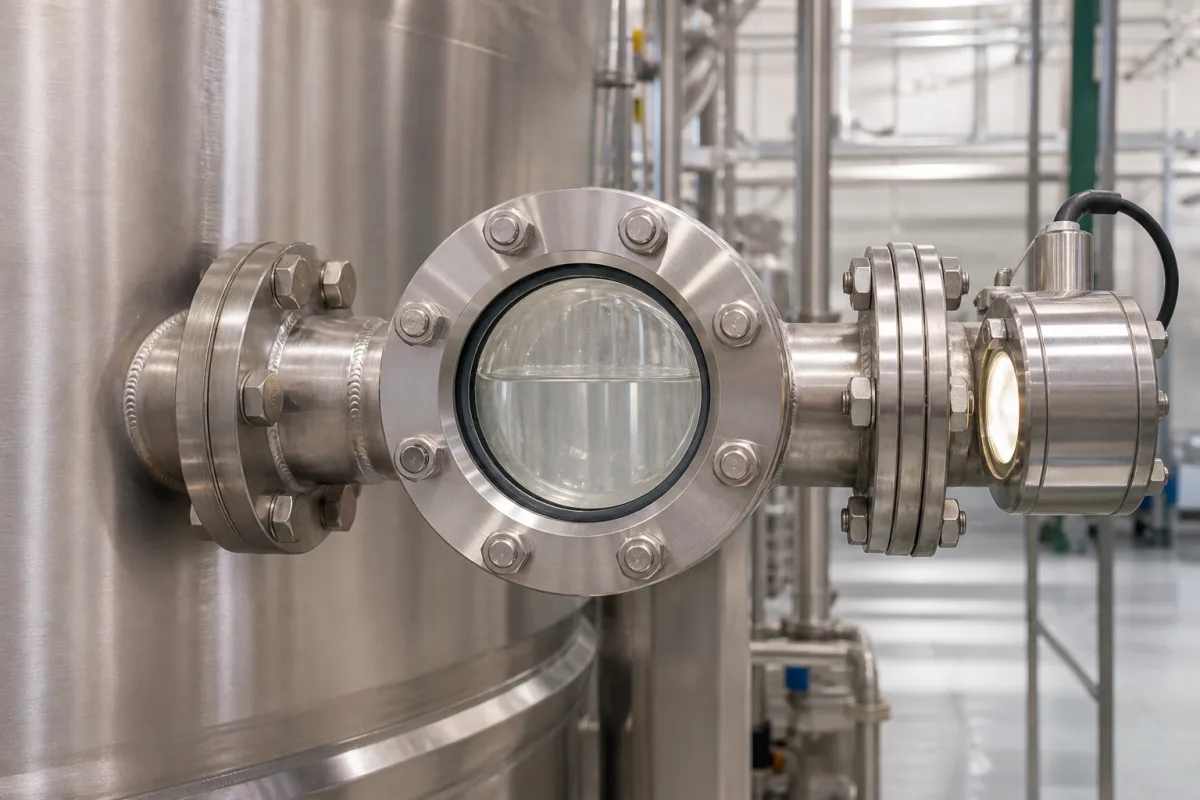
Process sight glasses for vessels and pipelines · Glass type (toughened borosilicate or metal-fused), fitting standard, pressure and shape, bolting, cleaning and lighting
A sight glass assembly is a glass window clamped or fused into a metal fitting on a vessel or pipe so operators can watch level, flow, foaming or cleaning without opening the system. Fix three things before ordering: the glass type and its standard, the fitting standard, size, pressure and temperature rating, and the shape, gaskets, bolting procedure, cleaning nozzles and lights the process needs.
Sight glass windows and fittings for process vessels, reactors and pipelines — bolted flange types, clamp types, metal-fused glasses and their lights and cleaning accessories. Level gauge glasses, sight flow indicators sold as line components, and laboratory glassware are outside this page.
CNFX editorial research · Sources checked October 11, 2026 · 4 sources
Metaglas, a sight glass maker and MAXOS sales representative, describes toughened borosilicate safety sight glasses to DIN 7080, used where vessel processes must be viewed under pressure, thermal and chemical stress, and long sight glasses to DIN 7081 in reflex and transparent forms. Its DIN 7080 page gives minimum surface compressive stress of 40 N/mm² for non-special tempered glass and 100 N/mm² for specially tempered glass, and refers to a catalogue for dimensions, temperature and chemical resistance. [1]
Metaglas describes its metal-fused sight glasses as glass fused into a steel ring, where the different expansion of glass and metal puts the glass under compressive stress, and lists circular sight glass fittings to DIN 28120 or similar and clamp-connection sight glasses to DIN 32676. [2]
In its comparison, Metaglas states that toughened glass needs faces flat and smooth within 0.07 mm to avoid uneven torquing, that re-bolting creates residual stress that can lead to failure, and that surface damage or erosion can cause sudden failure; it says its metal-fused glass tolerates uneven torquing and surface damage and remains leak-tight. These are the maker's own claims. [2]
Editorial note: name the glass standard, fitting standard and the maker's pressure and temperature rating for the exact size, and ask for the installation and torque procedure in writing. [1][2]
Give the supplier the vessel or pipe connection (flange standard, clamp size, weld-on), nominal size, design pressure and temperature, medium and cleaning chemicals, glass type and standard, gasket material, body material and surface finish, shape (round or obround), lights and wiper or spray nozzles, documentation (pressure equipment, material certificates) and quantity.
02
Set shape, bolting, cleaning and lighting
LJ Star's guidance says the choice of sight glass shape should follow what the process needs to show. It says round sight glasses, including fused constructions, withstand higher pressure and are the more suitable shape above 150 psig, while obround windows give a wider view for watching flow, level and blending. [3]
The same guidance notes that every sight glass collects residue — condensation, splashing, powders and crystallisation — and that cleaning nozzles positioned along an obround window can reach its full length including the corners. [3]
Editorial calculation: 150 psig is about 10.3 bar gauge (150 × 0.06895). [3]
03
Flange, float ball, tank, turbine-type and 3-way sight glasses on offer
NTGD lists flange sight glasses alongside float ball, tank, turbine-type and 3-way sight glasses and sight glass valves.
Ask any supplier for the glass and fitting standards, rated pressure and temperature for the size quoted, and the bolting procedure. [1][2]
04
Check the pressure, temperature and bolt torque of a DIN 28120 glass
Alfa Laval's leaflet for its bolted sight glass to DIN 28120 describes a base flange welded into or onto the vessel wall, gaskets, a borosilicate glass disc to DIN 7080, a cover flange, nuts and studs. It rates the assembly at a maximum product pressure of 145 psi (10 bar) down to full vacuum, and at -14 °F to +284 °F with EPDM gaskets, rising to 536 °F with Klingersil gaskets. The leaflet states that the pressure resistance of the disc depends on the care with which the bolts and nuts are tightened, working on diametrically opposed pairs, and that its tabled torque values have to be strictly respected; its text gives the torques in Nm while the table header says lbf ft, so confirm the unit with the maker. [4]
The leaflet lists AISI 316L base flanges and AISI 321 cover flanges with 3.1B/AD-W2 material certificates, a 2.2 certificate for the glass disc, and studs to DIN 938/934 in A2-70. It asks buyers to state the DN size and the gasket material on the product side. [4]
Editorial calculation: -14 °F is about -26 °C, 284 °F is 140 °C and 536 °F is 280 °C, using (°F − 32) × 5/9. The 145 psi rating sits just below the 150 psig level above which LJ Star favours a round glass. [4][3]
Glass disc, fused steel ring, fitting body, gaskets and bolting, shape, lights and nozzles
Gaskets and bolting are the row tied to failure: Metaglas says re-bolting toughened glass leaves residual stress, and Alfa Laval says the disc's pressure resistance depends on careful tightening in opposed pairs. [2][4]
DN, rated pressure and temperature, glass type and thickness, body and seal materials for a sight glass order
For one DIN 28120 design, Alfa Laval's leaflet fills four of these rows: 10 bar down to full vacuum, -26 to 140 °C with EPDM gaskets, 316L base flanges and disc thicknesses for DN 100 to 150; surface roughness, leakage rate and weight have no published value in the sources. [4]
1 company lists this product among what they make. Company figures are quoted from each
company's own website; every card states where the relationship came from.
NTGD Sight Glass
Manufacturing site to be confirmed for the order
Lists flange sight glasses, alongside float ball, tank, turbine-type and 3-way sight glasses and sight glass valves.
Explore company information and manufacturing capabilities, then discuss the scope of your project with a relevant supplier.
Share this page
Compiled and source-reviewed by the CNFX editorial team.
Each manufacturer above links to the page on that company's own website where the product is listed, with the date we checked it. How we source and review
· Page last updated 13 October 2026
Buyer questions
What standard covers toughened borosilicate sight glass discs?
Metaglas lists DIN 7080 for round discs and DIN 7081 for long reflex and transparent glasses. [1]
What is a metal-fused sight glass?
Metaglas describes glass fused into a steel ring so that the glass is under compressive stress. [2]
When should a sight glass be round rather than obround?
LJ Star says round is the more suitable shape above 150 psig. [3]
Why does bolting matter for toughened sight glasses?
Metaglas says faces must be flat within 0.07 mm and that uneven or repeated bolting can lead to failure. [2]
How tightly should a DIN 28120 bolted sight glass be torqued?
Alfa Laval's leaflet lists 19.18 lbf ft for DN 100 and 34.67 lbf ft for DN 150 with lubricated studs, tightened in diametrically opposite pairs, and says the values must be strictly respected; its text gives the same table in Nm, so confirm the unit with the maker. [4]
Sources and what still needs a direct check
Sources checked 2026-10-11. Metaglas publishes DIN 7080 glass and metal-fused sight glass pages; LJ Star publishes shape and cleaning guidance; Alfa Laval's leaflet covers one bolted sight glass to DIN 28120.