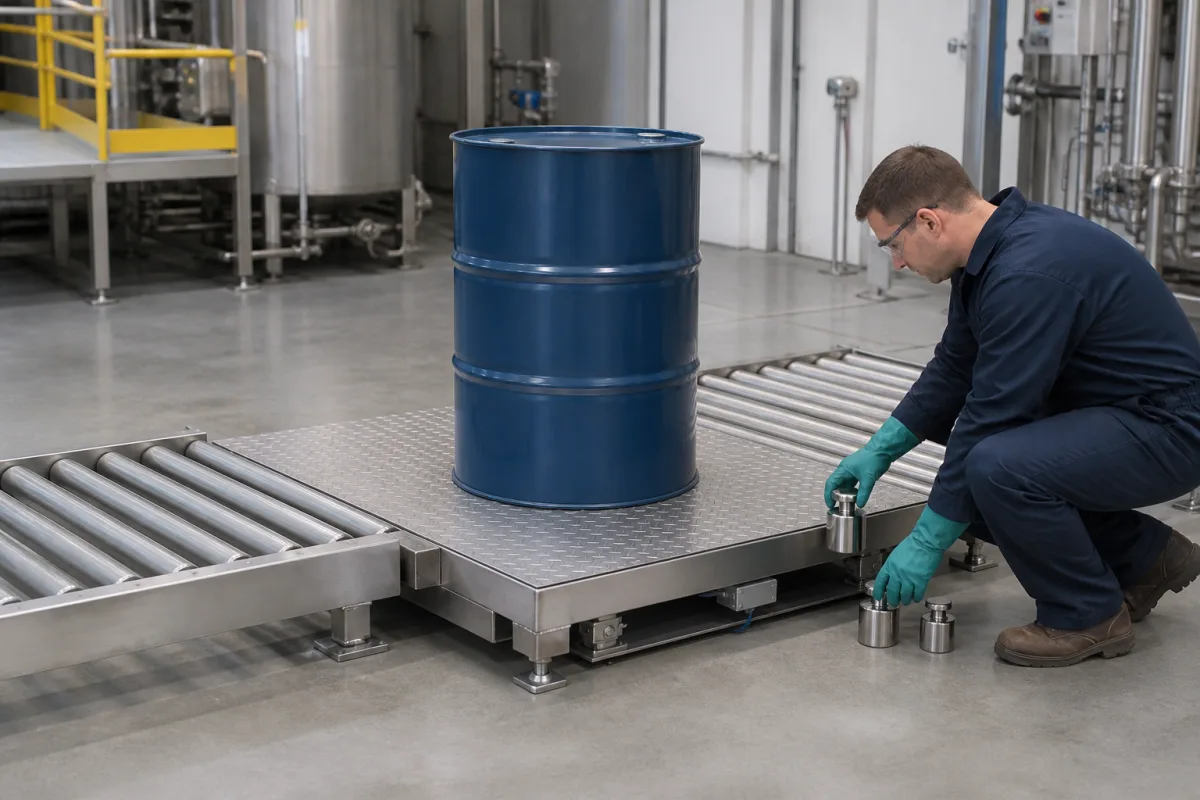
Weighing platform for drum filling: a class III platform scale for 200 L drums, checked with test weights and, when filling is automatic, against fill-by-fill limits
Weighing platforms for filling chemical drums · OIML R76 class III intervals and errors for static weighing, OIML R61 deviation of each fill for automatic filling, eccentric loading and test weights to OIML R111
This page covers platform scales on which chemical drums stand while they are filled and weighed, from portable low-profile drum scales to stainless platforms set between roller conveyors under a filling lance. Ask three things first: the capacity and verification scale interval the platform is approved for, whether filling is controlled by an operator or automatically by the scale (which changes the legal requirements), and how the platform will be checked with test weights in service.
Weighing platforms for filling drums and similar containers in chemical plants, including portable drum scales and stainless platforms within roller conveyors, approved for static weighing or as part of automatic gravimetric filling. Tank, hopper, vessel and general process platform scales built from load cells and weigh modules are covered on the Load cell scale page. Truck scales, livestock scales, bench scales with single-point load cells and the filling valves themselves are outside this page.
CNFX editorial research · Sources checked October 12, 2026 · 4 sources
Class III scale interval, number of intervals, minimum load and error bands for a drum platform
OIML R76-1 (2006) sets, for accuracy class III with a verification scale interval e of 5 g or more, between 500 and 10,000 intervals (n = Max/e) and a minimum capacity of 20 e. On initial verification the maximum permissible error is ±0.5 e from 0 to 500 e, ±1.0 e from 500 e to 2,000 e and ±1.5 e from 2,000 e to 10,000 e, and in service it is twice those values. For eccentric loading, a load of one third of the maximum capacity plus maximum additive tare is placed at different positions on a receptor with up to four supports. [1]
Editorial calculation: 300 kg with e = 100 g gives n = 3,000, inside the class III range of 500–10,000; the eccentric test load is 100 kg if no additive tare is declared. [1] Baykon lists its PS drum scale at 300 and 600 kg with precision of 50, 100 or 200 g, a 35 mm platform height and short ramp for drum trolleys, galvanised or optional AISI 304 stainless platforms, IP65 or IP67 protection, a Zone 2 option and battery-powered IP67 indicators with colour-changing displays to prompt the operator. [4]
Give the supplier the drum sizes and filled weights, how drums arrive and leave (trolley, roller conveyor, pallet), whether filling is stopped by an operator or by the scale, the approval needed (OIML R76 or R61 class), hazardous-area zone, wash-down, and the signals to the filling valve or control system.
02
When the scale itself stops the fill: OIML R61 limits on each fill from the average
OIML R61-1 (2017) covers automatic gravimetric filling instruments, which produce a predetermined mass of individual fills by automatic weighing, and places no limit on their capacity. The manufacturer specifies an accuracy class X(x), where x is 1, 2 or 5 × 10ᵏ and no more than 2; each fill may deviate from the average of all fills in a test by the Table 2 limits multiplied by x. For fills above 15,000 g, class X(1) allows 0.8% of the fill at initial verification and 1% in service; from 1,000 to 10,000 g it allows 1.2% and 1.5%. R61 adds that national authorities may set which classes apply to an application. [2]
Editorial calculation: for a 180 kg drum fill, the maximum deviation of each fill from the average at initial verification is about ±1.44 kg in class X(1), ±0.72 kg in X(0.5) and ±0.29 kg in X(0.2). [2] Editorial note: whether R76 or R61 applies depends on whether an operator or the scale's own control ends each fill; confirm with the supplier and the local metrology authority which approval the installation needs.
03
Test weights for checking the platform in service
OIML R76 requires standard weights used for verification to meet OIML R111 and to have an error no greater than one third of the scale's maximum permissible error for the applied load. OIML R111 gives the maximum permissible error of a 20 kg weight as ±0.3 g in class F2, ±1 g in M1, ±3 g in M2 and ±10 g in M3. [1][3]
Editorial calculation: at 300 kg on a 100 g interval platform the initial-verification error limit is ±150 g, so test weights may be in error by up to ±50 g; fifteen 20 kg class M1 weights add up to at most ±15 g, and fifteen class M3 weights to at most ±150 g, which would exceed that limit. [1][3]
04
Send the drums, filling method and approval needed together
Paste it into your enquiry below or into an email to a maker, then replace every bracket.
Drums: [size; filled mass; material]
Handling: [trolley; roller conveyor; pallet]
Filling: [operator stop or automatic; lance; signals]
Approval: [OIML R76 class III; OIML R61 X(x); local authority]
Environment: [hazardous zone; wash-down; IP rating]
Service: [test weights; calibration interval]
Explore company information and manufacturing capabilities, then discuss the scope of your project with a relevant supplier.
Share this page
Compiled and source-reviewed by the CNFX editorial team.
Each manufacturer above links to the page on that company's own website where the product is listed, with the date we checked it. How we source and review
· Page last updated 13 October 2026
Buyer questions
What accuracy does a class III drum scale have?
Under OIML R76, a class III platform with interval e has errors of ±0.5 e up to 500 e, ±1.0 e up to 2,000 e and ±1.5 e up to 10,000 e at initial verification, doubled in service, and a minimum load of 20 e. [1]
Which rules apply when the scale controls the drum fill?
OIML R61 for automatic gravimetric filling instruments: in class X(1), each fill above 15 kg may deviate from the average by 0.8% at initial verification and 1% in service. [2]
Which test weights can check a 300 kg drum platform?
OIML R76 limits test weight error to one third of the scale's permissible error; R111 gives ±1 g for a 20 kg class M1 weight and ±10 g for class M3. [1][3]
Sources and what still needs a direct check
Sources checked 2026-10-12. OIML Recommendations R76, R61 and R111 set weighing, filling and test weight requirements; Baykon describes its own drum scale.