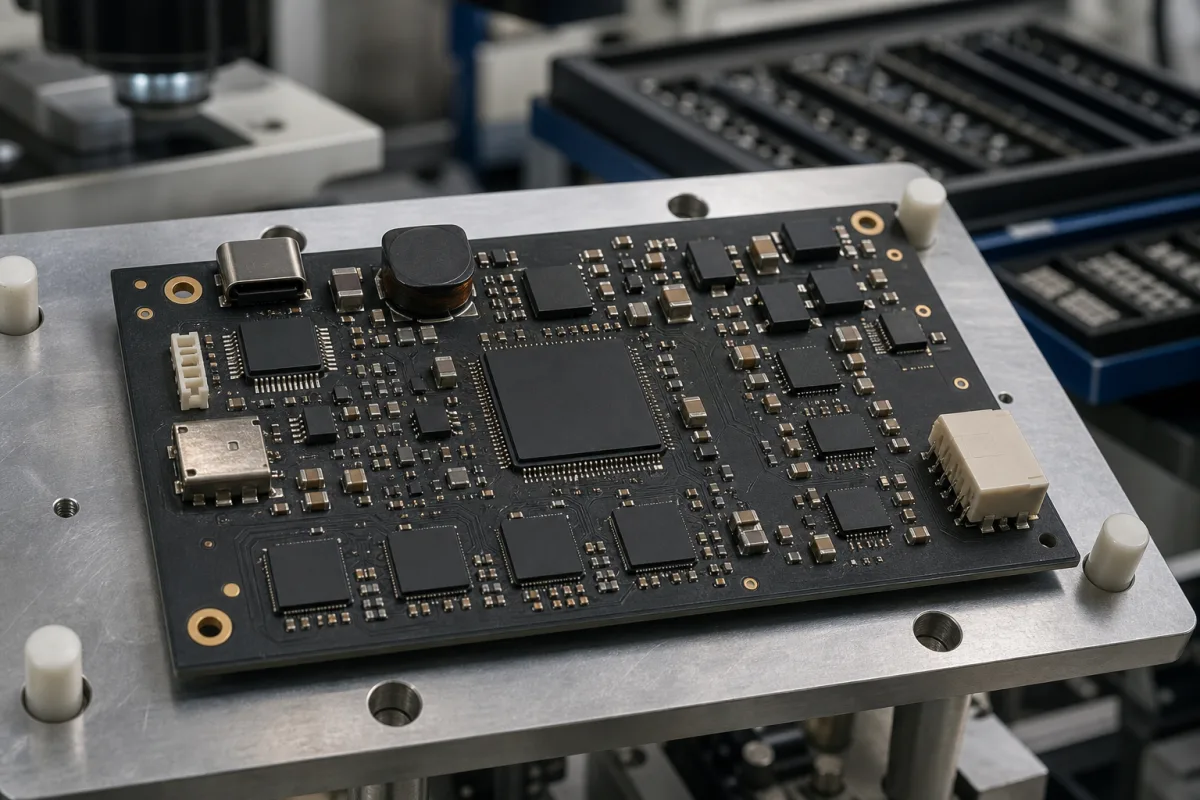
Control circuit board (the dimming and control board of a smart LED desk lamp, set up to keep flicker low)
The control board of a smart LED desk lamp, specified for flicker · PWM dimming frequency against percent flicker under IEEE 1789, why PWM is close to 100% modulation, testing across the dimming range, and where a lamp board has to go above 1,250 Hz
In a smart desk lamp the control board reads the touch keys or app, sets brightness and colour temperature, and drives the LEDs, for example by switching them on and off fast (PWM). How fast it switches, and how deep the light swings at each dimming level, decides whether the lamp flickers for the person reading under it. Specify the dimming method, the PWM frequency at every dimming step, and how flicker will be measured, before choosing a board.
Control and dimming boards of smart LED desk and task lamps, specified for flicker: PWM frequency and modulation, the IEEE 1789 recommended practice, and flicker testing across the dimming range. Complete desk lamps and the EU ecodesign limits on them are covered on the Smart LED desk lamp page; separate AC-DC LED drivers on the LED driver page; built-in driver modules on the Built-in LED driver module page; DMX decoders on the DMX512 LED controller/driver page; general appliance MCU boards on the Main control board for an appliance or machine page.
CNFX editorial research · Sources checked October 12, 2026 · 2 sources
Naomi Miller and Brad Lehman's 2015 DOE presentation on the IEEE PAR1789 recommended practice gives the rule as "Max % Flicker ≤ Flicker Frequency x 0.08": find the flicker frequency ("it must be ≥100 Hz"), measure percent flicker, multiply the frequency by 0.08 and round up; if the product's percent flicker is lower, it is acceptable "for all but the most unusually sensitive individuals". Their examples: "At 120 Hz frequency, max allowable % flicker is 10%. At 1250 Hz or higher, 100% flicker is allowed." If the frequency is hard to determine, percent flicker "shall not exceed 10%". [1]
Mike Wood, writing for ESTA, explains that PWM "is close to 100%" modulation, so for PWM-dimmed LEDs only the top line of the limit chart matters; at 1,200-1,500 Hz PWM reaches the IEEE 1789 low-risk limit, but "we don’t get fully into the “No Observable Effect Level” until we reach 3 kHz", and DOE labs suggest phantom array and stroboscopic effects may still matter up to 5 kHz. [2]
Editorial calculation with the 0.08 factor: at 400 Hz the limit is 32% flicker and at 1,000 Hz 80%, so a board switching at full depth (close to 100%) needs to run at 1,250 Hz or above to stay inside the line. [1][2]
Testing at every dimming step, and for sensitive users
Miller and Lehman say "LED flicker and dimming performance depends on the LED driver", list "LEDs with Pulse Width Modulation (PWM) drivers" among the products more likely to flicker, and advise manufacturers to "Test for flicker. Test over dimming range." For special populations they give a stricter line: "% Flicker ≤ Flicker Freq x 0.0333". [1]
Editorial calculation with the 0.0333 factor: at 1,250 Hz the special-population limit is about 42% flicker, so full-depth PWM at that frequency would not meet it. [1]
Wood adds that higher PWM rates are possible but "requires some engineering work to maintain smooth dimming". [2]
Ask for the PWM frequency and measured percent flicker at each brightness and colour-temperature step, the instrument used, and whether the lamp is meant for users who need the stricter 0.0333 line.
03
Desk lamp control board details
Paste it into your enquiry below or into an email to a maker, then replace every bracket.
LEDs: [channels; warm/cool white; current]
Dimming: [PWM; constant-current reduction; steps]
PWM: [frequency at each step]
Flicker: [% flicker at each step; IEEE 1789 line; special populations]
Inputs: [touch keys; app; sensors]
Power: [USB-C; adapter; voltage]
Test: [flicker meter; report]
Explore company information and manufacturing capabilities, then discuss the scope of your project with a relevant supplier.
Share this page
Compiled and source-reviewed by the CNFX editorial team.
Each manufacturer above links to the page on that company's own website where the product is listed, with the date we checked it. How we source and review
· Page last updated 13 October 2026
Buyer questions
What PWM frequency avoids flicker problems?
Under the IEEE 1789 rule summarised by DOE, full-depth PWM needs 1,250 Hz or more; ESTA's Mike Wood points to 3 kHz for no observable effect. [1][2]
How is the IEEE 1789 limit worked out?
Multiply the flicker frequency by 0.08 and round up to get the maximum percent flicker, for frequencies of 100 Hz and above. [1]
Why test across the dimming range?
DOE notes flicker depends on the driver and dimming; it advises testing over the dimming range. [1]
Is there a stricter limit?
For special populations the DOE summary gives % flicker ≤ frequency × 0.0333. [1]
Sources and what still needs a direct check
Sources checked 2026-10-12. The US Department of Energy hosts Naomi Miller and Brad Lehman's LightFair 2015 presentation on IEEE PAR1789; ESTA's Protocol magazine published Mike Wood's article on flicker, stroboscopic effect and SVM.