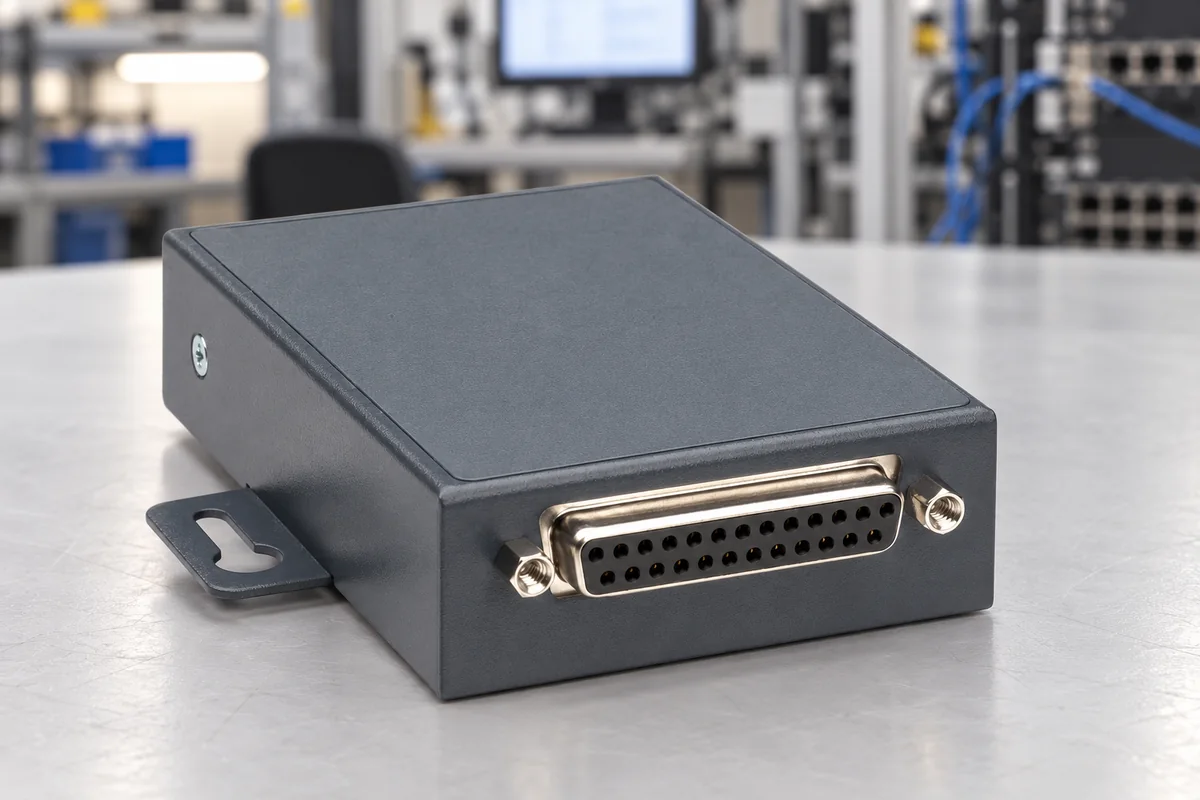
Serial device servers · RS-232/422/485 ports and signals, baud rate and framing, operation modes and drivers, isolation and surge immunity, DC input, temperature, MTBF
A serial device server is a small network adapter, built from an embedded processor, one or more RS-232/422/485 serial interfaces, an Ethernet port and a DC power stage in a metal or plastic housing, that lets PLCs, meters, scanners and other serial equipment be reached over a TCP/IP network as if they were local COM ports or network sockets. Ask three things first: how many serial ports, which standards and speeds it must handle, which operating modes and drivers your software needs, and what isolation, surge immunity, power and temperature the installation requires.
Serial-to-Ethernet device servers and converters for industrial and commercial use, wired or Wi-Fi. Protocol gateways that translate Modbus or fieldbus protocols, cellular routers and printer servers are outside this page.
CNFX editorial research · Sources checked October 12, 2026 · 4 sources
Moxa's NPort 5150 specification lists one DB9 male serial port configurable for RS-232, RS-422 or RS-485 (2- or 4-wire), at 50 bps to 921.6 kbps, with 5–8 data bits, 1, 1.5 or 2 stop bits and none, even, odd, space or mark parity, RTS/CTS, DTR/DSR and XON/XOFF flow control, selectable 1 kΩ or 150 kΩ RS-485 pull resistors and automatic RS-485 data direction control. [1]
Operation modes include Real COM (a virtual COM port on the host), TCP server, TCP client, UDP, pair connection, Ethernet modem and reverse Telnet, with Real COM drivers for Windows, Linux, macOS and other systems, configuration by web, Telnet, serial console or Windows utility, and SNMP and DHCP among management features. [1]
Editorial calculation: with 8 data bits, no parity and 1 stop bit, each byte takes 10 bits on the line, so 921.6 kbps carries at most about 92,160 bytes per second and 9,600 bps about 960 bytes per second. Ask whether the device server's buffering and packing settings suit your protocol's timing.
One protocol for virtual COM operation is the Telnet Com Port Control Option, IETF RFC 2217 (1997, Experimental), which Lantronix lists among its supported protocols. The RFC lets the client send port settings (baud rate, data size, parity, stop size and control such as flow control, BREAK, DTR and RTS) to the access server. The server in turn notifies the client of line and modem-signal changes such as carrier detect. Flow control between client and server is handled without interfering with the data session. It assigns the option code 44. [2][3]
Specifications differ between makers. Lantronix's UDS1100/2100 family lists RS-232, RS-422 or RS-485 (2- and 4-wire) at 300 bps to 921.6 kbps with 7 or 8 data bits, 1 or 2 stop bits, odd, even or no parity, and CTS/RTS or XON/XOFF flow control. The UDS1100 has one 25-pin female DCE connector (listed as DM25F) and the UDS2100 two DB9 male (DTE) ports. Lantronix supplies COM port redirector software and a built-in web server. [3]
A third maker's figures show how far single-port units differ. Digi International's Digi One SP lists one switch-selectable RS-232/422/485 port on a DB-9M connector with serial throughput up to 230 kbps, a 10/100Base-T Ethernet port, full modem and hardware flow control and modem emulation. Its protocol list names TCP/UDP socket services, UDP multicast, Telnet, reverse Telnet, RFC2217 and DHCP/RARP/ARP-Ping for address assignment, and Digi's RealPort COM port redirector supports Windows 7 to 10, Windows Server 2012 to 2019 and Linux. Digi marks the model NRND (not recommended for new designs) and names the Digi Connect EZ Mini/2/4 as its replacement. [4] Editorial calculation: 230 kbps is about one quarter of the 921.6 kbps top rate listed by Moxa and Lantronix, so confirm the top baud rate your device needs before accepting a substitute model.
Give the supplier the number of serial ports, standard per port (RS-232, RS-422, RS-485 2/4-wire), connector type, baud rates and framing, flow control, required operating modes and host drivers, network interface (copper, fibre, Wi-Fi), isolation and surge needs, power supply, temperature range, mounting, approvals and quantities.
02
Check isolation, EMC, power and environment
The NPort 5150 has 1.5 kV built-in magnetic isolation on its 10/100BaseT(X) Ethernet port, takes 12–48 V DC at 200 mA (12 V), and operates from 0 to 55 °C (storage −40 to 75 °C) at 5–95% relative humidity in a 340 g metal housing of 52 × 80 × 22 mm without ears. EMC approvals cover EN 55032/35, CISPR 32 and FCC Part 15B Class A, with immunity to IEC 61000-4-2 ESD (4 kV contact, 8 kV air), IEC 61000-4-4 EFT (1 kV) and IEC 61000-4-5 surge (1 kV on power); safety is to EN/IEC 62368-1 and UL 60950-1. Moxa states an MTBF of 2,736,202 hours and a five-year warranty. [1]
Editorial calculation: 200 mA at 12 V is about 2.4 W. The stated surge immunity is 1 kV on the power input; serial lines running between buildings or near heavy machinery may need separately isolated or surge-protected models, so state the cable route and length in the enquiry. [1]
For comparison, the Lantronix UDS1100/2100 takes 9–30 V DC (with a PoE option on one version) at 1.8 W maximum, operates from 0 to 60 °C (storage −40 to 85 °C) at 10–90% humidity, and comes in a metal enclosure of 9.5 × 7.2 × 2.3 cm weighing 0.4 kg, rated IP30, with a 2-year limited warranty. [3]
Digi's Digi One SP is rated for a narrower office range: 10 to 45 °C operating at 5–90% non-condensing humidity, 9–30 V DC at 0.5 A maximum input (4 W in operation, 6 W maximum), with a 12 V DC / 1.5 A wall-mount supply for 100–240 V AC. It lists 4 kV EFT per EN 61000-4-4 and 2 kV surge per EN 61000-4-5, safety approval to UL 60950, EN 60950 and CAN/CSA C22.2 No. 60950, and FCC Part 15 Subpart B Class A and EN 55022 Class A emissions. The housing measures 9.40 × 4.30 × 2.30 cm and weighs 65 g. [4] Editorial note: a 10 °C lower limit rules this model out for unheated cabinets; compare the operating range on each quotation with the coldest and hottest cabinet temperature on site.
Editorial note: the 0–55 °C range applies to this standard model; ask for wide-temperature variants for cabinets outdoors or near heat sources.
03
Compare what suppliers offer
Suppliers linked to this page list serial device servers; each card links to the page reviewed.
Listings include one- to four-port serial device servers and serial-to-Ethernet and serial-to-Wi-Fi converters.
04
Trace the device server components
This is a functional reference built from the sources cited; it is not one maker's design.
Fill the specification fields with values for your equipment
A device server quotation needs values for your equipment. The table explains each field, gives published values where a reviewed source states them, and says what to obtain from the supplier.
Explore company information and manufacturing capabilities, then discuss the scope of your project with a relevant supplier.
Share this page
Compiled and source-reviewed by the CNFX editorial team.
Published product pages show what a company offers, not tested performance. Confirm the legal seller, factory, approvals and scope for your order. How we source and review
· Page last updated 13 October 2026
Buyer questions
What is Real COM mode?
Moxa's NPort drivers create a virtual COM port on the host so existing serial software can reach the device over the network. [1]
How fast can a serial device server run?
The NPort 5150 supports 50 bps to 921.6 kbps on its serial port. [1]
Is the Ethernet port isolated?
Moxa lists 1.5 kV built-in magnetic isolation on the NPort 5150's Ethernet port. [1]
What protocol lets a device server act as a remote COM port?
IETF RFC 2217, the Telnet Com Port Control Option, carries port settings and line-state changes between client and server; Lantronix lists it among its supported protocols. [2][3]
Sources and what still needs a direct check
Sources checked 2026-10-12. Moxa publishes specifications for its own device server; values for your device must come from the supplier's data sheet and certificates. Lantronix's product brief adds a second maker's figures, and IETF RFC 2217 defines the Telnet COM port control protocol. Digi International's Digi One SP specification adds a third maker's ratings.