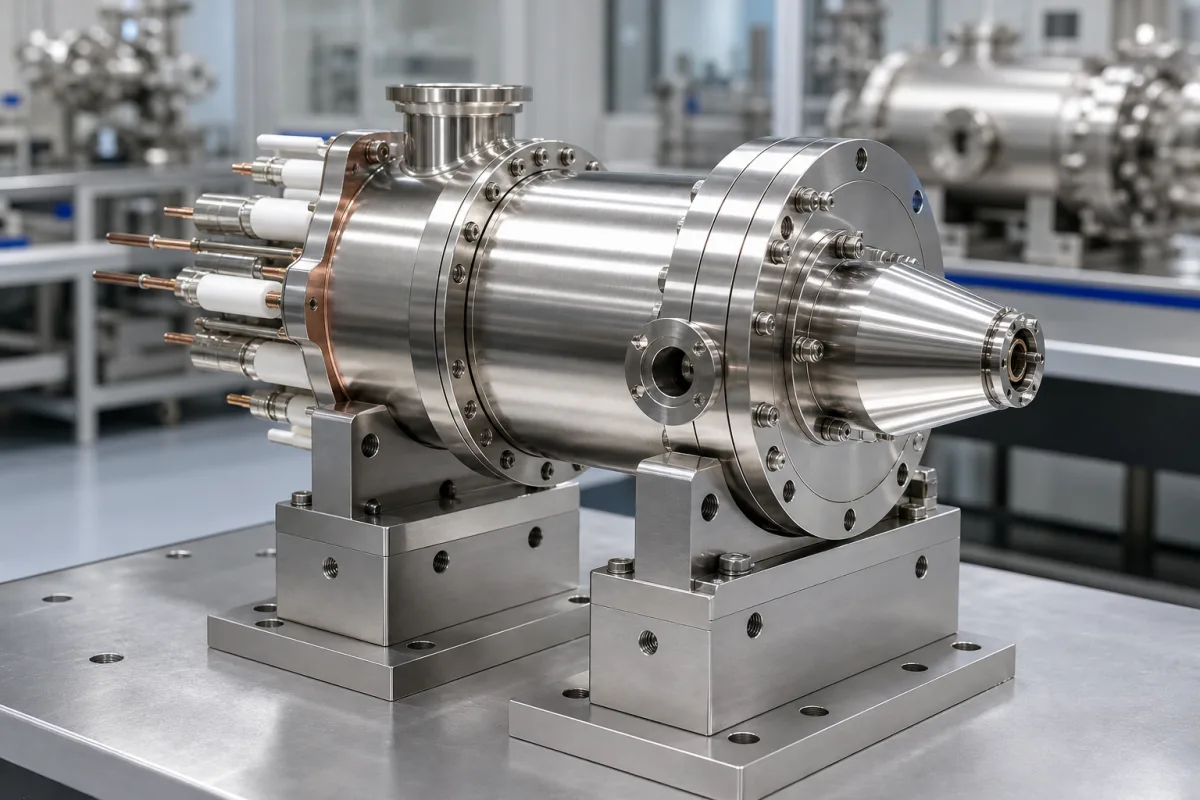
Electron gun for a medical linear accelerator: the diode or triode injector, its cathode, grid drive and grid-failure protection
The thermionic electron injector at the start of a radiotherapy linac's accelerating waveguide · diode or gridded triode guns, dispenser cathodes that need vacuum better than 5 × 10⁻⁷ Torr, grid pulses that set current and dose per pulse, and what happens if the grid connection fails
Every electron in a radiotherapy beam starts at the cathode of a small vacuum device bolted to the entrance of the accelerating waveguide. That electron gun decides how many electrons enter each RF pulse and with what initial energy, and so it sets beam current and, through it, dose per pulse. This page covers the gun alone: diode against triode construction, the cathode and the vacuum it needs, how a grid pulse controls current and dose, and the failure that makes grid monitoring a patient-safety matter.
Thermionic electron guns (injectors) for medical electron linear accelerators: diode and gridded triode guns, tungsten and dispenser cathodes, grid drive and bias, gun high voltage, vacuum conditions, and monitoring of the grid. The complete radiotherapy linac, with treatment head, multileaf collimator, imaging and couch, is covered on the Medical linear accelerator page; beam-shaping leaves in the treatment head on the Multi-leaf collimator page; X-ray tubes for imaging on the X-ray tubes and tube assemblies page. RF sources, accelerating waveguides and electron guns for industrial, cargo-scanning or research linacs appear only where their published data explain the medical gun.
CNFX editorial research · Sources checked October 12, 2026 · 4 sources
From a tungsten diode gun to a dispenser cathode-grid triode: the 6/15 MeV design at Świerk
For a 6/15 MeV multi-energy medical linac, the Andrzej Sołtan Institute for Nuclear Studies at Świerk reported that its earlier medical machines (Neptun, Limex, Coline) used a diode gun with a tungsten thermionic cathode, and that the new machine would use a triode gun built around a purchased spherical cathode-grid assembly with a dispenser cathode. [1]
The authors give the triode's advantages over the diode as independent regulation of gun current and energy, at much lower heater power and lower anode voltage, with gun dimensions reduced at least twice; the gun energy is adjusted for each output energy of the 29-cell, 2998.5 MHz standing-wave structure, and a bucking coil keeps the solenoid's field off the cathode. [1]
Daresbury Laboratory's injector for its synchrotron light source shows a research-linac version of the same idea: an 80 kV gun built on the oxide cathode-grid assembly of an Eimac 8755 planar triode (heater power 10 W, a tenth of the original gun's), with a 0 to −200 V grid bias supply and 500 MHz grid modulation that pre-bunches the beam; cathode re-activation starts only when the vacuum is better than 10⁻⁷ Torr and keeps it below 10⁻⁵ Torr while the heater voltage is raised. [2]
Editorial calculation: +60 V on the grid for 1 A against a 12 kV anode means the grid swing controlling the beam is 0.5% of the anode voltage (60 ÷ 12,000); at the stated 12% grid current, 1 A of cathode current puts 0.12 A into the grid.
Cathode-grid assembly, maker's nominal data (Świerk 2001)
Ask the gun supplier for cathode type and expected life, heater rating, anode voltage, grid cut-off and drive, maximum pulse width and duty cycle, and the vacuum the cathode needs before it is activated.
02
Grid pulses set the current and dose per pulse: −80 to +300 V on the grid, 50 ns to 5 µs long
A patent by ETM Electromatic on interleaved-energy linacs, written for cargo scanning, sets out how a triode gun's grid driver controls the beam. Grid voltage sets the amplitude of the current pulse launched into the linac; the duration of the grid pulse sets the duration of the current pulse and so the dose of each X-ray pulse. [3]
The patent describes a dual grid driver with two independently controlled modules so that alternate pulses can carry different currents and durations, with pulses of 2 to 2.5 µs at 100 to 400 pulses per second in its scanning application. [3]
Editorial calculation: shortening a grid pulse from 2.5 µs to 0.1 µs at the same current reduces the charge per pulse 25-fold; at 400 pulses per second and 2.5 µs, the beam is on 0.1% of the time. These are figures for a cargo-scanning linac; ask a medical-linac supplier for the corresponding grid voltage, pulse length and repetition range of its own gun driver.
ETM gun driver, preferred embodiment
Value
Grid pulse voltage, relative to cathode
−80 V to +300 V (grid top supply adjustable −100 V to +300 V) [3]
Cathode voltage, relative to ground
−5,000 V to −20,000 V; −20 kV in one embodiment [3]
Up to 200 mA, down to 1 mA or less for very low dose [3]
Bias supply
Holds the gun off between pulses so it emits no current into the linac [3]
03
If the grid connection opens: full electron flow and up to 300 times the dose per pulse
Elekta's patent application on electron sources for radiotherapy linacs identifies a failure of the conventional triode gun: if the connection to the grid fails open circuit, the grid floats to the potential of its equipotential line between cathode and anode, the gun is effectively uncontrolled and delivers full electron flow into the accelerating structure. [4]
Elekta states that, in electron therapy, this could give a massive dose even from a single pulse, with dose per pulse rising by a factor of 300. [4] Its answer is a controller that applies a potential to the grid and analyses the result, for example the current needed to charge the grid or the ripple current from an alternating test voltage, and suspends operation if the grid is found disconnected or dysfunctional before pulsing the gun. [4]
Editorial note: a diode gun has no grid to fail in this way but also no grid with which to set current independently of gun voltage; for a triode gun, ask the linac or gun supplier how grid integrity is checked, how often, and what interlock stops the beam.
Ask how the gun's grid connection is monitored, whether the check runs before every beam-on or continuously, and which interlock inhibits the gun and RF source when it fails.
04
What to send for a medical linac electron gun
Paste it into your enquiry below or into an email to a maker, then replace every bracket.
Linac: [energies; RF frequency; accelerating structure]
Gun type: [diode or triode; cathode type]
Electrical: [gun voltage; heater; grid cut-off, drive and bias]
Pulses: [width; repetition rate; duty cycle]
Beam: [peak current; emittance or spot size at injection]
Vacuum: [pressure for activation and operation]
Safety: [grid integrity check; interlocks]
Life: [expected cathode hours; replacement]
Explore company information and manufacturing capabilities, then discuss the scope of your project with a relevant supplier.
Share this page
Compiled and source-reviewed by the CNFX editorial team.
Each manufacturer above links to the page on that company's own website where the product is listed, with the date we checked it. How we source and review
· Page last updated 13 October 2026
Buyer questions
What is the difference between a diode and a triode electron gun in a linac?
A triode adds a grid between cathode and anode; the Świerk group notes it allows independent regulation of gun current and energy at lower heater power and anode voltage than a diode. [1]
What vacuum does a dispenser cathode gun need?
The Świerk 6/15 MeV design states better than 5 × 10⁻⁷ Torr for its dispenser cathode. [1]
How does the grid control dose per pulse?
In ETM's gun driver, grid voltage (−80 to +300 V relative to cathode) sets current amplitude and grid pulse duration (50 ns to 5 µs) sets pulse length and dose per pulse. [3]
Why must a triode gun's grid be monitored in radiotherapy?
Elekta notes that if the grid connection opens, the gun delivers full electron flow and dose per pulse could rise by a factor of 300. [4]
Sources and what still needs a direct check
Sources checked 2026-10-12. Cathode-grid data and the diode-to-triode change come from the Świerk paper at PAC 2001; the 80 kV gun and vacuum figures from Daresbury's LINAC 96 paper; grid drive voltages, pulse lengths and currents from an ETM Electromatic patent written for cargo-scanning linacs; the grid-failure hazard and its check from an Elekta patent application.