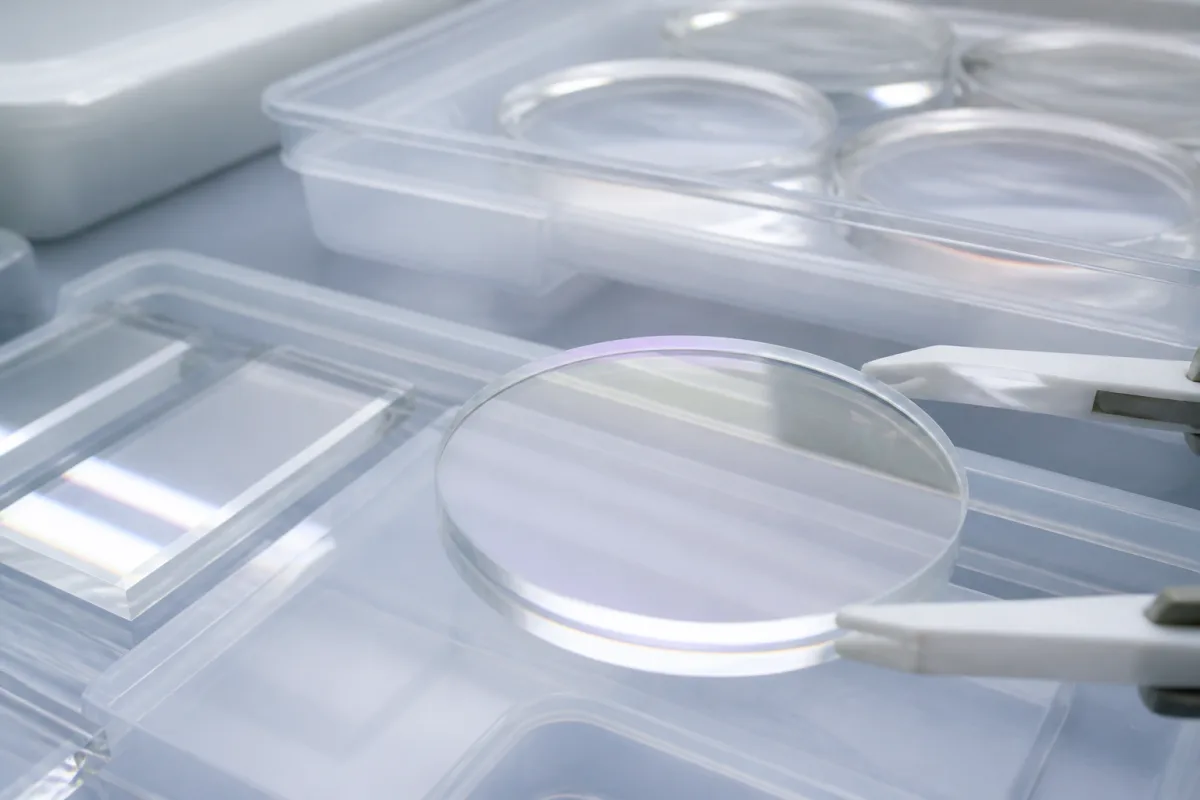
High-purity quartz crystal blank (cultured quartz for resonators)
Single-crystal quartz blanks: material evidence, orientation and finishing boundary
A resonator blank is an oriented piece of single-crystal quartz prepared for subsequent resonator manufacture. Identify the crystal-quality evidence and the blank’s cut, dimensions and finish separately from the electrodes, mounting and final frequency adjustment of a completed crystal unit.
Cultured (synthetic) single-crystal quartz for piezoelectric resonators — as-grown and lumbered bars, swept quartz and the oriented blanks and wafers cut from them. Packaged crystal units and oscillators, fused silica and quartz glass, and natural quartz for optics are outside this page; crystal oscillators have their own page.
CNFX editorial research · Sources checked October 18, 2026 · 4 sources
Distinguish material-quality evidence from resonator performance
Sawyer’s general material specification, issued February 1997, explicitly distinguishes inferred material Q from the electrical Q of a finished resonator. The material value is obtained through a correlation with infrared absorption; device geometry, electrodes and mounting also affect finished-resonator performance. A material-grade certificate is not a measured Q result for every completed device. [1]
In that dated specification, the grade table pairs infrared alpha 0.060 with material Q 1.8 × 10⁶, 0.045 with 2.2 × 10⁶, and 0.033 with 3.0 × 10⁶. It describes sampling a Y-cut slice from the largest crystal in an autoclave run and reporting the maximum alpha reading across the slice. Keep the grade, sampling and correlation method together. [1]
The current Sawyer electronics page separately lists high-Q/low-alpha and low-etch-channel material, as well as swept quartz. Confirm the currently offered grade and inspection agreement; the historic specification’s cited IEC edition is not evidence of a current standard or a certificate for another supplier’s lot. [3][1]
02
Specify the blank cut separately from the lumbered-bar reference
The dated Sawyer specification distinguishes seed-free and seed-centred lumbered bars. It gives ±15 arcminutes for the minus-X reference surface in both cases, while the Z-surface allowance is ±15 arcminutes for seed-free material and ±1° for seed-centred material. These are different reference-surface conditions, not a universal finished-blank cut-angle tolerance. [1]
Its ±0.13 mm X/Z dimensional tolerance and 0.1 mm minus-X reference-surface flatness concern lumbered stock. The final blank still needs its own dimension, thickness variation, surface and cut-orientation drawing. Do not transfer bar-stock machining limits to a polished resonator blank. [1]
Sawyer’s hydrothermal-growth brief explains growth on seed crystals from dissolved quartz in an autoclave. That process establishes cultured crystalline material; a transparent appearance alone cannot distinguish a piezoelectric single-crystal blank from fused silica or identify its cut. [2]
03
Have the resonator designer define mode, contour and finishing allowance
The historical quartz-resonator patent distinguishes AT- and BT-cut thickness-shear arrangements and discusses how contour and electrode placement affect vibration confinement. Its examples are design context, not a universal thickness or contour schedule for current blanks. [4]
The patent’s displayed frequency-constant wording uses “kHz per mm”, while its prose instructs division by frequency to obtain thickness. That printed unit wording is inconsistent with the length dimension required by the described operation. No thickness table is calculated from it here; confirm the intended constant and units with the source holder or resonator designer. [4]
Order the required mode, orientation, contour and material-removal allowance against the resonator design. Finishing, electrode deposition and mounting are later operations that influence the delivered device; a raw-blank thickness is not a final frequency guarantee. [4][1]
04
Identify whether the supplied product is growth stock or a processed blank
Sawyer lists as-grown/lumbered stock and special electronic quartz options. Timemaker’s own quartz-blank description discusses cutting, grinding and finishing blanks before electrodes and packaging produce a resonator. Establish which of those manufacturing stages is included in the order. [3]
Ask for the crystal source and lot evidence, the finished blank drawing, orientation inspection and surface measurements. An offer to process quartz blanks does not by itself establish that the same supplier grows the original crystal or supplies every material grade. [1]
05
Keep inclusions, etch channels and sweeping as distinct requirements
Sawyer’s specification treats inclusion size/count, etch-channel density, twinning/cracks and handedness separately. Its inclusion and etch-channel examinations use samples taken to represent a growth run. Those records should identify the sampling basis rather than imply destructive inspection of every delivered blank. [1]
Its electronics page lists low etch-channel density before sweeping and swept material for particular applications. Specify the ordered condition and inspection stage; neither the word swept nor a raw-material grade alone establishes the completed resonator’s radiation or frequency performance. [3][1]
06
Agree the material certificate and blank acceptance drawing
State cultured single-crystal material, required grade and sampling evidence, handedness, swept/unswept condition, cut orientation and tolerance, blank shape/contour, dimensions and finishing allowance. Require the applicable surface, edge and inspection requirements for the delivered manufacturing stage. [1][3]
Identify the resonator design and subsequent processing responsibility. Do not substitute generic purity wording, a bar-stock tolerance or an historical frequency example for the agreed certificate and blank drawing. [4][1]
07
Send the material, cut and dimension data together
Paste it into your enquiry below or into an email to a maker, then replace every bracket.
1 company lists this product among what they make. Company figures are quoted from each
company's own website; every card states where the relationship came from.
Chengdu Taimeikejingti Technology Co.,Ltd.
TBC
Official quartz-blank page describes cutting and finishing blanks for piezoelectric resonators before electrode deposition and packaging. Confirm crystal source, grade, cut and the delivered blank inspection evidence.
Explore company information and manufacturing capabilities, then discuss the scope of your project with a relevant supplier.
Share this page
Compiled and source-reviewed by the CNFX editorial team.
Each manufacturer above links to the page on that company's own website where the product is listed, with the date we checked it. How we source and review
· Page last updated 13 October 2026
Buyer questions
Does material Q equal the Q of the completed resonator?
No. Sawyer’s dated specification obtains material Q through an infrared correlation and separately identifies the influence of device considerations on finished-resonator Q. [1]
Does ±15 arcminutes specify every delivered blank?
The cited value concerns specified lumbered reference surfaces. The source distinguishes seed-free and seed-centred Z surfaces; a finished blank needs its own cut-angle tolerance. [1]
Can the historical patent’s printed constant be used as a thickness specification?
Its printed unit wording and the stated division operation need clarification. No calculated thickness schedule is supplied here; the resonator designer must confirm the intended constant, units and finishing requirements. [4]
Sources and evidence scope
Sources checked 2026-10-18. Sawyer’s dated material specification is separated from its current product offering and growth explanation. The historical resonator patent supplies design context; its ambiguous unit notation is not turned into a sizing table.