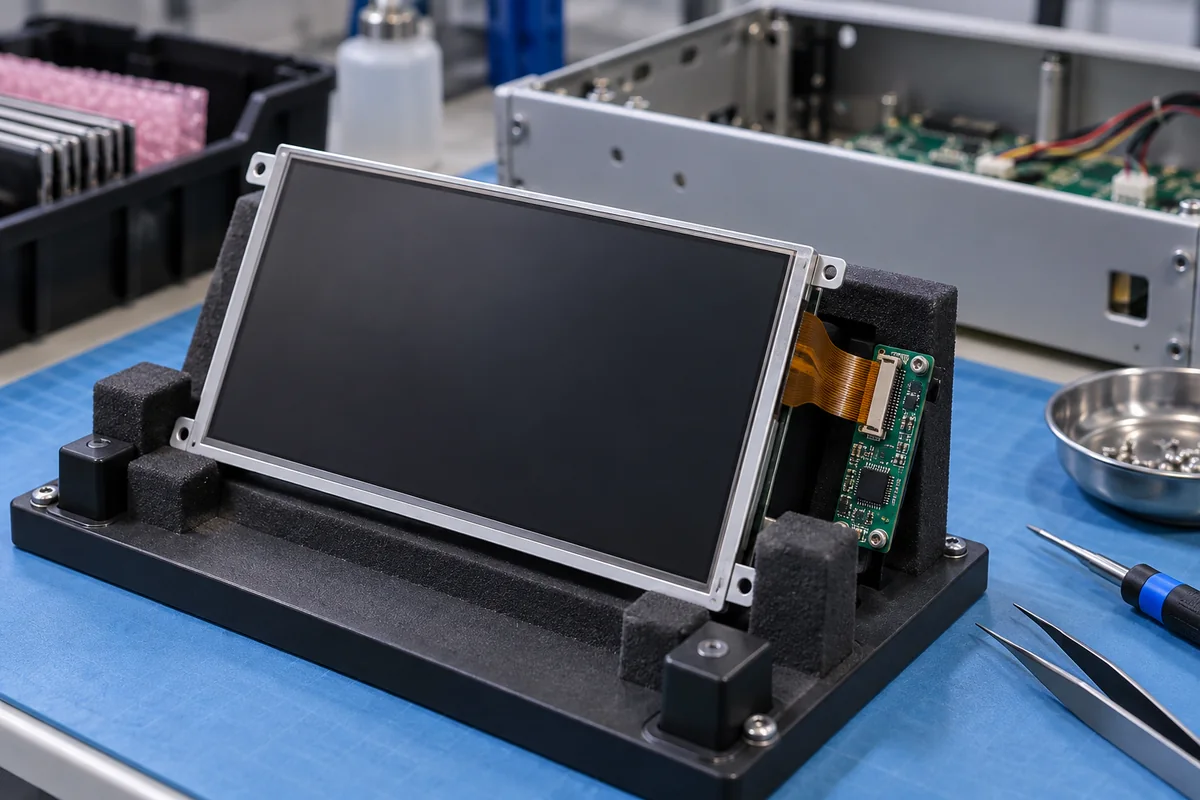
TFT and character LCD modules · Size, resolution and interface, luminance and viewing angles, backlight drive and life, temperature range and reliability tests
An LCD module is a liquid-crystal panel assembled with its backlight, driver ICs, flexible connector and, on some models, a touch panel, ready to connect to a host board. Settle three things before comparing modules: the size, resolution and electrical interface your board can drive, the luminance, viewing angles and backlight the viewing conditions need, and the temperature range and reliability tests the product must meet.
Colour TFT and monochrome character or graphic LCD modules with backlights, with or without touch panels, for embedded and industrial equipment. Complete HMI terminals and panel PCs, OLED and e-paper modules, and bare LCD glass are outside this page; HMIs and panel PCs have their own pages.
CNFX editorial research · Sources checked October 12, 2026 · 4 sources
Newhaven Display's datasheet for its NHD-4.3-480272EF-ASXN#-T describes a 4.3 in TFT module of 480 × RGB × 272 pixels with up to 16.7 million colours, a built-in driver without controller (ST7282T2), a 24-bit RGB interface on a 40-pin FPC and a 4-wire resistive touch panel. Its logic supply is 3.0–3.6 V, 3.3 V (typ.), at 10–50 mA, 25 mA (typ.). [1]
The 16-LED backlight draws 40 mA (typ.), 50 mA maximum, at 22.4–27.2 V, 25.6 V (typ.); the datasheet stresses that the LEDs are current-driven, the voltage is for reference only, and the drive must keep current below the maximum. [1] Backlight lifetime is 20,000 hours minimum and 50,000 hours (typ.) to half brightness at 40 mA and 25 °C. [1]
Editorial calculation: at the datasheet's typ. values the logic draws about 0.08 W (3.3 V × 25 mA) and the backlight about 1.02 W (25.6 V × 40 mA), so the backlight takes over 90% of the module's power. Dimming the backlight is the main lever for power and heat. [1]
Editorial note: a module 'without controller' needs the host to generate RGB timing (clock, sync and data enable); modules with a built-in controller or a serial 'smart' interface take that work off the host. State which one the board supports.
Give the supplier the active-area size and resolution, interface (RGB, LVDS, MIPI DSI, SPI, MCU parallel, UART), controller required or not, supply voltage, backlight luminance and drive, touch type (none, resistive, capacitive), viewing direction or IPS, operating and storage temperatures, reliability tests, FPC length and pin-out, and annual quantity.
02
Check luminance, viewing angles, temperature and reliability
The same datasheet gives luminance of 620 cd/m² minimum and 780 cd/m² (typ.) at 40 mA, contrast 400 minimum and 500 (typ.), response time (rise plus fall) of 20 ms (typ.) and 30 ms maximum, and viewing angles at contrast ≥10 of 55° top and 75° bottom, left and right, with a 6 o'clock viewing direction, transmissive normally-white anti-glare TN mode and a brightness-enhancement film. [1] Operating temperature is −20 to +70 °C and storage −30 to +80 °C. [1]
Its listed reliability tests are 96 hours each at +80 °C and −30 °C storage, +70 °C and −20 °C operation, and +50 °C at 90% RH; 20 thermal-shock cycles of 60 minutes at −20 °C and 60 minutes at +70 °C; vibration at 10–50 Hz and 5 G for 30 minutes; and ESD of ±4 kV air and ±2 kV contact. [1]
Linked suppliers list TFT modules from 3.2 to 10.1 in, including IPS versions with wide viewing angles, and character LCD modules for industrial HMIs. [2][3]
Editorial note: the uneven 55°/75° angles in this datasheet go with its TN panel and 6 o'clock viewing direction; if the display will be read from above or from the sides, specify IPS or confirm the angles in each direction.
03
Compare a sunlight-readable IPS module of the same size and resolution
Crystalfontz's product page for the CFAF480272H0-043SN lists a 4.3 in, 480 × 272 TFT module with an IPS transmissive panel, a 160° viewing angle that it says allows mounting above, at or below eye level without colour inversion, and a 1,000 cd/m² (nits) white LED backlight it describes as sunlight readable. It has a built-in Sitronix ST7282 controller with a DOT-CLK / generic RGB interface on a 40-pin ZIF connector; logic supply is 3.0–3.6 V, 3.3 V (typ.), and the backlight takes 40 mA at a forward voltage of 16.2–21 V. [4] Operating temperature is −20 to +70 °C and storage −30 to +80 °C. The module measures 105.50 × 64.15 × 2.90 mm and weighs 41.2 g, with an active area of 95.04 × 53.86 mm; capacitive and resistive touch versions are offered. [4]
Editorial calculation: at 40 mA the backlight draws about 0.65–0.84 W, below the roughly 1.0 W worked out above for the TN module at 25.6 V, while giving about 28% more luminance (1,000 against 780 cd/m²). The active area's diagonal, √(95.04² + 53.86²) ≈ 109 mm, confirms the 4.3 in class. If the display will be read from above or the side, an IPS panel like this avoids the uneven 55°/75° angles of the TN example; ask for the backlight driver requirement and lifetime at your current. [4][1]
The listings reviewed range from character and small TFT modules to industrial touchscreen displays, smart UART display modules and ESP32-based display boards; ask each for the full datasheet with electrical, optical and reliability tables.
05
Panel, driver IC, backlight, FPC, touch layer and films
The backlight row ties luminance to power: in the Newhaven calculation above it takes over 90% of the module's power. [1]
Size, brightness, viewing angles, rails and temperature
The 1,000 cd/m² figure in the brightness row belongs to a sunlight-readable IPS module; the 620 and 780 cd/m² figures are for a TN panel of the same size. [4][1]
TFT, character and ESP32 display modules from linked makers
Shenzhen Able Technology Co., Ltd. lists TFT modules from 3.2 to 10.1 in, including IPS versions; HOTHMI lists custom TFT and character LCD modules; Beijing DWIN Technology Co., Ltd. lists TFT displays, HMI touch screens and video LCD modules; Friendly Elec lists LCD modules for its own embedded boards; Shenzhen Jingcai Intelligent Co., Ltd. lists ESP32-P4 display modules, including a 10.1 in module.
Shenzhen Able Technology Co., Ltd.
Manufacturing site to be confirmed for the order
Lists TFT LCD modules from 3.2 to 10.1 in, including IPS versions, and touch screens.
Explore company information and manufacturing capabilities, then discuss the scope of your project with a relevant supplier.
Share this page
Compiled and source-reviewed by the CNFX editorial team.
Each manufacturer above links to the page on that company's own website where the product is listed, with the date we checked it. How we source and review
· Page last updated 13 October 2026
Buyer questions
How long does an LCD module backlight last?
Newhaven rates one 4.3 in module at 50,000 hours (typ.), 20,000 minimum, to half brightness at 40 mA and 25 °C. [1]
What temperature range do TFT modules work in?
Newhaven's 4.3 in module lists −20 to +70 °C operating and −30 to +80 °C storage. [1]
Why are TFT viewing angles different from the top?
Newhaven's TN module lists 55° top but 75° bottom, left and right at contrast ≥10. [1]
What reliability tests apply to LCD modules?
Newhaven lists 96 h high and low temperature, humidity, thermal shock, vibration and ESD tests. [1]
What brightness makes a small TFT module sunlight readable?
One 4.3 in IPS module described as sunlight readable lists a 1,000 cd/m² backlight and a 160° viewing angle, against 780 cd/m² (typ.) for a standard TN module of the same size. [4][1]
Sources and what still needs a direct check
Sources checked 2026-10-12. Newhaven Display is an LCD module maker publishing a full datasheet with electrical, optical and reliability data; Able and HOTHMI are linked suppliers.