Editorial Technical Reference

LED Light Module

This page explains how LED Light Module is classified within Computer, Electronic and Optical Product Manufacturing. Technical values and manufacturer relationships are research references; confirm the current specification and supplier evidence for each order.

Technical Definition & Core Assembly

Integrated light-emitting component containing LED chips, driver circuitry, and optical elements
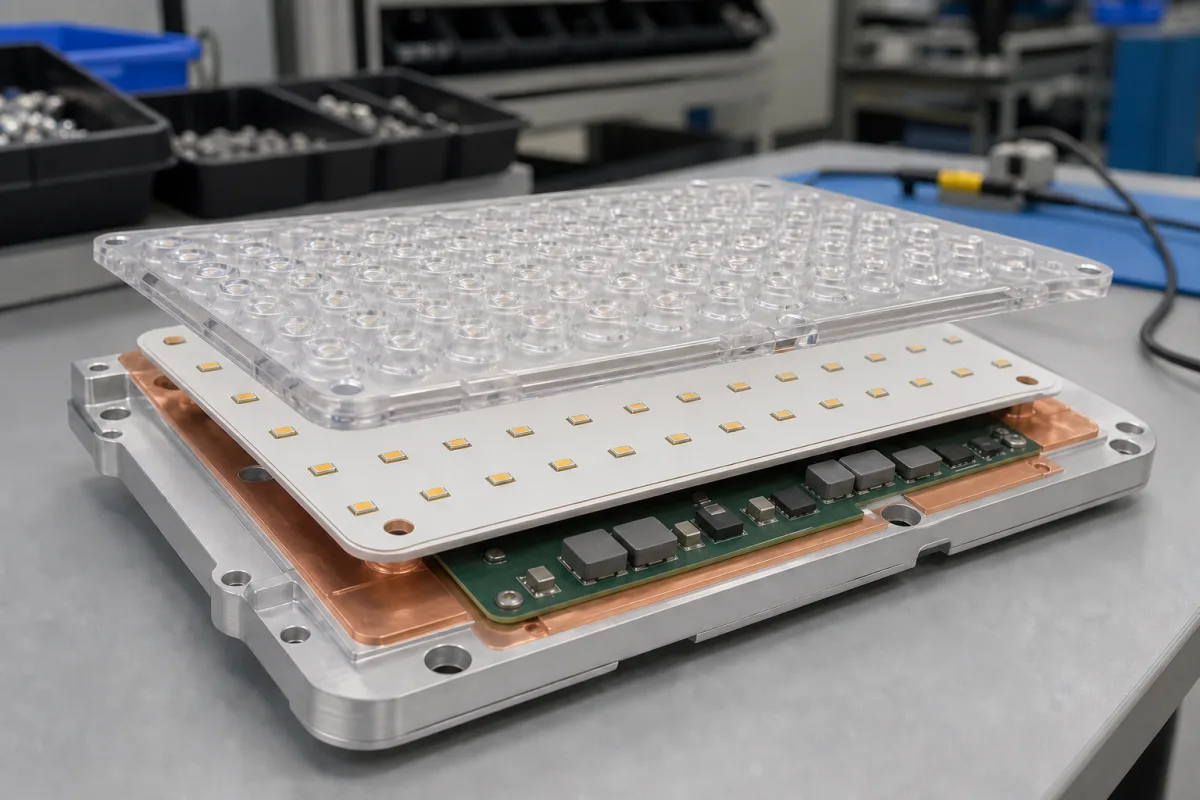
LED Light Module in a manufacturing environment
Representative product image. Confirm appearance and specifications with the manufacturer.

Product Specifications

Technical details and manufacturing context for LED Light Module

Definition
The LED Light Module is a self-contained illumination unit designed specifically for integration into Smart LED Desk Lamps. It provides controlled light output with adjustable brightness and color temperature capabilities. The module converts electrical energy into visible light through semiconductor electroluminescence in LED chips, with integrated driver circuitry regulating current and voltage for stable operation. Key materials include LED chips, PCB substrate, thermal interface material, and optical diffuser. The module is characterized by several parameters: luminous flux ranges from 100 to 200 lm/W (IES LM-79), color temperature from 2700 to 6500 K (ANSI C78.377), color rendering index from 80 to 95 Ra (CIE 13.3), input voltage from 100 to 277 V AC (IEC 62386), power consumption from 10 to 50 W (IEC 62301), operating temperature from -40 to 85 °C (IEC 60068-2-1), ingress protection from IP54 to IP67 (IEC 60529), beam angle from 15 to 120 degrees (IES LM-79), lifetime from 50000 to 100000 hours (IES LM-80), dimensions from 50×50 to 300×300 mm, weight from 50 to 500 g, and thermal resistance from 0.5 to 2.0 K/W (IEC 61788-6). These values are reference ranges for directory purposes; actual model-specific values must be confirmed with the legal manufacturer or supplier. The module is intended for use in desk lamps, and its performance should be verified against the listed standards for procurement. The module's design allows for integration into various lamp housings, with considerations for thermal management and optical performance. The module does not include the lamp housing, power cord, or control interface; these are part of the final product. The module's driver circuitry is designed to operate with standard AC mains voltage, but the actual input range should be verified for the specific model. The module's optical diffuser ensures uniform light distribution, but the beam angle can be customized for different applications. The module's lifetime is based on L70 lumen maintenance, meaning the light output will decline to 70% of initial after the specified hours. The module's thermal resistance is critical for heat dissipation; proper heat sinking is required to maintain performance and longevity. The module's ingress protection rating indicates its resistance to dust and water, but the actual rating depends on the enclosure design. The module's dimensions and weight are typical for the specified power range, but custom sizes are available. The module's color temperature and CRI are selectable for different lighting ambiances, and high CRI ensures accurate color rendering. The module's power consumption depends on the size and brightness, and the input voltage range is universal for global use. The module's operating temperature range is extended for outdoor applications, but the actual range should be confirmed. The module's standards are procurement references, not proof of certification. Always verify model-specific values and standards with the legal manufacturer or supplier.
Working Principle
The LED Light Module operates on the principle of electroluminescence, where electrical energy is converted into visible light within semiconductor LED chips. When a forward voltage is applied, electrons recombine with holes in the semiconductor material, releasing energy as photons. The integrated driver circuitry regulates the current and voltage supplied to the LED chips, ensuring stable operation and preventing damage from voltage fluctuations. The driver also enables dimming and color temperature adjustment by modulating the current or using pulse-width modulation. The optical diffuser spreads the emitted light to achieve a desired beam angle and uniformity. Thermal management is handled through the PCB substrate and thermal interface material, which conduct heat away from the chips to a heat sink. The module's design ensures efficient light output with high luminous efficacy, as indicated by the luminous flux range. The working principle is consistent across the specified parameters, but actual performance depends on the specific model and operating conditions.
Common Materials
LED chips, PCB substrate, thermal interface material, optical diffuser
Technical Parameters
ParameterTypical rangeNotes & selection driver
Luminous Flux100–200 lm/WHigher values indicate better efficacyIES LM-79
Color Temperature2700–6500 KSelectable for different lighting ambiancesANSI C78.377
Color Rendering Index80–95 RaHigh CRI for accurate color renderingCIE 13.3
Input Voltage100–277 V ACUniversal voltage range for global useIEC 62386
Power Consumption10–50 WDepends on module size and brightnessIEC 62301
Operating Temperature-40–85 °CExtended range for outdoor applicationsIEC 60068-2-1
Ingress ProtectionIP54–IP67Higher IP for dust/water resistanceIEC 60529
Beam Angle15–120 °Narrow for spot, wide for floodIES LM-79
Lifetime50000–100000 hL70 lumen maintenanceIES LM-80
Dimensions50×50–300×300 mmCustom sizes available
Weight50–500 gDepends on size and heat sink
Thermal Resistance0.5–2.0 K/WLower is better for heat dissipationIEC 61788-6

Ranges are indicative industry figures for RFQ preparation, not a supplier commitment. Confirm every value and standard with the legal manufacturer before ordering.

Components / BOM
  • LED Array
    Primary light emission through multiple LED chips arranged in specific pattern
    Material: semiconductor (GaN/InGaN)
  • Driver Circuit Board
    Regulates power supply and controls current to LED chips
    Material: FR-4 PCB with copper traces
  • Thermal Management Plate Part
    Dissipates heat generated by LED operation to prevent overheating
    Material: aluminum alloy
  • Optical Diffuser Part
    Evenly distributes and softens light output from LED chips
    Material: polycarbonate or PMMA

Applied To / Applications

This component is essential for the following industrial systems and equipment:

Industrial Ecosystem & Supply Chain Structure

Complementary Systems
Downstream Applications
Specialized Tooling

Application Fit & Sizing Matrix

Operational Limits
pressure: Atmospheric (non-pressurized enclosure)
other spec: Humidity: 5-95% RH non-condensing, IP rating: IP65/IP67 typical, Input voltage: 12-48V DC typical
temperature: -40°C to +85°C (operating), -40°C to +105°C (storage)
Media Compatibility
✓ Indoor ambient air ✓ Clean dry environments ✓ General industrial atmospheres
Unsuitable: High-pressure washdown or submerged conditions without proper IP68/IP69K rating
Sizing Data Required
  • Required luminous flux (lumens)
  • Beam angle and optical distribution pattern
  • Input voltage and power supply compatibility

Reliability & Engineering Risk Analysis

Failure Mode & Root Cause
Thermal degradation of LED chips
Cause: Inadequate heat dissipation due to poor thermal management design, dust accumulation on heatsinks, or operation in high ambient temperatures exceeding specifications
Electrolytic capacitor failure in driver circuit
Cause: High operating temperatures, voltage spikes, or poor-quality capacitors leading to electrolyte drying, increased ESR, and eventual open/short circuit
Maintenance Indicators
  • Flickering or intermittent operation (indicating driver circuit instability or failing components)
  • Visible dark spots or color shifts in the light output (signaling individual LED chip failures or phosphor degradation)
Engineering Tips
  • Ensure proper thermal management by maintaining clean heatsinks/fins, verifying adequate ventilation, and avoiding installation in enclosed fixtures without thermal derating
  • Use surge protection devices and ensure stable input voltage within manufacturer's specifications to prevent electrical stress on driver components

Indicative industry ranges for design and RFQ preparation. Confirm the exact figures and applicable standard with the manufacturer before specifying.

Compliance & Manufacturing Standards

Applicable Standards
ANSI C78.377-2017 (Specifications for the Chromaticity of Solid State Lighting Products) CE Marking (EU Compliance for Safety, Health, and Environmental Protection)

Quoted from the published standard.

Manufacturing Precision
  • LED Chip Alignment: +/-0.05mm
  • Thermal Interface Flatness: 0.15mm
Quality Inspection
  • Luminous Flux and Color Consistency Test
  • Thermal Cycling and Humidity Test

Manufacturers of LED Light Module

1 company lists this product among what they make. Company figures are quoted from each company's own website; every card states where the relationship came from.

Shenzhen Sunshine Opto-Electronics Technology Ltd.
Shenzhen, Guangdong, CN
Listed on the company's own website · profile compiled by CNFX from public sources
Listed there as: “smd 3030 led light module”
View source page ↗ sunshineopto.com · checked 2026-09-07

Manufacturer listings support early research and capability understanding. They are not certification, ranking, or transaction guarantees.

Share this page
Technical documentation
Request current drawings, revision history, and a signed specification sheet.
Manufacturing capability
Verify equipment lists, process limits, capacity, and representative production evidence.
Inspection readiness
Confirm test methods, calibrated equipment, sampling plans, and traceable reports.
Supplier transparency
Check the legal entity, factory address, ownership, certifications, and direct contacts.

CNFX does not score or rank suppliers. Buyers must verify all claims and documents with the legal manufacturer before ordering.

Supply Chain Compatible Machinery & Devices

Modular Industrial Edge Computing Device

This modular industrial edge computing device is a ruggedized system designed for deployment in harsh industrial environments to perform real-time data processing, analytics, and control functions at the network edge.

Explore Specs →
Industrial Smart Camera Module

The Industrial Smart Camera Module is a compact, self-contained vision processing unit designed for integration into industrial machinery and production lines.

Explore Specs →
Surface Mount Resistor

Passive electronic component for current limiting and voltage division in circuits

Explore Specs →
Surface Mount Capacitor

A surface mount capacitor is a fundamental electronic component used for energy storage, filtering, coupling, and decoupling in electronic circuits.

Explore Specs →

Frequently Asked Questions

What is the typical luminous flux range of the LED Light Module?

The reference range for luminous flux is 100 to 200 lm/W, measured according to IES LM-79. This indicates the light output efficiency. Actual values depend on the specific model and should be confirmed with the manufacturer.

Can the color temperature be adjusted?

Yes, the module supports color temperatures from 2700 K to 6500 K, per ANSI C78.377. This allows for different lighting ambiances, from warm to cool white. The adjustment method may vary by model.

What is the input voltage range?

The module accepts an input voltage of 100 to 277 V AC, per IEC 62386. This universal range is designed for global use, but always verify the specific model's voltage requirements.

What standards are relevant for verifying the module's performance?

Key standards include IES LM-79 for luminous flux, ANSI C78.377 for color temperature, CIE 13.3 for CRI, IEC 62386 for input voltage, and IEC 60529 for ingress protection. These are procurement references; actual compliance must be confirmed with the supplier.

Data Basis

Editorial classification, named public sources where available, and source-reviewed manufacturer records.

Preliminary Technical Classification
This page supports structured research, RFQ preparation, and supplier evaluation. It does not replace buyer-led supplier qualification, standards review, or technical approval.
Buyer enquiry

Request manufacturing insight for LED Light Module

Ask for use case, specification boundaries, supplier type, and RFQ preparation information for this product.

Where it goes
Straight to the CNFX editorial desk, and to the manufacturer if this product is linked to a claimed profile. Nothing is broadcast to a supplier list.
Your details stay here
We do not sell or rent enquiry data, and we do not add you to a mailing list. Used only to answer this request.
No commission, no middleman
CNFX is a directory. We take no cut of any order and never negotiate on a supplier's behalf.
What we don't claim
A listing is not an endorsement. Qualify every supplier and verify every figure yourself before ordering.

Your business information is used only to process this request.

Thank you! Your message has been sent. We'll respond within 1–3 business days.
Sorry, we couldn't send your message. Please try again, or email us at [email protected].

Need to Manufacture LED Light Module?

Compare manufacturer profiles with relevant product and process capability.

Previous Product
XY Positioning Stage
Last Product
Get QuotesChat