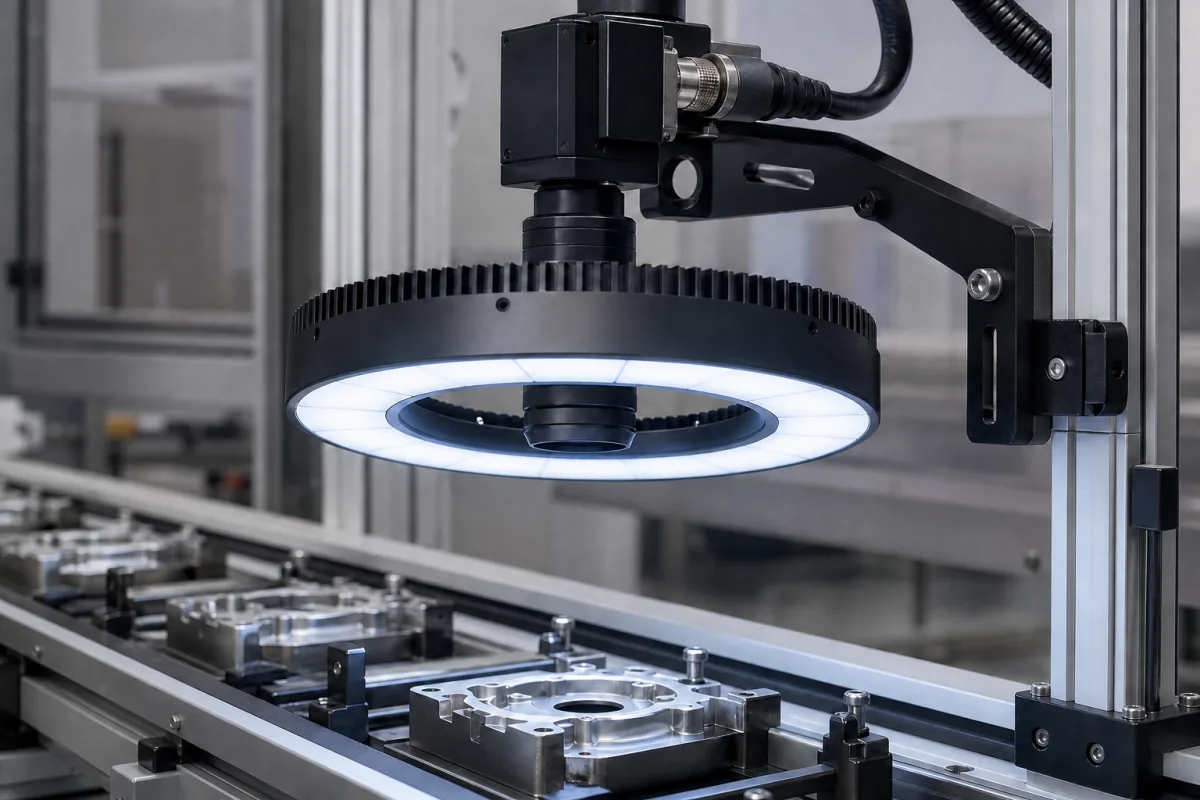
On this page the lighting module is the LED ring that mounts around a vision camera's lens and lights the part from all sides at once, as in the illustration over machined aluminium housings. This page reads three datasheet entries together, the working-distance range, the outer and inner diameter, and the illuminance at a stated distance, to find the angle of the light on the part, whether the ring fits the lens, and how much light is left at the working distance.
Covers LED ring lights for machine vision cameras: ring diameter and working distance against light angle, low-angle and dark-field ring accessories, illuminance against distance and strobe overdrive, sector control, inner diameter and lens mounting. The general LED lighting module of the original definition (LED array, heat sink, lumens and colour temperature for luminaires) is covered on LED Light Module (3643). Machine vision lighting as a whole, including dome, coaxial and backlight, is on Illumination Unit (8964); bright-field, dark-field and overdrive theory on LED Lighting System (620); tiered RGB rings for solder-joint AOI on LED Illumination System (614); vision boxes that drive the lights on Image Processing Unit (588); bar and linear lights on LED Illumination Array (638).
CNFX editorial research · Sources checked October 13, 2026 · 3 sources
Ring radius and working distance fix the light angle: 49° at 38 mm, 7° at 500 mm
A ring's LEDs sit at a radius around the lens axis, so the angle at which their light reaches the centre of the part follows from the ring radius and the working distance (WD). Datasheets give the diameters and the WD range; the angle is left to the user.
The angle is arctan(outer radius ÷ WD), taken at the outer edge as an upper bound because the datasheets do not give the radius of the LED circle (Editorial calculation).
Where a lower angle is needed than distance alone gives, Wenglor fits accessories to its LMRX ring: the ZMRG low-angle accessory (LMLX) gives a 45° angle of incidence and, in Wenglor's description, picks out edges, indents, protrusions and scratches on shiny parts and makes dot-peen codes readable; the dark-field attachment (LMFX) gives 60° and suits glossy and dark surfaces. The bare LMRX ring is described as highly diffuse, for matte surfaces and fast-moving objects.
Ring
Outer / inner diameter
Working distance stated
Angle from lens axis at the outer edge (Editorial calculation)
Schott CV 66 mm bright-field ring
90 / 66 mm
38–152 mm
49.8° at 38 mm; 16.5° at 152 mm
StarLight RL-10s R (625 nm)
130 / 66 mm
150–500 mm, optimum about 260 mm
23.4° at 150 mm; 14.0° at 260 mm; 7.4° at 500 mm
Wenglor LMRX10x / LMRX20x
inside 80 / 130 mm
minimum 60 / 50 mm; field of view stated from 100 mm
—
Wenglor states 45° and 60° as angles of incidence without naming the reference plane; confirm with the maker before comparing them with the editorial angles from the lens axis above.
02
Illuminance against distance: 20,160 lux at 100 mm falls to 3,330 lux at 300 mm
Wenglor publishes illuminance for its LMRX rings in ring configuration, white light, continuous mode, at four distances.
Doubling the distance from 100 to 200 mm cuts the LMRX10x illuminance by 2.8 times, and tripling it by 6.1 times, less than the 4 and 9 times a point source would lose (Editorial calculation). The larger LMRX20x starts lower at 100 mm but is brighter from 200 mm onward, so on Wenglor's figures the bigger ring is the brighter choice once the camera stands 200 mm or more away.
Wenglor's strobe overdrive gives 4 times (LMRX10x) and 3.8 times (LMRX20x) these figures; overdrive pulse and duty-cycle limits are covered on LED Lighting System (620). Through the standard 5-pin M12 connector the ring takes 24 V DC, switches between continuous and strobe and dims from 100% to 30%; the 8-pin option adds overdrive, colour and sector control. The ring's LEDs are split into four sectors that can be lit as four, as two (acting like two parallel bar lights) or one at a time by remote control.
Working distance
LMRX10x field of view
LMRX10x illuminance
LMRX20x field of view
LMRX20x illuminance
100 mm
150 × 100 mm
20,160 lux
200 × 150 mm
16,680 lux
200 mm
200 × 150 mm
7,180 lux
200 × 150 mm
9,470 lux
300 mm
250 × 200 mm
3,330 lux
200 × 200 mm
4,970 lux
500 mm
—
—
400 × 300 mm
1,990 lux
Wenglor's figures are for white light in ring configuration; red, infrared or cyan versions and accessory-fitted rings will measure differently.
03
Inner diameter and mounting: a 66 mm bore, M67 × 0.75 thread and reducing rings
The ring hangs on the lens, so the bore has to clear the lens body and must not cut into the field of view.
At about 750 g, the StarLight ring hangs on the lens through its M67 thread unless it is mounted on its own bracket; on a camera arm like the one illustrated, ask whether the maker offers a bracket mount.
12 power LEDs, red 625 nm, rated life 50,000 h (maker's figure)
bright-field ring
Power
Control unit 100–240 V AC in, 24 V DC 1 A out; about 15 W
—
Accessories
Diffuser and protection glasses, polarisation filter sets, cable extensions
—
Weight, thread and accessories are StarLight's figures for this ring.
04
What to give a ring-light supplier
Paste it into your enquiry below or into an email to a maker, then replace every bracket.
Give the lens outer diameter or filter thread, the working distance range and field of view, the part surface (matte, machined, glossy, dark), the colour or wavelength, continuous or strobe operation and the camera exposure time, the supply voltage and the control connector you need. Ask for the illuminance at your working distance, the outer and inner diameter, the angle of incidence of any low-angle or dark-field accessory and its reference, sector control, and weight.
Explore company information and manufacturing capabilities, then discuss the scope of your project with a relevant supplier.
Share this page
Compiled and source-reviewed by the CNFX editorial team.
Each manufacturer above links to the page on that company's own website where the product is listed, with the date we checked it. How we source and review
· Page last updated 13 October 2026
Buyer questions
How do I find the angle a ring light reaches the part at?
Take arctan of the ring's outer radius over the working distance as an upper bound. A Schott ring of 90 mm outer diameter gives 49.8° at 38 mm and 16.5° at 152 mm, the ends of its stated range (Editorial calculation). [3]
How much light does a ring give at 300 mm?
Wenglor lists 3,330 lux for its LMRX10x and 4,970 lux for the larger LMRX20x at 300 mm, white light in continuous mode; strobe overdrive raises this four times for the LMRX10x. [1]
What ring light suits shiny machined parts?
Wenglor describes its 45° low-angle LMLX as suited for edges, indents and scratches on shiny parts and for dot-peen codes, and the 60° dark-field LMFX as suited to glossy and dark surfaces. [1]
Will a ring fit my lens?
Check the inner or clamping diameter against the lens. StarLight's RL-10s R clamps up to 66 mm with an M67 × 0.75 thread and reducing rings for smaller lenses. [2]
Sources and what still needs a direct check
Sources checked 2026-10-13. One maker's product-family page with measured illuminance, one maker's ring-light datasheet and one distributor listing of a ring light's dimensions and working distance.