Industry-Verified Manufacturing Data (2026)

Touchscreen Display

Based on aggregated insights from multiple verified factory profiles within the CNFX directory, the standard Touchscreen Display used in the Computer, Electronic and Optical Product Manufacturing sector typically supports operational capacities ranging from standard industrial configurations to heavy-duty production requirements.

Technical Definition & Core Assembly

A canonical Touchscreen Display is characterized by the integration of Display Panel and Touch Sensor. In industrial production environments, manufacturers listed on CNFX commonly emphasize Glass substrate construction to support stable, high-cycle operation across diverse manufacturing scenarios.

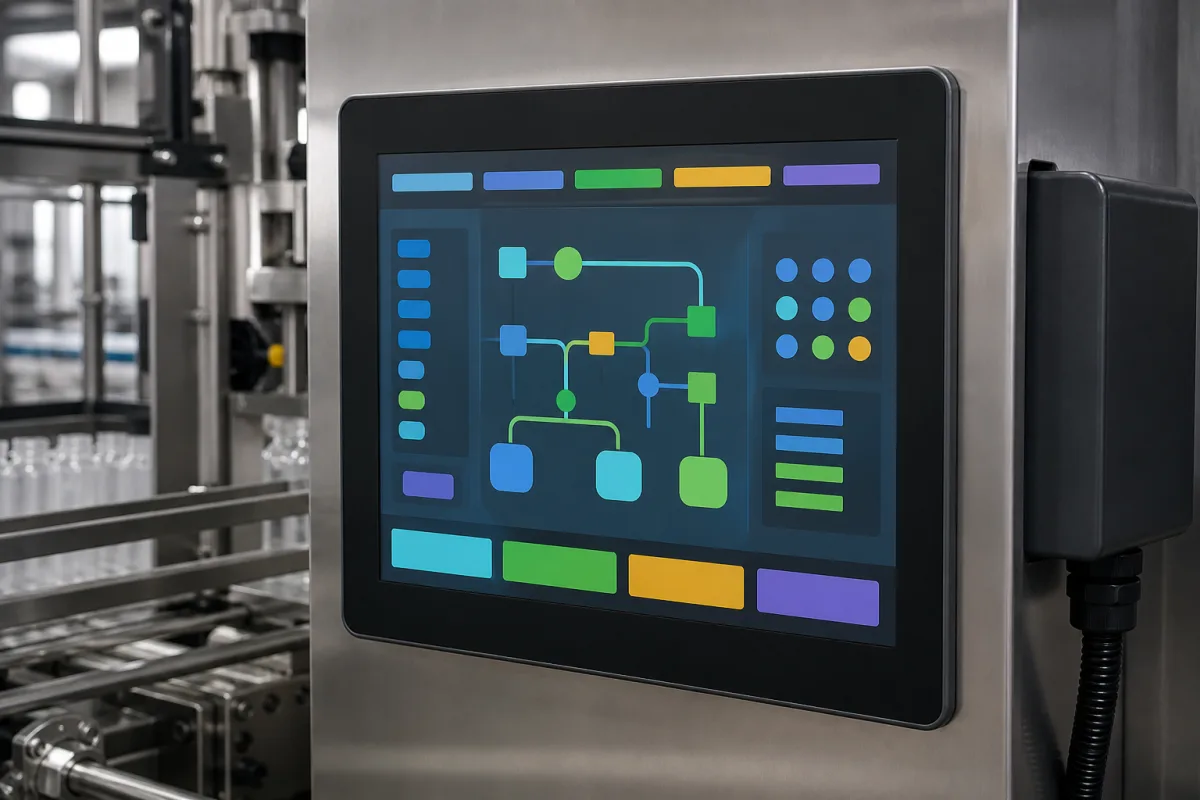
A visual interface component that combines display and touch input capabilities for human-machine interaction.
Product Specifications

Technical details and manufacturing context for Touchscreen Display

Definition
The touchscreen display is the primary user interface component within a Touchscreen HMI system, providing both visual feedback and touch-sensitive input capabilities. It serves as the interactive surface where operators view process data, receive alerts, and input commands through direct touch gestures, eliminating the need for separate input devices like keyboards or mice in industrial control environments.
Working Principle
The touchscreen display integrates a display panel (typically LCD or OLED) with a touch sensor overlay. When an operator touches the screen, the sensor detects the contact location through capacitive, resistive, or other sensing technologies. This positional data is processed by the HMI controller and translated into commands that interact with the displayed interface elements, while the display panel simultaneously renders visual feedback and system information.
Common Materials
Glass substrate, ITO (Indium Tin Oxide) coating, Liquid crystal or OLED materials, Polymer protective layer
Technical Parameters
  • Diagonal screen size measurement (inch) Standard Spec
Components / BOM
  • Display Panel
    Provides visual output by rendering images, text, and interface elements
    Material: Glass, liquid crystal/OLED materials, polarizers
  • Touch Sensor
    Detects and locates touch input on the screen surface
    Material: ITO-coated glass or film, conductive polymers
  • Controller IC
    Processes touch signals and communicates with the HMI system
    Material: Semiconductor silicon
  • Protective Cover
    Shields the display and touch layers from physical damage and environmental factors
    Material: Tempered glass or polycarbonate
Engineering Reasoning
0-85°C ambient temperature, 0-95% relative humidity (non-condensing), 0.5-2.0 m viewing distance
Glass transition temperature of 120°C for polycarbonate substrates, 150°C for indium tin oxide layer degradation, 10,000 N/m² compressive stress on touch sensor
Design Rationale: Thermal expansion coefficient mismatch (Δα=8×10⁻⁶/°C) between glass and ITO layers causing microcracking, piezoelectric effect in capacitive sensors exceeding 5 V/μm breakdown voltage
Risk Mitigation (FMEA)
Trigger Electrostatic discharge exceeding 15 kV at 1.5 ns rise time
Mode: Dielectric breakdown in capacitive touch sensor grid
Strategy: Integrated ESD protection diodes with 0.7 V forward voltage and 5 pF capacitance per node
Trigger Ultraviolet radiation exposure at 365 nm wavelength exceeding 100 W/m² for 1000 hours
Mode: Photodegradation of optical bonding adhesive (refractive index shift from 1.48 to 1.52)
Strategy: UV-blocking hard coat with 99% absorption at 200-400 nm spectrum

Industry Taxonomies & Aliases

Commonly used trade names and technical identifiers for Touchscreen Display.

Applied To / Applications

This component is essential for the following industrial systems and equipment:

Industrial Ecosystem & Supply Chain DNA

Complementary Systems
Downstream Applications
Specialized Tooling

Application Fit & Sizing Matrix

Operational Limits
pressure: Atmospheric (non-pressurized)
other spec: IP65/IP67 ingress protection, 100,000+ touch cycles, 500-1500 cd/m² brightness
temperature: -20°C to +70°C (operating), -40°C to +85°C (storage)
Media Compatibility
✓ Indoor control panels ✓ Cleanroom environments ✓ Dry industrial settings
Unsuitable: High-pressure washdown or submerged conditions
Sizing Data Required
  • Display resolution (e.g., 1920x1080)
  • Screen diagonal size (inches)
  • Required communication interface (e.g., HDMI, USB, Ethernet)

Reliability & Engineering Risk Analysis

Failure Mode & Root Cause
Touchscreen Delamination
Cause: Thermal cycling and UV exposure degrading adhesive layers, leading to separation between touch sensor and display layers
Digitizer Circuit Failure
Cause: Electrostatic discharge (ESD) events or moisture ingress damaging capacitive sensing circuits and controller ICs
Maintenance Indicators
  • Ghost touches or unresponsive areas indicating digitizer degradation
  • Visible air gaps, bubbles, or discoloration at screen edges signaling delamination onset
Engineering Tips
  • Implement anti-static protocols during installation/cleaning and use UV-protective screen films in high-sunlight environments
  • Maintain stable ambient temperature/humidity ranges and avoid direct chemical cleaners; use microfiber with isopropyl alcohol (70% max) only

Compliance & Manufacturing Standards

Reference Standards
ISO 9241-307: Ergonomics of human-system interaction - Requirements for electronic visual displays IEC 61000-4-2: Electromagnetic compatibility (EMC) - Electrostatic discharge immunity test CE marking for compliance with EU directives (e.g., RoHS, EMC)
Manufacturing Precision
  • Touch accuracy: +/- 1.5mm across active area
  • Surface flatness: ≤ 0.2mm deviation over entire display surface
Quality Inspection
  • Optical inspection for dead pixels and uniformity using calibrated light sources
  • Touch functionality test with automated multi-point contact verification

Factories Producing Touchscreen Display

Verified manufacturers with capability to produce this product in China

✓ 98% Supplier Capability Match Found

T Technical Director from Singapore Feb 07, 2026
★★★★★
"The technical documentation for this Touchscreen Display is very thorough, especially regarding technical reliability."
Technical Specifications Verified
P Project Engineer from Germany Feb 04, 2026
★★★★☆
"Reliable performance in harsh Computer, Electronic and Optical Product Manufacturing environments. No issues with the Touchscreen Display so far. (Delivery took slightly longer than expected, but technical support was excellent.)"
Technical Specifications Verified
S Sourcing Manager from Brazil Feb 01, 2026
★★★★★
"Testing the Touchscreen Display now; the technical reliability results are within 1% of the laboratory datasheet."
Technical Specifications Verified
Verification Protocol

“Feedback is collected from verified sourcing managers during RFQ (Request for Quote) and factory evaluation processes on CNFX. These reports represent historical performance data and technical audit summaries from our B2B manufacturing network.”

15 sourcing managers are analyzing this specification now. Last inquiry for Touchscreen Display from Germany (38m ago).

Supply Chain Compatible Machinery & Devices

Modular Industrial Edge Computing Device

Rugged computing platform for industrial data processing at the network edge

Explore Specs →
Industrial Smart Camera Module

Embedded vision system for industrial automation and quality inspection.

Explore Specs →
Industrial Wireless Power Transfer Module

Wireless power transfer module for industrial equipment applications

Explore Specs →
Industrial Smart Sensor Module

Modular industrial sensor with embedded processing and wireless connectivity

Explore Specs →

Frequently Asked Questions

What are the main advantages of ITO coating in touchscreen displays?

ITO (Indium Tin Oxide) coating provides excellent electrical conductivity while maintaining optical transparency, enabling precise touch detection without compromising display clarity in industrial applications.

How do touchscreen displays enhance human-machine interaction in manufacturing?

Touchscreen displays combine visual feedback with intuitive touch input, allowing operators to control machinery, monitor processes, and access data through a single interface, improving efficiency and reducing training time.

What protective features make these displays suitable for industrial environments?

Our touchscreen displays feature durable glass substrates, polymer protective layers, and robust construction to withstand vibration, temperature fluctuations, and potential impacts common in manufacturing settings.

Can I contact factories directly on CNFX?

CNFX is an open directory, not a transaction platform. Each factory profile provides direct contact information and production details to help you initiate direct inquiries with Chinese suppliers.

Get Quote for Touchscreen Display

Request technical pricing, lead times, or customized specifications for Touchscreen Display directly from verified manufacturing units.

Your business information is encrypted and only shared with verified Touchscreen Display suppliers.

Thank you! Your message has been sent. We'll respond within 1–3 business days.

Need to Manufacture Touchscreen Display?

Connect with verified factories specializing in this product category

Add Your Factory Contact Us
Previous Product
Touch Sensor Panel
Next Product
Traffic Manager