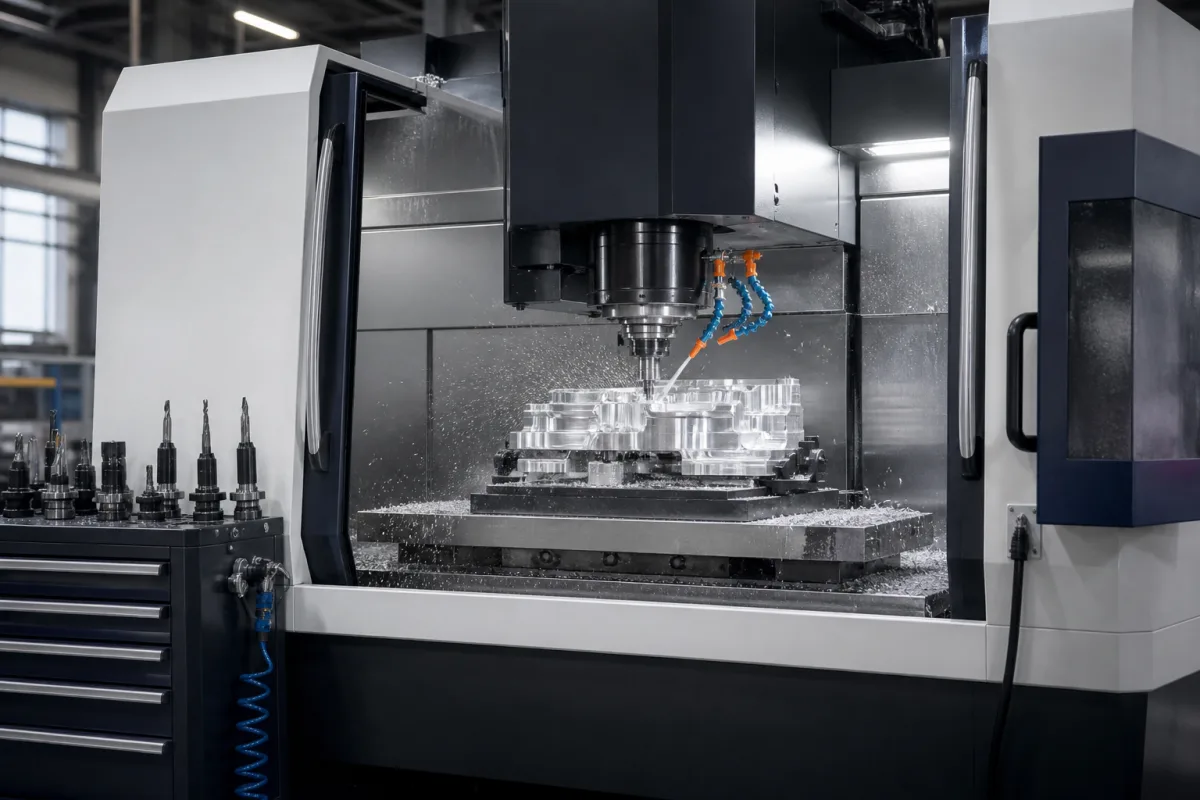
Aluminum CNC milling machine: high-speed BT30 machining centre for aluminium parts
High-speed BT30 machining centres for aluminium parts · 10,000–27,000 min⁻¹ spindles, cutting speed versus cutter diameter, rapid traverse, tool change and ISO 230-2 accuracy
This page covers compact, high-speed vertical machining centres with BT30 spindles used to mill, drill and tap aluminium parts from bar, plate or castings. Ask three things first: which spindle speed reaches the cutting speed your cutters need, how the spindle power and torque fall at the high-speed option, and what positioning accuracy, tool change time and travels the machine offers.
High-speed vertical machining centres with No. 30 taper (BT30) spindles of 10,000 min⁻¹ and above, used for milling, drilling and tapping aluminium parts. General-purpose three-axis vertical machining centres with BT40 spindles are covered on the CNC machining centers page. Aluminium profile (extrusion) CNC machining centres, window and curtain-wall machines, routers and five-axis machines are outside this page.
CNFX editorial research · Sources checked October 12, 2026 · 3 sources
Match spindle speed to the cutting speed your cutters need
Cutting speed in m/min equals π × cutter diameter in mm × spindle speed in rpm ÷ 1,000, so the spindle speed a machine needs depends on the cutter diameters used. In a 2023 Materials study of finish milling 7075 aluminium alloy on a DMG Mori DMU 100 Monoblock, the constant parameters were a cutting speed of 900 m/min, a rotational speed of 18,000 rpm and an axial depth of cut of 20 mm; with three flutes the force frequency was 900 Hz, and the minimum cutting force came with a cutting-edge rounding radius of about 15–20 µm. [2]
Editorial calculation: 900 m/min at 18,000 rpm corresponds to a cutter of about 900,000 ÷ (π × 18,000) ≈ 15.9 mm diameter. Holding 900 m/min with a 12 mm cutter needs about 23,900 rpm, and with a 10 mm cutter about 28,600 rpm, above a 27,000 min⁻¹ spindle; a 63 mm face mill reaches 900 m/min at about 4,550 rpm. [2][1]
A 2021 Materials study of high-speed milling of ADC12 die-cast aluminium used a VMC-850E vertical machining centre with an 8,000 rpm maximum spindle speed, a BT40 holder and a 63 mm four-insert cutter, at cutting speeds including 300, 600 and 1,200 m/min. It reports adhesion and pit wear on the rake face, a maximum flank wear land width of about 20 µm at 300 m/min after 20 m of milling, and wear land width falling as cutting speed rose, except at 600 m/min. [3] Editorial calculation: 1,200 m/min with that 63 mm cutter needs about 6,060 rpm, inside the 8,000 rpm limit; small end mills are what push aluminium work toward 16,000–27,000 min⁻¹ spindles. [3]
Give the supplier your aluminium alloys, the cutter diameters and cutting speeds you run, the largest face mill and tap sizes, and the cycle times you need to beat.
02
Check spindle power, accuracy, rapids and tool change
Brother's SPEEDIO S300X2, S500X2 and S700X2 data list a 7/24 taper No. 30 spindle with 10,000 min⁻¹ standard and 16,000, 27,000 or 10,000 min⁻¹ high-torque options; main spindle motor ratings (10 min/continuous) of 10.1/7.1 kW at 10,000 min⁻¹, 7.4/5.1 kW at 16,000 min⁻¹, 12.8/9.2 kW for the high-torque 10,000 min⁻¹ option and 8.9/6.3 kW at 27,000 min⁻¹; and a maximum tapping speed of 6,000 min⁻¹, or 8,000 min⁻¹ on the 27,000 min⁻¹ specification. [1]
The same data give 50 × 50 × 56 m/min rapid traverse, cutting feed of 1–30,000 mm/min, tool change times of 0.7 s tool-to-tool and 1.3 s chip-to-chip (measured to JIS B6336-9 and MAS011-1987), 14 or 21 tools, bidirectional positioning accuracy of 0.006–0.020 mm and repeatability of less than 0.004 mm to ISO 230-2:2006. Coolant through spindle is optional but not available for the 27,000 min⁻¹ specification, and required air flow rises from 45 to 115 L/min for that specification. [1]
Editorial calculation: moving from the 10,000 to the 27,000 min⁻¹ spindle on these machines lowers the 10-minute spindle motor rating from 10.1 to 8.9 kW while raising top speed 2.7 times, so check torque at the speeds where you rough, not only the maximum speed. [1]
03
Brother S300X2, S500X2 and S700X2 travels and tables
Brother publishes one table for three travel sizes; compare other suppliers' machines on the same items.
Editorial calculation: the S500X2 needs 1,560 × 2,223 mm of floor space without the control-unit door swing, about 3.5 m², and the S700X2 2,050 × 2,223 mm, about 4.6 m². [1]
Explore company information and manufacturing capabilities, then discuss the scope of your project with a relevant supplier.
Share this page
Compiled and source-reviewed by the CNFX editorial team.
Each manufacturer above links to the page on that company's own website where the product is listed, with the date we checked it. How we source and review
· Page last updated 13 October 2026
Buyer questions
What spindle speed does aluminium milling need?
It depends on cutter diameter: 900 m/min, as used in a 7075 study at 18,000 rpm, needs about 23,900 rpm with a 12 mm cutter but about 4,550 rpm with a 63 mm face mill (editorial calculation). [2]
What spindle speeds are offered on BT30 machining centres?
Brother lists 10,000 min⁻¹ standard and 16,000, 27,000 or high-torque 10,000 min⁻¹ options on its S300X2–S700X2. [1]
How fast is tool change on a BT30 centre?
Brother lists 0.7 s tool-to-tool and 1.3 s chip-to-chip, measured to JIS B6336-9 and MAS011-1987. [1]
Sources and what still needs a direct check
Sources checked 2026-10-12. Brother publishes its own machine data; the two Materials papers are peer-reviewed cutting studies on aluminium alloys.