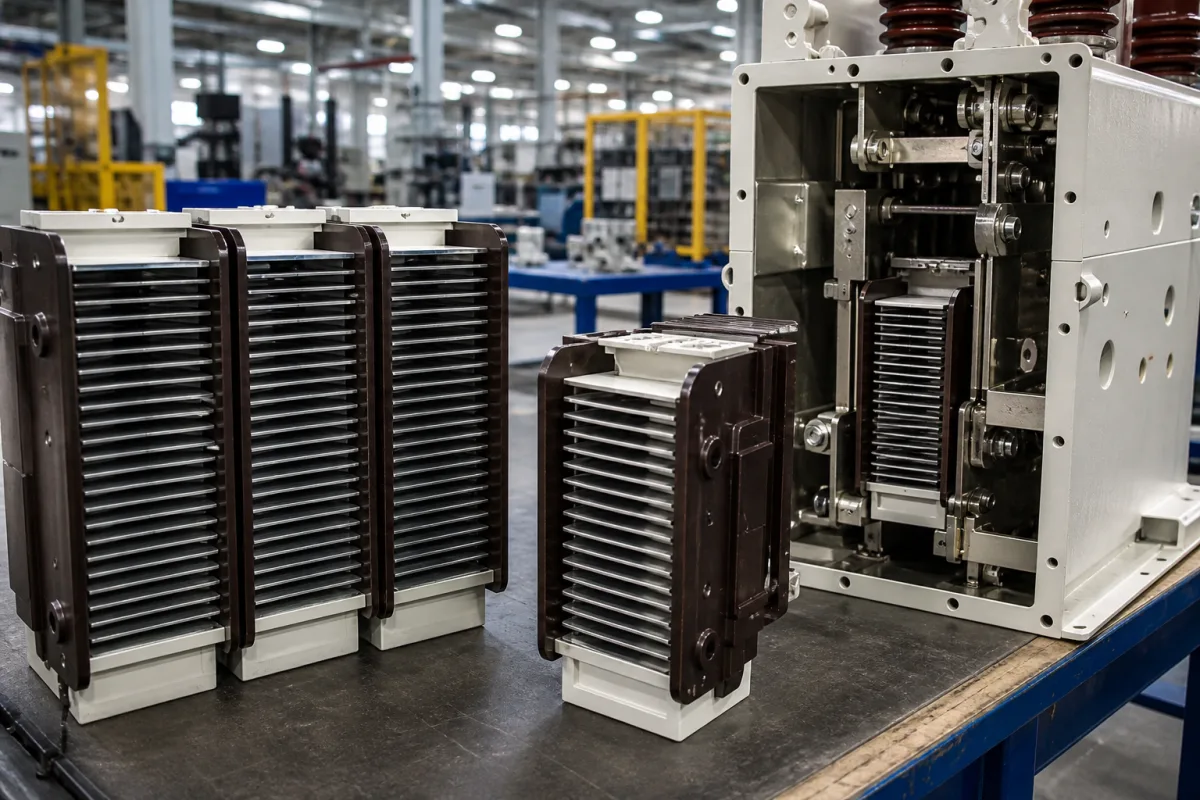
Replacement arc chute for low-voltage air circuit breakers
Replacement arc chutes for low-voltage air circuit breakers · cycle limits per breaker version, filters, screws and inspection
A replacement arc chute is the removable assembly of splitter plates, filters and insulating walls that sits over each pole of a low-voltage air circuit breaker and is changed as a spare part during the breaker's service life. Ask three things first: which breaker type, rating and version the chute is for, how many operating cycles at rated current the breaker maker allows before replacement, and what the maker requires when the chute is inspected and refitted.
Replacement arc chute assemblies for low-voltage air (power) circuit breakers, chosen and maintained against the breaker maker's documents. Arc chutes as a design subject, including how arcs are split and the arc covers of small breakers, are covered on the Arc chute page; vacuum interrupters and complete breakers are outside this page.
CNFX editorial research · Sources checked October 12, 2026 · 3 sources
Plan replacement by the breaker version's cycle limit
Schneider Electric's maintenance guide for MasterPact NT/NW breakers describes the arc chutes as mounted on each arc chamber of the breaking unit and composed of splitters and filters: the splitters help extinguish the arc and absorb the arc energy, and the filters filter the pressured gas expelled from the arc chamber and cool it until it is no longer ionized. It names frequent switching at rated current and stresses from high short-circuit currents as the causes of degradation, and states that beyond the electrical-endurance limit, wear of the arc chutes (insulating materials, separators) reduces the insulation and so the device's suitability for isolation. [1]
The same guide sets a maximum number of operating cycles at rated current (In) before the arc chute must be replaced, which changes with the version and operating voltage of the breaker; for MasterPact NT 06–16 it gives the values in the table, the same figures it gives for the main contacts. [1]
Eaton's manual for its IZM withdrawable and fixed circuit-breakers states that the arc chutes and the contact system must be replaced depending on their condition but at the latest after 10,000 switching operations, and that withdrawable units with arc chute covers are to be exchanged at the latest after three short-circuits in the circuit-breaker. [3]
Editorial calculation: at an assumed 4 operations at rated current per day, the 3,000-cycle limit for a MasterPact NT 06–16 H1/H2 at 690 V is reached after about 750 days, roughly two years, against about four years for the 6,000-cycle limit at 440 V; count operations at your duty and voltage before setting a spares stock. [1]
MasterPact NT 06–16 version
Arc chute cycles at In
Main contact cycles at In
440 V, H1 and H2
6,000
6,000
690 V, H1 and H2
3,000
3,000
440 V, L1
3,000
3,000
690 V, L1
2,000
2,000
Give the supplier the breaker maker, type, frame and rating, performance version (for example H1, H2, L1), operating voltage, number of poles, fixed or withdrawable design, the breaker's serial or catalogue number, the number of chutes needed, and whether screws, filters or an instruction sheet are to be included.
02
Inspect, clean and refit the chutes as the breaker maker requires
Eaton asks the user to set inspection intervals by operating conditions, at minimum once a year, after heavy switch-offs and after tripping by the electronic overcurrent release, and to check the arc chute and contact system during the inspection and/or after 1,000 rated-current switch-offs. On visual inspection, heavy wear (burnout on the arc splitter plates) means the arc chutes are to be replaced, and a removed chute is not to be stood vertically on its insulating walls but laid on its side, at risk of breaking. [3]
Schneider Electric's procedure for the arc chutes of its MasterPact MTZ breakers starts by checking that every screw is present, which it says is mandatory to help prevent ionized gas leaking through the edges of the chute. The screws are then undone and tightened with a torque wrench to 1.5 N·m on MTZ1 or 7 N·m on MTZ2/MTZ3, and dust is removed from the filters with a vacuum cleaner without blowing air or using a cloth; if the filters are still dirty, for example with greasy compound, the arc chutes are replaced. The procedure does not apply to the MTZ1 H3, whose arc chutes are not removable. [2]
Its NT/NW guide lists checking the mounting of the arc chutes and the cleanliness of the filters as part of standard end-user preventive maintenance. [1] Editorial note: the torques and steps above belong to the named breaker types; ask for the instruction sheet of the exact breaker the replacement chute is for.
03
Splitter plates, filters, walls and screws in one chute
The plates break up the arc and the filters cool the expelled gas; the insulating walls and fixing screws keep that gas contained at the edges of the chute.
Part
Role
Fix in the order
Splitter plates
Help extinguish the arc and absorb its energy. [1]
Plate condition at inspection.
Filters
Cool expelled gas until it is no longer ionized. [1]
Cleanliness; replace if greasy.
Insulating walls and cover
Hold the plates; insulation wears with use. [1][3]
Voltage, plate count and fit tolerances for a replacement chute
Only a few of these fields have published values: the operating voltage decides how many operations a chute lasts, and the fit of chute and screws is set by the breaker maker's instructions.
Field
What it means and published values
Ask the supplier for
Rated voltage (kV)
Breaker operating voltage; chute life halves from 440 V to 690 V on one H1/H2 version. [1]
Voltage the chute is listed for.
Breaking capacity (kA)
Set by the breaker type and version.
Breaker type and version.
Plate count (pcs)
Number of splitter plates in the chute.
Count for your breaker.
Insulation class (class)
Insulating materials of the chute walls.
Material and class.
Arc extinguishing time (ms)
Part of the breaker's tested breaking performance.
Explore company information and manufacturing capabilities, then discuss the scope of your project with a relevant supplier.
Share this page
Compiled and source-reviewed by the CNFX editorial team.
Each manufacturer above links to the page on that company's own website where the product is listed, with the date we checked it. How we source and review
· Page last updated 13 October 2026
Buyer questions
How long does an air circuit breaker arc chute last?
It depends on the breaker version and voltage: Schneider Electric gives 6,000 cycles at rated current for a MasterPact NT 06–16 H1/H2 at 440 V and 3,000 at 690 V. [1]
When must the arc chutes be changed after short-circuits?
Eaton states that IZM withdrawable units with arc chute covers are to be exchanged at the latest after three short-circuits. [3]
How are arc chute filters cleaned?
Schneider Electric's MTZ procedure uses a vacuum cleaner, not blown air or a cloth, and replaces the chutes if the filters stay dirty. [2]
What does arc chute wear affect?
Schneider Electric states that beyond the electrical-endurance limit, arc chute wear reduces insulation and so the device's suitability for isolation. [1]
Sources and what still needs a direct check
Sources checked 2026-10-12. Schneider Electric and Eaton are breaker makers describing the arc chutes of their own breakers; their figures apply to the breaker types named.