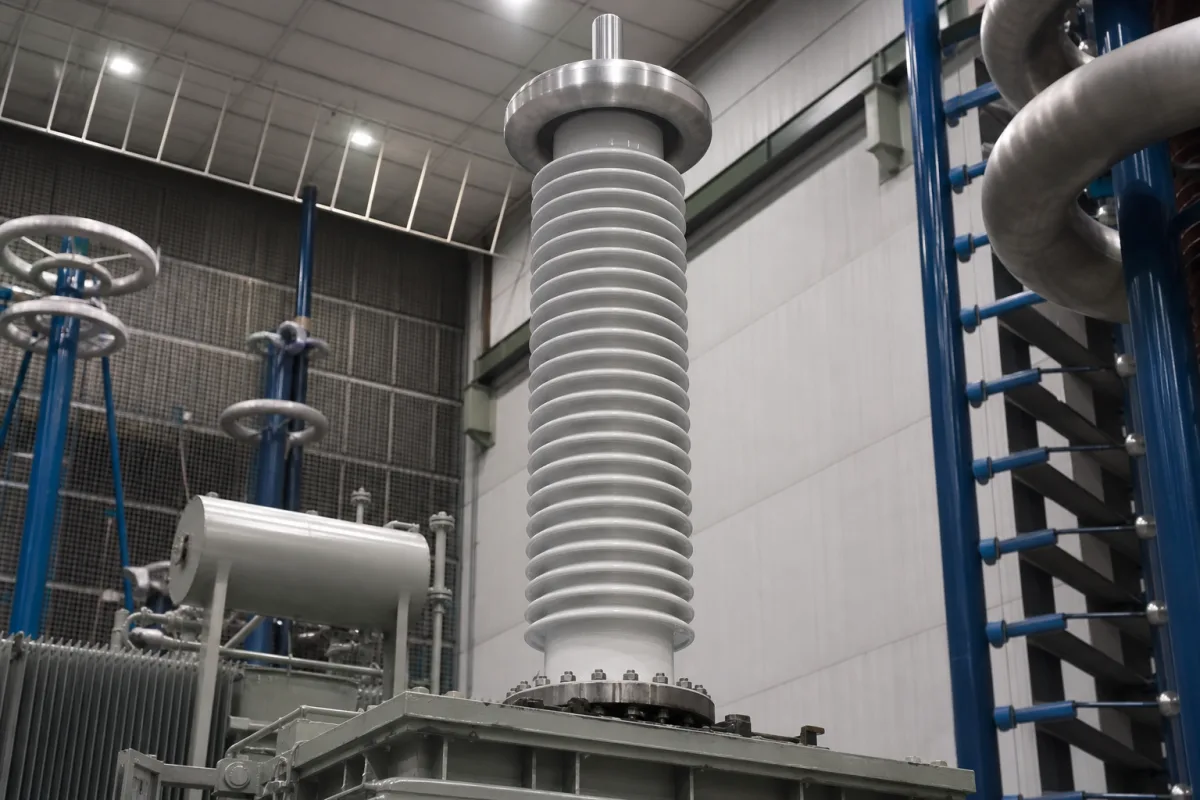
Transformer and wall bushings · Insulation levels, power factor limits, creepage class, current rating and C1/C2 field testing
A high-voltage insulating bushing carries a conductor through a grounded transformer tank or wall while insulating it, in condenser designs with a capacitance-graded condenser core of oil-impregnated paper (OIP) or resin-impregnated paper (RIP) inside a porcelain or silicone-rubber housing. Ask three things first: what insulation levels and loss limits it is tested to, which pollution class its creepage distance suits, and what current it carries at what oil and air temperatures.
Condenser and non-condenser bushings for power and distribution transformers, reactors and walls, oil-to-air, oil-to-oil and oil-to-SF6, with porcelain or composite housings. Cable terminations, post insulators and low-voltage feed-throughs are outside this page.
CNFX editorial research · Sources checked October 12, 2026 · 4 sources
ABB's product guide for RIP transformer bushings explains that the lightning impulse withstand (BIL) matches the transformer in ABB's guide and is a routine test from 850 kV BIL upward; the dry 1-minute power-frequency withstand is set 10% above the transformer's test level and is routine on all bushings; and the wet test is a type test for equipment up to 245 kV. Rated current is defined at a hot spot of 105 °C (120 °C for RIP), with air at 30 °C and oil 60 K above ambient under IEC, or 40 °C and 65 K under ANSI. [1]
IEC 60137 requires a power factor below 0.7% in the routine test; ABB applies 0.55% up to 362 kV, 0.5% above 362 to 550 kV and 0.4% above 550 kV, while noting that for a properly designed bushing a lower dissipation factor does not by itself improve service life. For pollution, IEC 60815-3 sets unified specific creepage distance (creepage divided by the highest line-to-ground voltage) classes of 22, 28, 35, 43 and 54 mm/kV from very light to very heavy — a definition that differs by √3 from the older line-to-line basis. IEC 60137 also defines two cantilever load levels. [1]
Editorial calculation: for a 245 kV system the highest line-to-ground voltage is 245 / √3 ≈ 141 kV, so medium pollution (35 mm/kV) needs about 4,950 mm of creepage and heavy (43 mm/kV) about 6,080 mm. The system voltage is an assumed example. [1]
Give the supplier the equipment type (transformer, reactor, wall), highest voltage Um, BIL and SIL, rated current, insulation type (OIP, RIP, RIS) and housing (porcelain, silicone), immersion media (oil-to-air, oil-to-oil, oil-to-SF6), pollution class and creepage, cantilever load level, test tap or voltage tap, mounting dimensions and standard (IEC 60137, IEEE C57.19.01).
02
Measure and trend C1 and C2 in service
A Transformer Technology article on OIP bushing condition assessment explains that C1 is the main insulation between conductor and test or voltage tap and C2 the layer between tap and flange; field power factor and capacitance tests are done at line frequency in that article's practice, 10 kV for C1 and 500–2,000 V for C2 or as the maker advises, with only the tap under test uncovered and all other tap caps closed. Bushings without a tap are tested by the hot-collar method. [2]
It says “Typical values for new bushings range between 0.2 and 0.4%” for power factor; cites CIGRE 445 that a doubling of initial power factor warrants closer monitoring or replacement and that a 10% rise in capacitance above nameplate could warrant replacement; and cites IEEE C57.19.100 that some makers treat 1.5–2 times the initial reading as significant and that a capacitance rise of 5% or more warrants investigation. Power factor should be corrected to 20 °C for trending, for which it recommends individual temperature compensation over fixed tables. [2]
ABB adds that bushings must be sealed against moisture and have a reliable ground connection between condenser core and tank for life, and that RIP bushings, having no oil, can be stored horizontally and energised immediately after installation. [1]
03
Read withstand levels, creepage and current margin from ratings
Moser Glaser's catalogue for its DURESCA DTOI(S) oil-to-air bushings, built to IEC 60137:2017 with a dry RIP (resin-impregnated paper) or RIS (resin-impregnated synthetic) core and a silicone housing, tabulates insulation levels and creepage for each highest voltage Um; its unified specific creepage distance is 53.7 mm/kV, and the same electrical and dimensional data apply to RIP and RIS. Draw-lead ratings are 800 or 1,250 A up to 170 kV and 800 A at 245–362 kV. [4]
The catalogue states that the bushings withstand 25 times rated current for up to 2 seconds, that for draw-lead types the 2-second thermal current in kA is 0.06 × the cable cross-section in mm², and that bushing rating and cable size should be at least 20% above the transformer rating. The test tap is tested at 2 kV for 60 s on 50 Hz networks. [4]
Editorial calculation: 123 ÷ √3 × 53.7 ≈ 3,813 mm, matching the table on a line-to-ground basis, near the 54 mm/kV very-heavy class cited above; a 240 mm² draw-lead cable gives 0.06 × 240 = 14.4 kA for 2 s; and a 1,000 A transformer current calls for at least a 1,200 A bushing. (cable size and current assumed). [4][1]
Ask for the rating-table row for your Um, the creepage class, the draw-lead cable size the rating assumes and the test-tap test voltage.
04
Plan inspection and maintenance of bushings in service
The US Bureau of Reclamation's FIST 3-30 (Transformer maintenance) says new bushings should be Doble tested as an acceptance test and the results kept as a baseline, and not tested while in a wooden shipping crate or lying on wood, which gives inaccurate readings. It states that about 90% of preventable bushing failures are caused by moisture entering through leaky gaskets, cracks or seals, which Doble testing can detect. [3]
FIST 3-30 adds that a stuck oil-level gauge pointer combined with a small leak can lead to explosive failure, that corona creeping down from the top of a bushing indicates contamination that should be inspected, tested and cleaned before flashover, and that hot-metal gases (ethane and ethylene) in transformer DGA can point to a bad connection inside the tank. [3]
Editorial calculation: one US quart is about 0.95 L.
Check in FIST 3-30
Interval or limit
Porcelain cracks and contamination, oil leaks, oil level
After 1 month of service and yearly
Infrared scan of connections
After 1 month of service and yearly
Close physical inspection and cleaning
Every 3 to 5 years (shorter where salt or dust deposits form)
Top-up volume that triggers replacement planning (low level, no visible leak)
More than one quart
Fill plug opening temperature
Per manufacturer manual; FIST 3-30 gives 15–35 °C as the general range
Ask the bushing supplier for factory C1 and C2 values to use as the acceptance baseline, the safe temperature range for opening the fill plug, and the gasket specification.
05
Transformer, wall and monoblock bushings from the listed makers
Wenzhou Shuowei lists transformer bushings including monoblock types and 25 kV bushing wells; Hewei lists composite capacitive transformer and wall bushings and porcelain wall bushings.
Listings include distribution transformer bushings and bushing wells and composite capacitive transformer and wall bushings; ask each for the rated Um, BIL, power factor limit and creepage of the exact model.
06
Conductor, condenser core, test tap, flange and housing
The test tap is the part field testing depends on: it gives access to C1 and C2, and a bushing without one has to be tested by the hot-collar method. [2]
Um, BIL, creepage, rated current and cantilever level for a bushing order
ABB's guide supplies the rating rules used here: BIL equal to the transformer's, creepage of 22–54 mm/kV times line-to-ground voltage, and rated current defined at a 105 °C hot spot (120 °C for RIP). [1]
2 companies list this product among what they make. Company figures are quoted from each
company's own website; every card states where the relationship came from.
Wenzhou Shuowei Electric Co., Ltd.
Manufacturing site to be confirmed for the order
Lists high-voltage bushings for transformers, including monoblock bushings and 25 kV bushing wells.
Explore company information and manufacturing capabilities, then discuss the scope of your project with a relevant supplier.
Share this page
Compiled and source-reviewed by the CNFX editorial team.
Each manufacturer above links to the page on that company's own website where the product is listed, with the date we checked it. How we source and review
· Page last updated 13 October 2026
Buyer questions
What power factor limit applies to bushings?
ABB says IEC 60137 requires below 0.7%; ABB applies 0.55%, 0.5% or 0.4% by voltage. [1]
How much creepage does a bushing need?
IEC 60815-3 classes run from 22 mm/kV (very light) to 54 mm/kV (very heavy) of line-to-ground voltage. [1]
How are bushings tested in the field?
C1 power factor and capacitance at about 10 kV and C2 at 500–2,000 V, trended against nameplate. [2]
When is a bushing a concern?
A doubling of power factor or a capacitance rise of 5–10% over nameplate are cited action points. [2]
What causes preventable bushing failures?
The US Bureau of Reclamation's FIST 3-30 states that about 90% of preventable bushing failures are caused by moisture entering through leaky gaskets, cracks or seals. [3]
What withstand voltages go with a bushing's highest voltage Um?
Moser Glaser's DTOI(S) catalogue lists, for example, 80 kV power-frequency and 200 kV lightning impulse at Um 36 kV, 255 / 550 kV at 123 kV and 560 / 1,175 kV at 362 kV. [4]
Sources and what still needs a direct check
Sources checked 2026-10-12. ABB is a bushing maker explaining its product guide and IEC/IEEE requirements; Transformer Technology is a trade publication on field testing citing IEEE and CIGRE guidance. The standards themselves govern requirements.