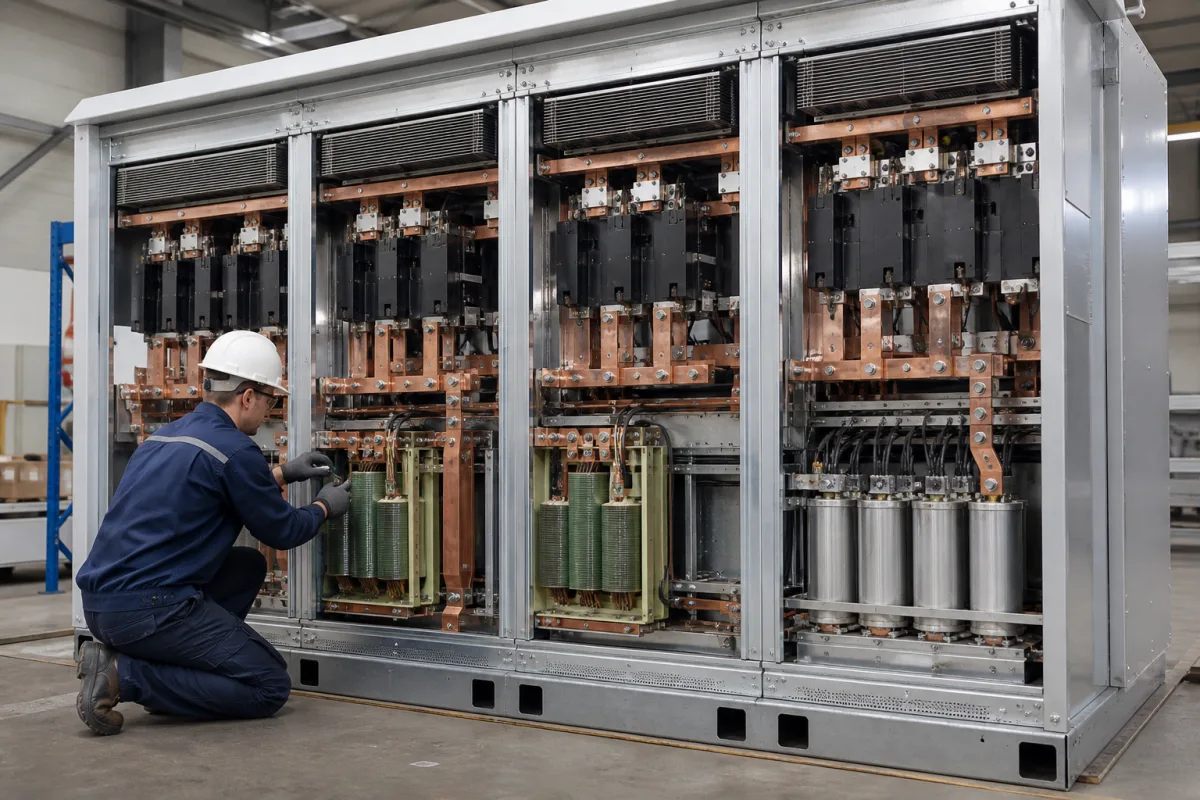
Power supply unit (high-current DC rectifier cabinet for electroplating, anodizing and electrolysis)
High-current DC power supply units for electrochemical processes · thyristor or IGBT rectifier cabinets, rectifier transformers, 6- and 12-pulse bridges, constant-current control, water-cooled busbars
A power supply unit here is the cabinet that turns the plant's AC supply into large, regulated direct current for an electrochemical process: a rectifier transformer feeds thyristor (or IGBT) bridges on heavy copper or aluminium busbars, cooled by air or water, with controls that hold the current or voltage the bath needs. Ask three things first: what DC current and voltage the process needs and how they vary, which bridge and pulse number meet your harmonic limits, and how the unit is cooled and protected in a corrosive plant room.
High-current DC rectifier power supply units for electroplating, anodizing, electrowinning, electro-refining and electrolysis, from single cabinets to multi-bridge systems with rectifier transformers. DIN-rail switch-mode power supplies for control cabinets are covered on the Industrial DIN-Rail Power Supply Unit page; induction furnace power systems and UPS are outside this page.
CNFX editorial research · Sources checked October 12, 2026 · 3 sources
Set the DC current, voltage and control mode for the process
ACE Electromagnetics lists custom AC-to-DC rectifiers delivering regulated DC at up to 7,500 A, with output voltage "typ. 6 V to ~150 V DC depending on process", 3-phase 415 V / 433 V input or HT supply through a dedicated rectifier transformer, closed-loop constant-current (CC) and constant-voltage (CV) regulation with digital firing control, and DC metering with over-current, over-temperature and fault alarms. It names electroplating and surface finishing, anodizing, electrowinning and electro-refining of copper and zinc, chlor-alkali electrolysis and large electromagnets as applications, and IS / IEC 60146 and IEEE-519 as standards. [1]
At the large end, GE Vernova offers high-current rectifier systems for electrochemical processes and hydrogen production in configurations "from 0 kA to 45 kA" of DC output current, fed from a grid connection between 30 kV and 66 kV through "a common step-down Power Transformer and AC main breaker". [2] A GE Vernova (originally Alstom) patent describes the field of rectifiers delivering up to 110 kA and DC voltages that may exceed 2,200 V, used for aluminium, copper, zinc and chlorine electrolysis and DC arc furnaces. [3]
Editorial calculation: DC power is current × voltage, so a plating line needing 7,500 A at 12 V draws 7,500 × 12 = 90 kW of DC power; 5,000 A at 40 V for anodizing is 200 kW. The currents and voltages are assumed examples; size the transformer for the DC power plus the rectifier's losses and your power factor.
Give the rectifier maker the process and bath (plating, anodizing, electrowinning, electrolysis), DC current and voltage range, duty cycle and ramp profile, control mode (CC, CV, pulse or reverse if needed), supply voltage, frequency and short-circuit level, harmonic limits, cooling water quality or ambient air, installation room and corrosion conditions, DC busbar route to the cells, metering and communication, and quantity.
02
Choose the bridge, pulse number, busbars and cooling
ACE describes these units as "typically thyristor (SCR) phase-controlled rectifiers" built as a matched transformer-rectifier set with converter-grade isolation transformer, multi-pulse bridge, interphase transformer and heavy DC busbar, configured as 6-pulse or 12-pulse (and higher) bridges with harmonic filtering, and air-cooled or water-cooled, with an oil-cooled option, for corrosive, high-dissipation rooms. [1]
GE Vernova builds its systems from 6-pulse thyristor bridges whose number varies with the output current, each bridge on its own step-down transformer for isolation; phase shifting of the transformer secondaries spreads the harmonics on the primary side. It lists press-pack SCR "(Thyristors or IGBT)", air-cooled building blocks up to 17 kA (5 MVA type, front access) and water-cooled blocks up to 45 kA (25 MVA type, access all round). [2]
The patent describes a twelve-phase double bridge rectifier in which diodes or thyristors in each arm sit on water-cooled aluminium or copper component busbars, with a fuse resistor in series with each semiconductor on a water-cooled fuse busbar, and collector busbars carrying the current to the DC terminals. [3]
03
Rectifier transformer, thyristor bridges, interphase transformer and busbars
The patent places each semiconductor on a water-cooled component busbar with its own fuse resistor, and collector busbars carry the current to the DC terminals.
Part
Role
Fix in the order
Rectifier transformer
Steps the supply down and isolates; phase shift spreads harmonics. [2][1]
DC current and voltage, pulse number, control mode and cooling for plating rectifiers
Current and voltage set the size, but pulse number and filtering decide whether the unit meets your harmonic limit; the published units run from 7,500 A process rectifiers to 45 kA systems.
Explore company information and manufacturing capabilities, then discuss the scope of your project with a relevant supplier.
Share this page
Compiled and source-reviewed by the CNFX editorial team.
Each manufacturer above links to the page on that company's own website where the product is listed, with the date we checked it. How we source and review
· Page last updated 13 October 2026
Buyer questions
How is this different from a DIN-rail power supply?
This page covers high-current DC rectifiers for electrochemical processes; small switch-mode supplies for control cabinets are on the Industrial DIN-Rail Power Supply Unit page. [1][2]
Why use 12-pulse or more bridges?
ACE uses 12-pulse and filtering to improve power factor and limit harmonics; GE Vernova phase-shifts transformer secondaries to spread harmonics on the primary side. [1][2]
How large can these rectifiers be?
GE Vernova lists 0 to 45 kA systems; its patent describes the field up to 110 kA and above 2,200 V. [2][3]
Which standards apply?
ACE names IS / IEC 60146 and IEEE-519 for harmonics. [1]
Sources and what still needs a direct check
Sources checked 2026-10-12. ACE Electromagnetics and GE Vernova publish their high-current rectifiers; a GE Vernova (Alstom) patent describes high-power rectifier architecture.