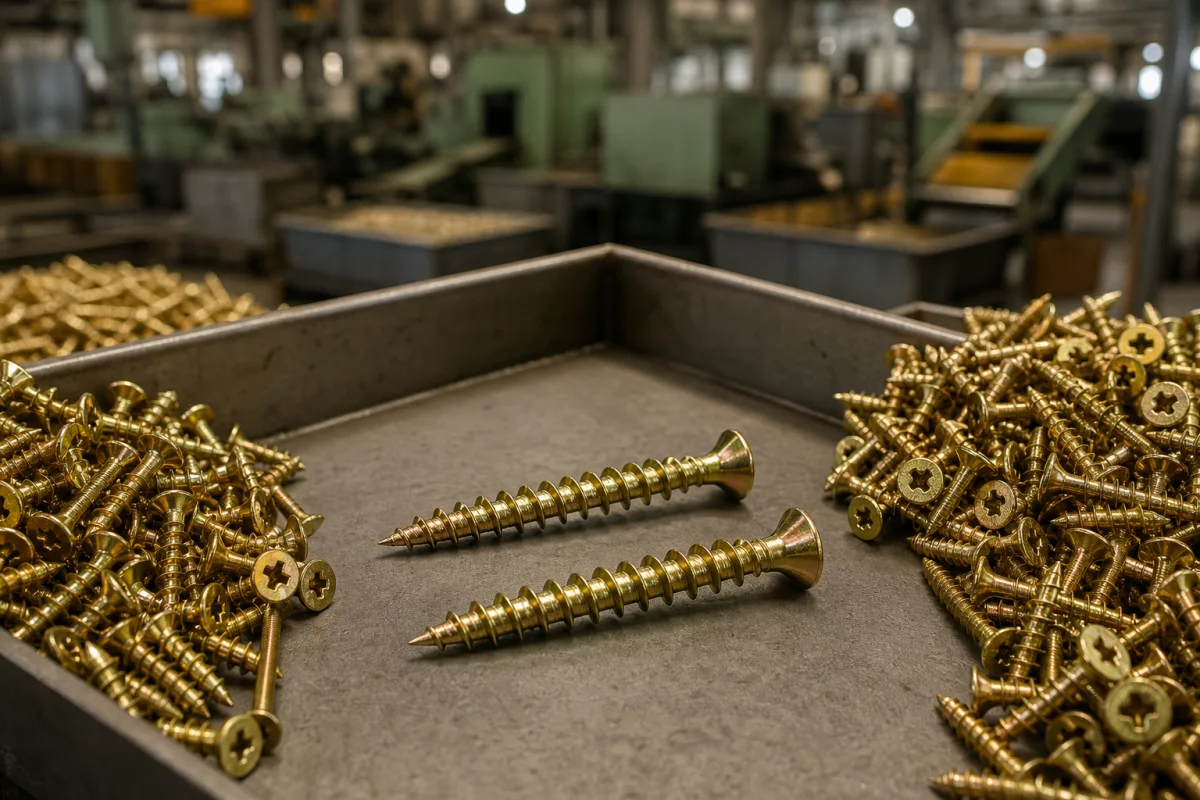
Chipboard screws · EN 14592 declarations and ETA values: withdrawal and head pull-through parameters, tensile, torsional and yield values, panel thickness limits, coatings and standard edition
A chipboard screw is a hardened carbon-steel wood screw with a sharp point, a single coarse thread with a small core, and a countersunk or other head, which may carry ribs or nibs, made by cold heading and thread rolling and zinc or other plated, for fixing chipboard, MDF and timber without pilot holes in furniture, joinery and construction. Ask three things first: which declared performance values the screw carries for your timber, what diameter, length, thread and head suit the joint, and which coating suits the service class.
Chipboard and general-purpose wood screws for panels and timber, including those declared to EN 14592. Drywall screws, self-drilling screws for steel, structural timber screws with their own ETA, machine screws and nails are outside this page.
CNFX editorial research · Sources checked October 12, 2026 · 4 sources
Compare declared withdrawal, pull-through and strength values
A Swisstec Sourcing declaration for a 5 × 70 mm chipboard screw (Torx head with nibs, type 17 saw thread, waxed and blue plated) states conformity with EN 14592:2008+A1:2012 and declares: withdrawal parameter 17.36 N/mm² loaded across the fibre and 12.87 N/mm² along it, head pull-through parameter 23.98 N/mm², both at a characteristic wood density of 350 kg/m³; torsional ratio ftor,k/Rtor,k 4.1; yield moment 5,844 N·mm; and characteristic tensile capacity 9.22 kN, in C10B21 steel. [1]
An earlier declaration for the same item number in carbon steel C1022 lists a withdrawal parameter of 17.41 N/mm² across and 13.73 N/mm² along the fibre but at a density of 440 kg/m³, head pull-through 20.26 N/mm² at 350 kg/m³, yield moments of 7,879 and 12,283 N·mm for ring and smooth sections, torsional ratio 2.58 and tensile capacity 9.95 kN. [1]
A DIBt European Technical Assessment, ETA-21/0826 of 14 October 2021, covers the FUSA-fast / F+S PRO CPS chipboard screws (drawn in Annex 4 from Ø 3.0 to Ø 6.0 mm) together with a woodbuilding screw range. At an angle of 90° to the grain and a characteristic density of 350 kg/m³ it sets a characteristic withdrawal parameter fax,k of 12.0 N/mm² for 3.0 mm ≤ d ≤ 5.0 mm and 11.0 N/mm² for 6.0 mm. [2]
For the chipboard diameters the same ETA tabulates, for d = 3.0 / 3.5 / 4.0 / 4.5 / 5.0 / 6.0 mm: characteristic yield moment My,k 1.6 / 2.3 / 3.3 / 4.5 / 5.9 / 9.5 Nm, characteristic tensile strength ftens,k 2.5 / 4.0 / 5.0 / 6.0 / 8.0 / 9.5 kN and characteristic torsional strength ftor,k 1.6 / 2.2 / 3.3 / 4.5 / 6.1 / 9.0 Nm. [2]
Editorial calculation: the declaration's yield moment of 5,844 N·mm is 5.84 N·m, close to the ETA's 5.9 Nm for a 5.0 mm screw; its tensile capacity of 9.22 kN is above the ETA's 8.0 kN; and its withdrawal parameter of 17.36 N/mm² is about 45% above the ETA's 12.0 N/mm² at the same 350 kg/m³ basis. Two 5 mm chipboard screws can therefore carry quite different declared values, so the comparison has to be made document against document. [1][2]
Editorial calculation: the simple product of withdrawal parameter, diameter and thread length in the member gives a first characteristic estimate before code factors. With an assumed 40 mm of thread in the member, 17.36 × 5 mm × 40 mm ≈ 3.5 kN for the declared screw and 12.0 × 5 mm × 40 mm = 2.4 kN on the ETA value. The two Swisstec declarations show almost the same across-grain value (17.36 and 17.41 N/mm²) but for different wood densities (350 and 440 kg/m³), and their torsional ratios differ (4.1 and 2.58). Ask for the current document, compare values only on the same density basis, and apply the timber design code for actual design. [1][2]
Give the supplier the diameter and length, thread type (single, double, partial), head type and drive, point type, steel grade and hardening, coating and service class, the EN 14592 declaration or ETA required, timber or panel type and density, packaging and quantities.
02
Check panel thickness, head size and installation rules in the ETA
ETA-21/0826 lists the wood-based panels its screws may fix to timber: OSB to EN 300, plywood to EN 636, particleboards to EN 312, cement-bonded particleboards to EN 634-2, fibreboards to EN 622-2 and EN 622-3 and solid wood panels to EN 13353, each also to EN 13986, with the panel on the side of the screw head. Use is limited to static and quasi-static loads. [2]
Head pull-through: at a characteristic density of 350 kg/m³ the ETA sets fhead,k = 9.4 N/mm² for timber and for those panels thicker than 20 mm, and 8.0 N/mm² for panels 12 mm to 20 mm thick. For panels thinner than 12 mm the parameter is 8.0 N/mm² and the head pull-through capacity is limited to 400 N. For wood-based panels no more than 380 kg/m³ may be used as characteristic density in the EN 1995-1-1 equation. [2]
The head diameter must be at least 1.8·ds, where ds is the smooth shank or inner thread diameter; otherwise the head pull-through capacity is taken as zero. Editorial calculation: for the declared 5 × 70 mm screw, 1.8 × the upper core diameter of 3.2 mm = 5.76 mm, well below its 9.64–10.0 mm head. [2][1]
Minimum panel thickness is 1.2·d and not less than the table values: plywood 6 mm, fibreboards 6 mm, OSB 8 mm, particleboards 8 mm, cement-bonded particleboards 8 mm, solid wood panels 12 mm. Editorial calculation: for a 5 mm screw 1.2 × 5 = 6 mm, so in particleboard the 8 mm table value governs. [2]
Installation: at least two screws per connection in load-bearing structures; softwood members are fixed without pre-drilling or in holes no larger than the inner thread diameter d1; holes in steel members are pre-drilled larger than d. In pre-drilled solid timber, glulam, LVL and CLT the minimum member thickness is 24 mm for screws below 8 mm. Spacings, end and edge distances follow EN 1995-1-1 clause 8.3.1.2 and Table 8.2 as for nails; without pre-drilling, spacings and distances parallel to the grain in Douglas fir are increased by 50%. [2]
The ETA also states a bending angle of at least 45/d^0.7 + 20, an assumed working life of at least 50 years, reaction to fire class A1 and AVCP system 3. [2]
Ask which document your screw carries (an EN 14592 declaration of performance or an ETA), request it in full, and check that the panel type and thickness of your joint are inside its scope.
03
Fix size, steel and coating
The declaration gives tolerance bands for the 5 × 70 mm screw: nominal diameter 4.7–5.0 mm, inner (core) thread diameter 2.9–3.2 mm, head diameter 9.64–10.0 mm, total length 68.5–70.0 mm and thread length 40.5–43.5 mm, with blue or yellow Cr3 zinc plating of 3–10 µm suited to service classes 1 and 2 under EN 1995-1-1. [1]
Editorial calculation: a core of about 3 mm on a 5 mm screw is about 60% of the outer diameter, which gives the deep thread that grips particleboard; it also limits torsional strength, which is why the torsional ratio is declared. [1]
ETA-21/0826 describes its screws as self-tapping, made from special carbon steel and hardened, with minimum coating thicknesses of 5 µm for blue or yellow chromated electrolytic zinc, 4 µm for zinc-nickel, and 5 µm for brass-plated, browned and nickel-plated finishes. The overall length of the range runs from 16 mm to 600 mm. [2]
EN 14592:2022 covers fasteners in carbon or stainless steel and names three coating purposes: corrosion protection (Type 1), lubrication to ease insertion (Type 2) and, for nails and staples, withdrawal enhancement or collation (Type 3). [3] Editorial note: by these definitions the waxing on the Swisstec screw and the wax coating fischer says reduces screw-in torque on PowerFast II are insertion aids, separate from the zinc corrosion protection. [1][4]
fischer describes the PowerFast II coating as electrogalvanised and blue passivated without Chromium (VI), and its FSP II countersunk screws as electrogalvanised with yellow or blue passivation. [4]
Editorial note: zinc plating of a few micrometres suits dry interiors; for exterior or damp use (service class 3) ask for coatings or stainless steel declared for that class.
04
Check which edition of EN 14592 the declaration cites
EN 14592:2022 (Swedish adoption SS-EN 14592:2022, approved 3 May 2022, 84 pages) replaces EN 14592:2008+A1:2012. It specifies characteristics of nails, staples, screws, dowels and bolts with nuts for structural use in load-bearing timber structures, the AVCP procedures and marking. [3]
For screws the 2022 edition also covers fixing roof or cladding elements to the timber structure, with or without insulation layers, and use as reinforcement against compression perpendicular to the grain. It does not cover fasteners treated with fire retardants or glued-in rods. [3]
Both Swisstec declarations (dated 17 Apr 2019 and 29 Aug 2020) cite EN 14592:2008+A1:2012, the edition the 2022 standard replaces. Ask whether a declaration to the current edition is available before relying on an older one. [1][3]
05
Compare what suppliers offer
Suppliers linked to this page list chipboard screws; each card links to the page reviewed.
Listings include countersunk and double-countersunk chipboard screws alongside drywall, self-drilling and wood screws.
For comparison with a branded range: fischer describes its PowerFast II chipboard screw with a three-rib tip for a quick bite without splitting, shank ribs and a core-milling geometry to cut insertion resistance, a double cone with mill pockets under the head, countersunk and pan head variants, and a bit system needing two bit changes across 3.0–6.0 mm; it states the range carries an ETA. [4]
06
Trace what defines the screw
This is a functional reference built from the sources cited; it is not one maker's design.
Feature
Role
Fix in the order
Thread and core
Grip in wood-based panels; core sets the 1.8·ds head rule. [1][2]
Outer and core diameter.
Point
Starts without pilot hole; three-rib tip on one range. [4]
Fill the specification fields with values for your joints
A chipboard screw quotation needs values for your joints. The table explains each field, gives published values where a reviewed source states them, and says what to obtain from the supplier.
Field
What it means and published values
Ask the supplier for
Applicable Standard
EN 14592:2008+A1:2012 in one declaration [1]; replaced by EN 14592:2022 [3]; ETA-21/0826 for one range. [2]
DoP or ETA and edition.
Nominal Size / Range
5 × 70 mm; core 2.9–3.2 mm in one declaration [1]; Ø 3.0–6.0 mm chipboard screws in one ETA. [2]
Sizes and tolerances.
Material
C10B21 or C1022 steel in two declarations [1]; hardened carbon steel in one ETA. [2]
Steel and hardening.
Strength / Performance
Withdrawal 17.36 N/mm², tensile 9.22 kN [1]; 12.0 N/mm², 8.0 kN for 5.0 mm in one ETA. [2]
Declared values and density basis.
Panel Thickness
Particleboard 8 mm minimum; 9.4 N/mm² head pull-through above 20 mm. [2]
Panel type and thickness.
Surface Finish
Cr3 zinc 3–10 µm, service classes 1–2 [1]; zinc 5 µm or zinc-nickel 4 µm minimum. [2]
Explore company information and manufacturing capabilities, then discuss the scope of your project with a relevant supplier.
Share this page
Compiled and source-reviewed by the CNFX editorial team.
Published product pages show what a company offers, not tested performance. Confirm the legal seller, factory, declarations and scope for your order. How we source and review
· Page last updated 13 October 2026
Buyer questions
What is a withdrawal parameter?
A declared value under EN 14592 for resistance to pulling out of timber; one 5 × 70 mm chipboard screw declares 17.36 N/mm² across the fibre at 350 kg/m³. [1]
Can the same screw have different declared values?
Yes; two declarations for the same item use different steels and density bases (350 and 440 kg/m³) and different torsional ratios (4.1 and 2.58). [1]
Which coating suits indoor use?
The declaration lists Cr3 zinc plating of 3–10 µm for service classes 1 and 2 under EN 1995-1-1. [1]
Is a higher declared withdrawal value always comparable?
Only on the same basis; one declaration gives 17.36 N/mm² and one ETA gives 12.0 N/mm² for 5.0 mm screws, both at 350 kg/m³ and 90° to the grain or across the fibre. [1][2]
How thin can the particleboard be?
Under ETA-21/0826 the panel must be at least 1.2·d and at least 8 mm for particleboard; below 12 mm the head pull-through capacity is limited to 400 N. [2]
Sources and what still needs a direct check
Sources checked 2026-10-12. The declarations are one sourcing company's EN 14592 statements for its own screw, and the ETA covers one German supplier's range; values for your screws must come from the supplier's current declaration or ETA.