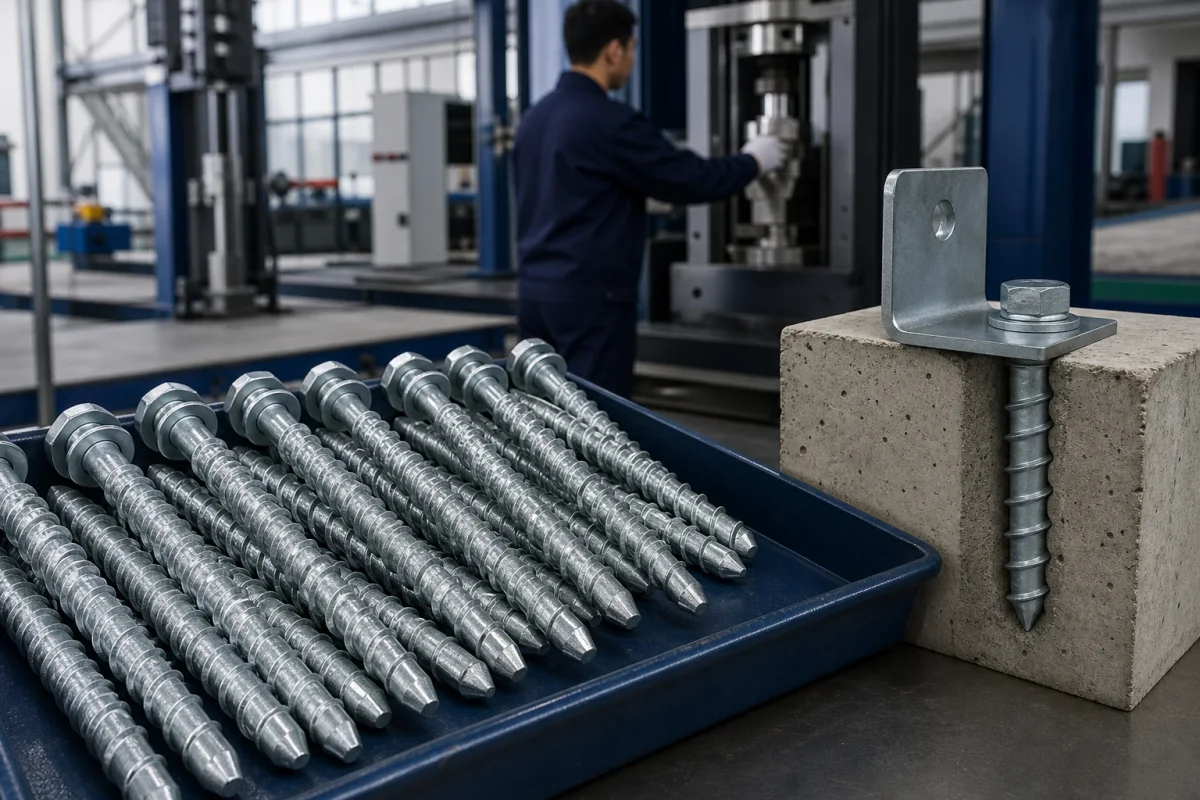
Concrete screw (screw anchor for concrete and masonry)
Concrete screw anchors · Heat-treated thread-cutting screws for concrete and masonry, diameter and embedment, drilled hole size and depth, coating for dry or damp exposure, evaluation reports for structural use
A concrete screw is a hardened threaded anchor driven into a pre-drilled hole in concrete or masonry, where its threads cut into the base material to hold a fixture. Ask three things first: what diameter and embedment the load and base material need, what hole size and depth the installer must drill, and which coating suits the exposure and whether published load values (an evaluation report) are required.
Thread-cutting concrete screws and screw anchors for concrete, masonry and block, with hex, washer, countersunk or rod-hanger heads, in carbon or stainless steel. Expansion, sleeve and drop-in anchors, adhesive anchors, ground screw anchors and concrete nails are outside this page except where compared.
CNFX editorial research · Sources checked October 11, 2026 · 4 sources
Choose diameter and embedment, and drill the right hole
ICC-ES evaluation report ESR-2713 (Simpson Strong-Tie Titen HD) describes a carbon steel screw anchor with hex-washer, countersunk or flat-washer head, made from heat-treated SAE J403 Grade 10B21 steel, in 1/4, 3/8, 1/2, 5/8 and 3/4 in shank diameters, for static, wind and seismic tension and shear loads in cracked and uncracked concrete of 2,500 to 8,500 psi. The pilot hole is drilled with a rotary hammer and a carbide bit to ANSI B212.15 at the same nominal diameter as the anchor, to the nominal embedment plus 1/8 in (1/4 in anchors), 1/4 in (3/8 in) or 1/2 in (1/2 in), and the anchor is driven to embedment with a socket or impact wrench within stated torque limits; it may be backed out up to one turn and reinstalled to align a fixture. [1]
Gangtong describes its concrete screw bolts as anchors whose threads cut into the base material when driven into a mounting hole, and lists them in carbon steel grades and 410 stainless steel with zinc, hot-dip galvanised and other finishes, with hex flange heads. [2]
Editorial calculation: for a 3/8 in anchor at an illustrative 2-1/2 in embedment, the hole is drilled to 2-1/2 + 1/4 = 2-3/4 in (about 70 mm). [1]
A metric screw under a European Technical Assessment gives the comparable setting data. fischer lists its UltraCut FBS II 10x60 5 US (art. no. 536858) with a 10 mm drill diameter, a minimum drill-hole depth of 70 mm for through fixings, a nominal embedment depth of 55 mm with a 5 mm fixture thickness, and a 15 mm hex drive (SW 15). Its approvals are ETA-15/0352, ETA-20/0321 and ETA-20/0134, covering concrete C20/25 to C50/60, cracked and non-cracked, seismic performance categories C1 and C2 and fire resistance class R 120, with diameters 8 and 10 also approved in clay and sand-lime brick. fischer says the FBS II offers up to three embedment depths, that drill holes need no cleaning for vertical installation in ceilings and floors, that floor holes must be drilled three drill-hole diameters deeper, and that the screw may be unscrewed twice to place up to 10 mm of packing or align the part and then retightened; it is correctly set when the head sits flush on the fixture and cannot be driven further. [3]
Editorial calculation: for that screw the 70 mm hole is 70 − 55 = 15 mm deeper than the nominal embedment, and a floor fixing adds 3 × 10 mm = 30 mm more; the ESR-2713 3/8 in example above adds 1/4 in (about 6.4 mm). Hole depth rules differ by product and report, so take them from the report for the screw being bought. [3][1]
Give the supplier the base material (concrete strength, cracked or uncracked, masonry, block), diameter and length, embedment, head type, fixture thickness, loads and whether seismic or structural, exposure (dry interior, damp, exterior, treated timber contact), coating, the evaluation report or approval needed, and quantity and packaging.
02
Match coating to exposure and ask for evaluation evidence
ESR-2713 limits anchors with electrodeposited zinc (ASTM B633, 5 µm minimum) to dry interior locations, and permits mechanically galvanised anchors (ASTM B695 Class 65) for exterior or damp exposure and interior contact with preservative-treated wood. It states that the anchors were evaluated for brittle failure and found not significantly sensitive to stress-induced hydrogen embrittlement, and requires periodic special inspection of anchor type, dimensions, hole cleaning, embedment and concrete during installation. [1]
Editorial note: published structural load values belong to a specific product and its evaluation report; a generic concrete screw without such a report should not be given those values. Ask the supplier which report, if any, covers its screws, and for hardness and coating test results.
03
Compare what suppliers offer
Suppliers linked to this page list concrete screws; each card links to the page reviewed.
The suppliers reviewed list concrete screw bolts with other anchors and fasteners; ask each for heat treatment and hardness, thread design, coatings and thickness, drill-bit size, any evaluation report, and test data.
04
Use hollow-core load tables only with the plank checks they require
Hilti's technical guide page for its KWIK HUS-EZ (KH-EZ) screw anchor gives allowable stress design values for installation into hollow core concrete panels, calculated with a factor of safety of 4. Its notes require prestressed concrete of at least 7,000 psi, an anchor location agreed with the plank supplier so drilling does not damage the prestressing cable, and on-site testing to determine actual performance, because the published ultimate loads are averages of tests in local base materials. [4]
Editorial calculation: 1,600 ÷ 4 = 400 lb and 5,620 ÷ 4 = 1,405 lb, so the allowable values are the ultimate loads divided by 4. These values belong to this anchor in hollow core panels; they do not transfer to another screw, report or base material. [4]
Diameter, min. effective embedment
Allowable tension / shear, lb
Ultimate tension / shear, lb
1/4 in, 1-1/8 in
400 / 610
1,600 / 2,440
1/4 in, 1-3/8 in
455 / 755
1,810 / 3,025
3/8 in, 1-1/8 in
435 / 890
1,740 / 3,560
3/8 in, 1-3/8 in
590 (2.6 kN) / 1,405 (6.3 kN)
2,360 (10.5 kN) / 5,620 (25.0 kN)
05
Trace the screw features
This is a functional reference built from the sources cited; it is not one maker's design.
Fill the specification fields with values for your fixing
A concrete screw quotation needs values for your fixing. The table explains each field, gives published values where a reviewed source states them, and says what to obtain from the supplier.
Field
What it means and published values
Ask the supplier for
Applicable Standard / Evidence
E.g. ICC-ES evaluation report; European Technical Assessment (ETA-15/0352). [1][3]
Report or approval.
Nominal Size / Range
E.g. 1/4–3/4 in diameters; 10 mm drill, 55 mm embedment in one metric screw. [1][3]
Explore company information and manufacturing capabilities, then discuss the scope of your project with a relevant supplier.
Share this page
Compiled and source-reviewed by the CNFX editorial team.
Published product pages show what a company offers, not tested performance. Confirm the legal seller, factory and scope for your order. How we source and review
· Page last updated 13 October 2026
Buyer questions
What size hole does a concrete screw need?
In ESR-2713 the hole has the same nominal diameter as the anchor and is drilled to embedment plus 1/8–1/2 in depending on size. [1]
Can zinc-plated concrete screws be used outdoors?
ESR-2713 limits electro-zinc-plated anchors to dry interior locations and allows mechanically galvanised ones for exterior or damp use. [1]
Can a concrete screw be adjusted after installation?
ESR-2713 allows backing out up to one turn and reinstalling to align a fixture. [1]
Does a concrete screw hole need cleaning?
It depends on the product's approval: fischer states that its FBS II holes need no cleaning for vertical installation in ceilings and floors, but floor holes must be drilled three drill-hole diameters deeper. [3]
Can concrete screws be used in hollow core planks?
Hilti publishes allowable loads for its KH-EZ screw anchor in hollow core panels, for example 590 lb tension and 1,405 lb shear for a 3/8 in anchor at 1-3/8 in embedment, with a factor of safety of 4, at least 7,000 psi concrete and the anchor location confirmed with the plank supplier. [4]
Sources and what still needs a direct check
Sources checked 2026-10-11. ICC-ES evaluation reports are third-party code evaluations of specific products; fischer's product page gives setting data and ETA references for its own screw; Hilti's technical guide page gives hollow-core load values for its own screw anchor; Gangtong describes its own products.