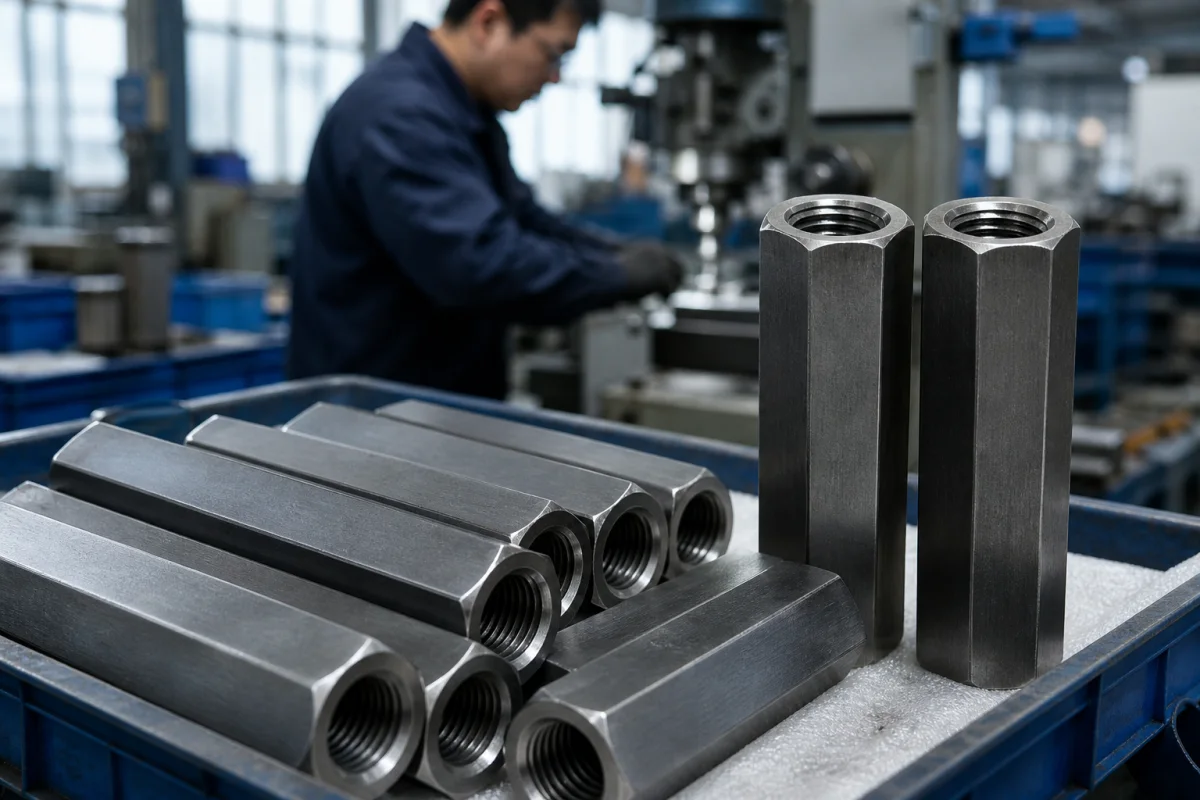
Coupling nut (extension nut) · Standard (DIN 6334, ASME), thread and size, length, material and grade (ASTM A194 2H, stainless 304/316), finish
A coupling nut is a long, internally threaded hex nut that joins two male threads, such as two lengths of threaded rod. Ask three things first: which thread and size it must match, which standard and length it is made to, and which material, grade and finish suit the load and environment.
Hex coupling nuts (also called extension or rod coupling nuts) in metric and inch threads, in carbon, alloy and stainless steel or brass. Threaded rod itself (see threaded rod), standard hex and flange nuts (see flange nut), turnbuckles and shaft couplings are outside this page.
CNFX editorial research · Sources checked October 12, 2026 · 4 sources
AFT Fasteners states that coupling nuts join two male threads (“a very common example of this is two threaded rods”) and also other externally threaded rods and studs, and lists them in SAE and metric sizes from #2-56 to 2 in-4½ and M5-0.80 to M30-3.50. [2]
Haiyan Bolt describes the hex coupling nut as an internally threaded hexagon longer than a regular hex nut, at more than 2.5 times the basic major thread diameter, with double chamfers at both ends to guide rods in; as an example it gives a 1/2 in coupling nut with 11/16 in across flats, 0.794 in across corners and 1 3/4 in length. It lists DIN 6334 and ANSI/ASME standards, UNC and UNF threads, metric sizes M6–M33 and inch sizes 1/4–1 1/2 in, and describes its stainless DIN 6334 coupling nut at about three times the thread diameter in M5–M30. [1]
Editorial calculation: 1 3/4 in ÷ 1/2 in = 3.5 times the diameter for Haiyan's 1/2 in example; 11/16 in ≈ 17.5 mm across flats and 1 3/4 in ≈ 44.5 mm long. [1]
Give the supplier the thread (metric or UNC/UNF) and size, length, standard (DIN 6334 or ASME), material and grade, finish, quantity, any sight hole or special chamfer, and the grade of rod or stud it must match.
02
Choose the material, grade and finish
Haiyan Bolt lists hex coupling nuts in low, medium-carbon and alloy steel, stainless 201, 304 and 316, brass and aluminium alloy, with SAE classes, ASTM A194 2H and metric classes 4 to 10, and finishes from plain and black oxide to zinc, hot-dip galvanized, nickel, chrome, Dacromet and Geomet; it notes 304 contains about 18% chromium and 8% nickel and 316 about 16% chromium, 10% nickel and 2–3% molybdenum for chloride environments. [1]
ASTM A194 covers carbon, alloy and martensitic stainless steel nuts from 1/4 to 4 in and M12 to M100, and austenitic stainless nuts from 1/4 in and M12, intended for high-pressure or high-temperature service, and does not allow grade substitution without the purchaser's permission. [3]
AFT lists coupling nuts in stainless steel, steel or brass with hot-dip galvanized, plain or zinc Cr+3 finishes, noting stainless or zinc finishes add corrosion resistance. [2]
03
Compare what suppliers offer
The suppliers linked to this page list coupling nuts; their cards link to the pages reviewed.
Ask any supplier for the standard and drawing with across-flats, length and chamfers, thread class, material and grade with certificates, proof-load or hardness test results, finish and coating thickness, and packaging.
04
Check proof load, hardness and coating specs on the certificate
Porteous Fastener Company's product information sheet for inch-series coupling nuts (undated) says they are purchased to meet ASTM A563 Grade A, from low carbon steel (1008 / 1010) for sizes up to 1 inch and 1045 steel for sizes over 1 inch, with hardness HRB 68 to HRC 32 and a minimum proof load strength of 90,000 psi, or 68,000 psi for hot-dip galvanized nuts. [4]
The sheet specifies zinc plating to ASTM F1941 FeZn3A and hot-dip galvanizing to ASTM A153, with galvanized nuts tapped oversize per ASTM A563. It defines proof load as an axially applied load, through a bolt or mandrel, that the nut must support without thread stripping or rupture, and notes that the specifications do not include the breaking strength or tensile strength of coupling nuts. [4]
Editorial calculation: 68,000 ÷ 90,000 ≈ 0.76, so the galvanized figure is about 24% below the 90,000 psi figure; at 1 psi = 0.006895 MPa, 90,000 psi ≈ 621 MPa and 68,000 psi ≈ 469 MPa. Editorial note: where a coupling nut joins high-strength rod, ask which ASTM A563 or ASTM A194 grade [3] the nut is made to, and for proof-load and hardness results on the certificate, since the sheet gives no tensile value.
Fill the specification fields with values for your order
A coupling nut quotation needs values for your joint. The table explains each field, gives published values where a reviewed source states them, and says what to obtain from the supplier.
Field
What it means and published values
Ask the supplier for
Applicable Standard / Evidence
DIN 6334; ANSI/ASME; ASTM A194 for pressure service. [1][3]
Explore company information and manufacturing capabilities, then discuss the scope of your project with a relevant supplier.
Share this page
Compiled and source-reviewed by the CNFX editorial team.
Published product pages show what a company offers, not tested performance. Confirm the legal seller, factory and scope for your order. How we source and review
· Page last updated 13 October 2026
Buyer questions
How long is a coupling nut?
Haiyan Bolt describes coupling nuts longer than 2.5 times the thread diameter, and its stainless DIN 6334 nut at about three times. [1]
Can a coupling nut join two threaded rods?
Yes; AFT Fasteners calls two threaded rods “a very common example”, along with joining other rods and studs. [2]
Which nut standard covers high-temperature service?
ASTM A194 covers nuts for high-pressure or high-temperature service. [3]
What proof load does a carbon steel coupling nut have?
Porteous Fastener Company's product sheet lists 90,000 psi minimum for inch coupling nuts purchased to ASTM A563 Grade A, and 68,000 psi for hot-dip galvanized nuts; it gives no tensile strength. [4]
Sources and what still needs a direct check
Sources checked 2026-10-12. Haiyan Bolt makes coupling nuts; AFT Fasteners distributes them; ASTM A194 is the standard for nuts in high-pressure or high-temperature service.