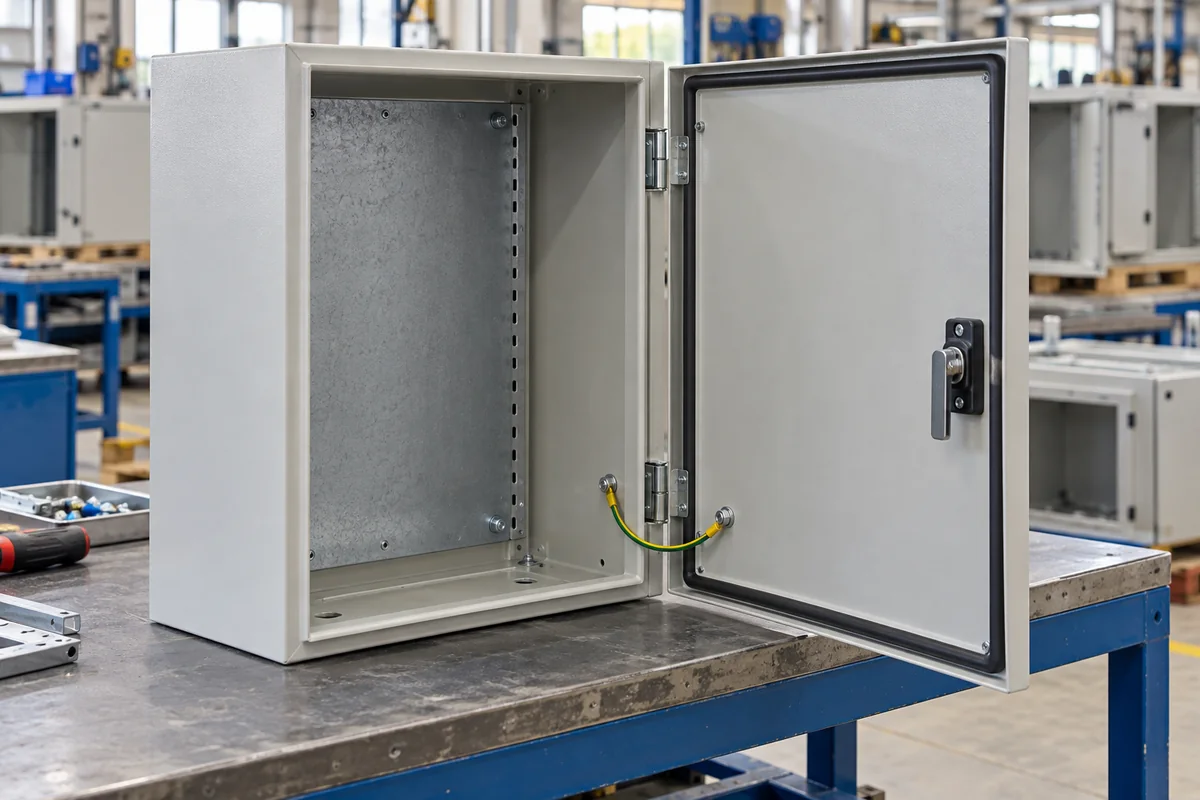
Enclosure door assembly: the gasketed, hinged and earthed front door of a wall-mount control enclosure
The hinged front door of a sheet-steel control enclosure · door leaf, foamed-in or strip gasket, swappable hinges, cam lock, PE earth strap and door stop
The door is the part of an enclosure that is opened and closed in service, and it carries the parts that decide whether the box still meets its IP or Type rating after installation: the seal against the body flange, the hinges, the lock and its insert, and the protective-earth connection across the hinge line. It is ordered with a new enclosure, as a spare for an existing one, or as a set of door parts (gasket, hinge, lock insert, earth strap, door stop) when a door is reworked in the field.
Front doors of sheet-steel and stainless wall-mount and compact control enclosures, with their gaskets, hinges, locks and lock inserts, protective-earth straps and door stops, supplied with the enclosure or as replacement and retrofit parts. Selection of the whole enclosure by NEMA Type, IP code, material and size is covered on the Industrial enclosure page. Building, vehicle and machine-guard doors, door-assembly gauges and complete control cabinets with their equipment are outside this page.
CNFX editorial research · Sources checked October 12, 2026 · 4 sources
Door leaf, seal and hinges on a 300 × 400 mm compact enclosure rated IP 66 and UL Type 4/12
Rittal's AX 1034.000 shows how a compact enclosure door is built. The door is sheet steel 1.5 mm thick on a 1.25 mm body, with an all-round foamed-in PU seal, a vertical perforated door strip on both sides and a PE conductor connection; the hinges are screw-fastened, the right-hand hinge can be moved to the left, and the door opens 130° to VDI and can be retrofitted to 180°. [1] The enclosure is rated IP 66 to IEC 60529, NEMA 1, 3R, 4 and 12 and UL 50E Types 1, 3R, 4 and 12, and IK10. [1]
Its body is folded from a single piece and welded, with a protection channel around the door opening; enclosure and door get a nanoceramic coating, electrophoretic dip-coat priming and a textured RAL 7035 powder coat on the outside. [1] The listed accessories that act on the door are the mini-comfort handle, lock inserts, door stay, viewing window, operating panels, earth straps and the 180° hinge. [1]
When the seal is worn or damaged, nVent Hoffman's gasket replacement kits replace foam-in-place or strip gaskets on door, cover and gland plate of its Type 4, 4X and 12 enclosures. The strip is 0.63 in (16 mm) wide for wall-mount enclosures and 1.00 in (25 mm) for free-standing and floor-mount enclosures, comes in EPDM or in silicone for extreme temperatures and harsh applications, is supplied as a 20 ft (6 m) roll, and is listed as UL 508A component recognised, Type 4, 4X, 12. [3] Editorial calculation: the 300 × 400 mm front of the AX 1034.000 has a 1.4 m perimeter, so one 6 m roll is about 4.3 times that length before joins and trimming.
Bonding the door across the hinges: a 16 mm², M8–M8 strap 170 mm long
The AX door has its own PE conductor connection, and earth straps are a listed accessory. [1] Rittal's SZ 2565.000 earth strap has a 16 mm² cross-section and M8 ring terminals at both ends, is 170 mm long, and is supplied in packs of five; for AX enclosures its connection points are the door or cover, the enclosure and the mounting plate, all M8. [2]
Rittal asks installers to follow the assembly instructions or PE conductor brochure of the enclosure system concerned. [2] Editorial note: on a replacement or retrofit door, check that the door has an earthing stud or a PE connection point before ordering, and route the strap so that it is not pinched when the door closes or opens to its full angle.
03
Holding the door open without losing the Type rating: drilled stop kits for doors 406 mm wide and up
nVent Hoffman's door stop kit holds the door of a standard Type 4 or 12 enclosure in an open position. It needs a B (width) dimension of 16.00 in (406 mm) or more and a horizontally opening door, mounts at the top or bottom of the door opening after drilling two small holes in the body and two in the door, and sets the angle with a wing nut; the arm slides out of the way when the door is closed. [4]
Hoffman states that the kit maintains UL/CSA Type 4, 4X and 12 if properly installed in its enclosures, and that it is not intended for window-door enclosures, enclosures with a swing-out panel or rack frame, or high-wind conditions. [4] Editorial calculation: the 300 mm-wide AX 1034.000 falls below the 406 mm minimum width this kit states; Rittal lists a door stay among the AX accessories. [1]
04
Data for an enclosure door or door-part enquiry
Paste it into your enquiry below or into an email to a maker, then replace every bracket.
Enclosure: [make, series and size W × H × D; IP code or NEMA/UL Type to keep]
Door: [material and thickness; cut-outs or window; finish and colour]
Seal: [foamed-in or strip; EPDM or silicone; width]
Hinges: [hinge side; opening angle]
Lock: [insert type to DIN 43668 or handle; locking points]
Earthing: [strap cross-section; length; stud size]
Accessories: [door stop or stay; document pocket]
Explore company information and manufacturing capabilities, then discuss the scope of your project with a relevant supplier.
Share this page
Compiled and source-reviewed by the CNFX editorial team.
Each manufacturer above links to the page on that company's own website where the product is listed, with the date we checked it. How we source and review
· Page last updated 13 October 2026
Buyer questions
How thick is a compact enclosure door?
Rittal's AX 1034.000 uses a 1.5 mm sheet-steel door on a 1.25 mm enclosure body, with a foamed-in PU seal. [1]
How wide is a replacement enclosure door gasket?
nVent Hoffman's strip gasket kits are 0.63 in (16 mm) wide for wall-mount enclosures and 1.00 in (25 mm) for free-standing and floor-mount enclosures, in EPDM or silicone, on a 6 m roll. [3]
What earth strap is used between door and enclosure?
Rittal's SZ 2565.000 is a 16 mm² strap with M8 ring terminals at each end, 170 mm long, connecting door, enclosure and mounting plate on AX enclosures. [2]
Does fitting a door stop break the enclosure rating?
nVent Hoffman states its drilled door stop kit maintains UL/CSA Type 4, 4X and 12 if properly installed, on enclosures at least 406 mm wide. [4]
Sources and what still needs a direct check
Sources checked 2026-10-12. Door construction, seal, hinge, lock and accessory details come from Rittal's AX 1034.000 product data; the earth strap from Rittal's SZ 2565.000 data; gasket replacement and door stop details from nVent Hoffman product pages. Values apply to the models named.