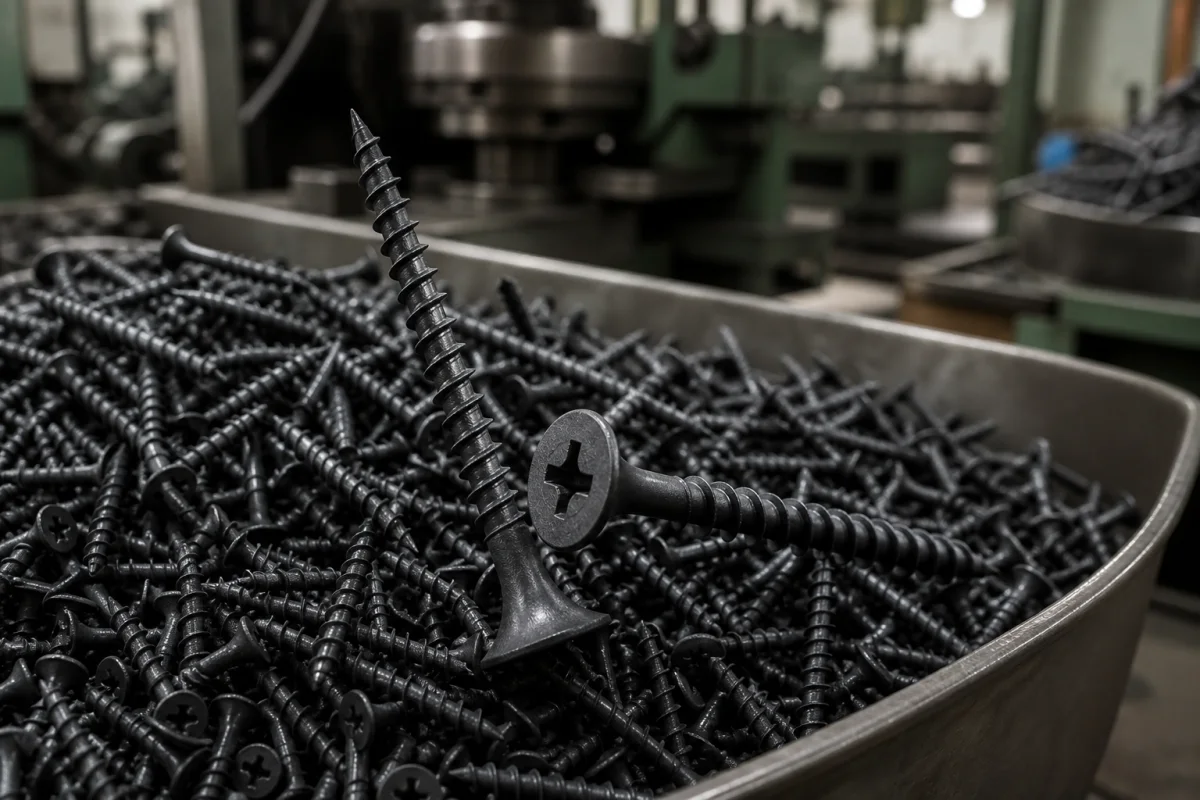
Drywall screws · Thread type by substrate (Type S, W, G, A), sharp point versus drill point by steel stud thickness, coating, length and collation
A drywall screw is a case-hardened steel screw with a bugle head and a fine, coarse or high thread, made by cold heading and thread rolling and phosphate-coated or otherwise finished, that fixes gypsum board to steel or timber studs or to other boards, driven by a screwdriver with a depth-setting nose. Ask three things first: which substrate and stud thickness it must penetrate, which thread and point type the standard calls for, and which length, coating and collation suit the board and tools.
Drywall (gypsum board) screws with sharp or drill points, loose or collated. Self-drilling screws for structural steel, wood screws, chipboard screws, machine screws and anchors are outside this page.
CNFX editorial research · Sources checked October 12, 2026 · 4 sources
ASTM C1002 covers steel self-piercing tapping screws for fastening gypsum panel products and metal plaster bases to cold-formed steel studs less than 0.033 in (0.84 mm) thick and to wood, and gypsum board to gypsum board. It defines four thread types: Type G, coarse-pitch high-thread screws for board to board; Type S, fine-thread screws for board to cold-formed steel; Type W, coarse-thread screws for board to wood; and Type A, coarse-pitch tapping screws for metal plaster bases. Screws must meet its performance, hardness and ductility tests and carry a corrosion-resistant treatment that does not stop finishing compounds adhering or bleed through decoration. [1]
For heavier steel, ASTM C954 covers steel drill screws for fastening gypsum panel products or metal plaster bases to steel members from 0.033 in (0.84 mm) to 0.112 in (2.84 mm) thick, made from grade 1018–1022 steel wire, carbonitrided to a specified depth and tested with a power-driven screw gun. [2]
Editorial calculation: a stud of 0.0296 in (0.75 mm) base metal falls under C1002 sharp-point screws; one of 0.0566 in (1.44 mm) is above 0.84 mm and needs C954 drill screws. Measure the base-metal thickness of the studs and state it in the enquiry. [1][2]
Give the supplier the substrate (steel stud base-metal thickness, timber, or board to board), board type and total thickness, thread type and standard (ASTM C1002 Type S/W/G/A or C954), head and drive, point (sharp or drill), length, coating, loose or collated and magazine type, packaging and quantities.
02
Fix length, coating and collation
Hilti's S-DS 01 B sharp-point drywall screw is phosphate-coated and collated for its SD-M 1 and SD-M 2 screw magazines, for fastening drywall boards to metal substructures up to 0.88 mm, and is offered in 25, 35, 41, 45 and 51 mm lengths. [3]
Editorial note: choose length from the total board thickness plus the engagement the board maker or applicable standard requires in the stud; ask the supplier for its length chart and for the hardness and ductility test results under ASTM C1002 or C954.
Editorial note: collated screws must match the magazine; confirm strip type and tool model before ordering.
03
Write the screws into a project specification
Public owners call up drywall screws by standard and stud thickness rather than by brand. The US Unified Facilities Guide Specification UFGS 09 29 00, Gypsum Board (August 2024, prepared by NAVFAC for USACE, NAVFAC and AFCEC), shows how. [4]
Its screw clause requires ASTM C1002 Type G, Type S or Type W screws for fastening gypsum board to gypsum board, to wood framing and to steel framing members less than 0.84 mm (0.033 in) thick, ASTM C954 steel drill screws for steel framing from 0.84 to 2.84 mm (0.033 to 0.112 in), and polymer-coated screws for cementitious backer units. Its notes send the designer to ASTM C840 and GA 216 for fasteners and application, and for moisture-resistant board advise studs no more than 406 mm (16 in) on centre behind tile and ceiling supports no more than 305 mm (12 in) on centre. [4]
Editorial calculation: 0.84 mm is the C1002/C954 boundary, so a 0.75 mm (about 30 mil) stud takes C1002 Type S screws while a 1.09 mm (about 43 mil) stud needs C954 drill screws; a board on 406 mm stud centres needs a screw line about every 0.41 m across its width, so a 1,219 mm (4 ft) wide board spans three bays and lands on four stud lines (1,219 ÷ 406 ≈ 3). [4]
Fill the specification fields with values for your boards
A drywall screw quotation needs values for your boards. The table explains each field, gives published values where a reviewed source states them, and says what to obtain from the supplier.
Field
What it means and published values
Ask the supplier for
Applicable Standard
ASTM C1002 (< 0.84 mm steel, wood, board); C954 (0.84–2.84 mm steel). [1][2]
Explore company information and manufacturing capabilities, then discuss the scope of your project with a relevant supplier.
Share this page
Compiled and source-reviewed by the CNFX editorial team.
Published product pages show what a company offers, not tested performance. Confirm the legal seller, factory, test results and scope for your order. How we source and review
· Page last updated 13 October 2026
Buyer questions
What is the difference between Type S and Type W drywall screws?
ASTM C1002 defines Type S as fine thread for cold-formed steel and Type W as coarse thread for wood. [1]
Which screws are needed for thicker steel studs?
ASTM C954 covers drill screws for steel 0.84 mm to 2.84 mm thick; C1002 covers studs thinner than 0.84 mm. [2][1]
What lengths do drywall screws come in?
Hilti's S-DS 01 B range offers 25, 35, 41, 45 and 51 mm. [3]
Which ASTM standard applies to drywall screws on heavier steel studs?
UFGS 09 29 00 calls up ASTM C954 drill screws for steel framing 0.84 to 2.84 mm thick and ASTM C1002 Type S screws for steel under 0.84 mm. [4]
Sources and what still needs a direct check
Sources checked 2026-10-12. ASTM's published scopes define the screw types; Hilti describes its own range. Results for your screws must come from the supplier's tests to the standard you specify.