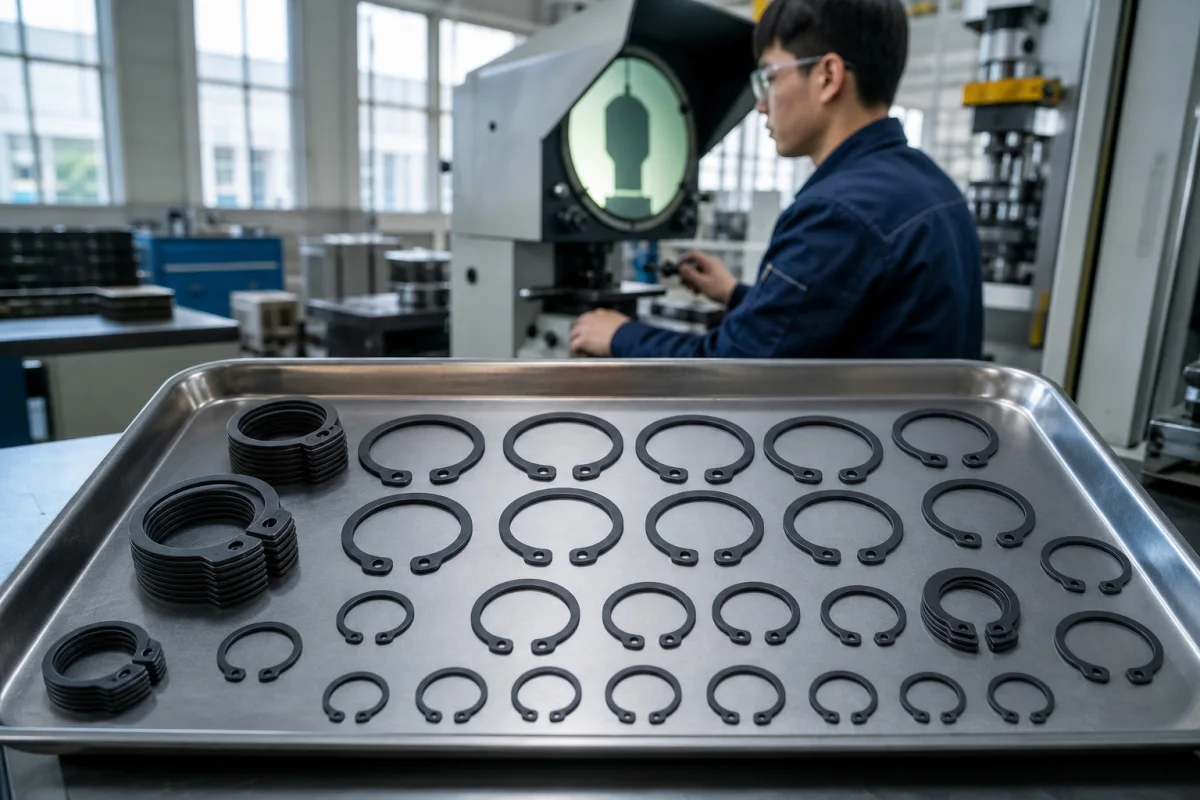
External (shaft) retaining rings · Ring type and groove, thrust load and speed, material and temper, finish and hardness checks
An external retaining ring (circlip or snap ring for shafts) is a spring ring that snaps into a groove on a shaft to stop a bearing, gear or spacer moving along it. Fix three things before ordering: the ring type and standard together with the shaft and groove dimensions, the thrust load, speed and shoulder it must work with, and the material, temper and finish for the environment.
External (shaft) retaining rings — tapered-section circlips to DIN 471 and similar, E-rings, spiral rings and push-on rings. Internal (bore) rings, wave springs, hose clamps and lock washers are outside this page.
CNFX editorial research · Sources checked October 11, 2026 · 5 sources
Rotor Clip's retaining ring FAQ describes a retaining ring — also called a circlip or snap ring — as a fastener that holds components on a shaft or in a housing bore; circular push-on rings can be used where there is no groove. It says a groove is all that is needed, so no threads are machined and no re-torquing is required, and that its largest rings withstand thrust loads above 260,000 lb (about 118,000 kg). [1]
The FAQ says the choice between an axial ring (installed along the shaft) and a radial ring (pushed on from the side) can be set by shoulder size, thrust load and speed; that an E-ring which cannot withstand the application's speed can be replaced by a reinforced RE ring in the same groove; and that a reinforced SHR ring carries higher thrust and speed than an SH ring but needs a wider groove. Some catalogue rings fit two shaft or groove sizes, and E-ring variants of the same nominal size suit different grooves. [1]
Kunshan Zhonggu lists retaining rings for shafts to DIN 471 in 65Mn spring steel, with black oxide finish, alongside DIN 472 bore rings. [3]
Editorial note: because ring variants are matched to particular groove widths and depths, give the supplier the groove dimensions as machined, not only the shaft diameter. [1]
Give the supplier the ring type and standard (for example DIN 471, E-ring, spiral, push-on), shaft diameter and groove diameter, width and edge condition, axial load and speed, shoulder or abutment size, material and temper, finish, installation method (pliers, applicator, automation), packaging (loose, stacked) and quantity.
02
Set material, temper, finish and hardness checks
Smalley's standard materials page lists two carbon steels for retaining rings — SAE 1070–1090 high-carbon spring steel, oil tempered, and SAE 1060–1075 high-carbon spring steel, hard drawn — and 302 and 316 stainless steels, with 17-7 PH as its standard wave-spring material. It says carbon steel is cost-effective but has low corrosion resistance and is supplied with an oil dip for shipment and storage, while stainless steel resists corrosion and withstands higher temperatures; 316 adds molybdenum for pitting resistance. [2]
Rotor Clip lists carbon steel, stainless steel and beryllium copper as retaining ring materials, with finishes chosen for appearance and corrosion protection. To check hardness, it says the finish must first be removed from both sides of the ring and the reading taken with the burr side up, then compared with the hardness table for that ring. [1]
03
Check the ring's free diameter, section height and groove depth
DIN describes DIN 471 as specifying requirements for retaining rings for shafts and the corresponding grooves, for fixing components such as rolling bearings on shafts and transferring axial forces; its catalogue lists the 2011-04 edition, in normal and heavy types, as withdrawn, so ask the supplier which edition its rings and groove tables follow. [5] The geometry behind a tapered-section shaft ring is set out in a 1958 patent filed by ring maker Waldes Kohinoor (US 2,982,165 A). It explains that the section height decreases from the middle of the ring to its free ends so the ring stays circular when spread. For a ring whose free inner diameter is 0.9 of the shaft diameter S, so that it spreads by 0.1 S to pass over the shaft, the patent states that the maximum section height must not exceed 0.1 S and the groove depth 0.05 S if the ring is to stay in its elastic range; its claimed heavier ring has a free inner diameter of about 0.90–0.92 S, a middle section height of 0.13–0.20 S and a thickness of up to half the maximum section height. [4]
Editorial calculation for a 20 mm shaft: a free inner diameter of 0.90–0.92 S is 18.0–18.4 mm; the 0.1 S section-height limit is 2.0 mm with a groove no deeper than 1.0 mm; the claimed 0.13–0.20 S section height is 2.6–4.0 mm. A taller section gives a larger shoulder for chamfered parts but needs a larger free diameter and so a shallower groove; the patent presents this as the trade-off its heavier ring addresses. [4]
Ask the supplier for the ring's free inner diameter, section height at the middle and at the ends, thickness, and the groove diameter and width it is designed for, and check them against the edition of DIN 471 or the maker's catalogue you are buying to. [5][1]
Suppliers linked to this page list external retaining rings; each card links to the page reviewed.
The listing reviewed offers DIN 471 shaft rings and DIN 472 bore rings in 65Mn with black oxide, and spiral retaining rings. Ask for the standard edition, hardness range, finish and the groove dimensions the ring is made for. [3]
05
Trace what each feature controls
This is a functional reference built from the sources cited; it is not one maker's specification.
Fill the specification fields with values for your shaft
A retaining ring quotation needs values for your shaft. The table explains each field, gives published values where a reviewed source states them, and says what to obtain from the supplier.
Explore company information and manufacturing capabilities, then discuss the scope of your project with a relevant supplier.
Share this page
Compiled and source-reviewed by the CNFX editorial team.
Published product pages show what a company offers, not tested performance. Confirm the legal seller, maker and certificates for your order. How we source and review
· Page last updated 13 October 2026
Buyer questions
What is an external retaining ring?
Rotor Clip describes a retaining ring as a fastener that holds components on a shaft or in a bore; external rings fit shafts. [1]
What materials are retaining rings made from?
Carbon steel, stainless steel or beryllium copper; Smalley lists SAE 1070–1090 and 1060–1075 carbon steels and 302 and 316 stainless. [1][2]
How much thrust can a retaining ring take?
Rotor Clip says its largest rings withstand thrust loads above 260,000 lb. [1]
How do you check retaining ring hardness?
Rotor Clip says remove the finish from both sides and test with the burr side up. [1]
How deep is the groove for an external retaining ring?
It depends on the ring's free diameter and section height. A Waldes Kohinoor patent states that for a ring with a free inner diameter of 0.9 times the shaft diameter, the section height should not exceed 0.1 and the groove depth 0.05 of the shaft diameter; standard groove tables are in DIN 471. [4][5]
Sources and what still needs a direct check
Sources checked 2026-10-11. Rotor Clip publishes a retaining ring FAQ and Smalley a standard materials page; a Waldes Kohinoor patent sets out tapered-ring geometry and DIN's catalogue page describes DIN 471; Kunshan Zhonggu is a linked supplier.