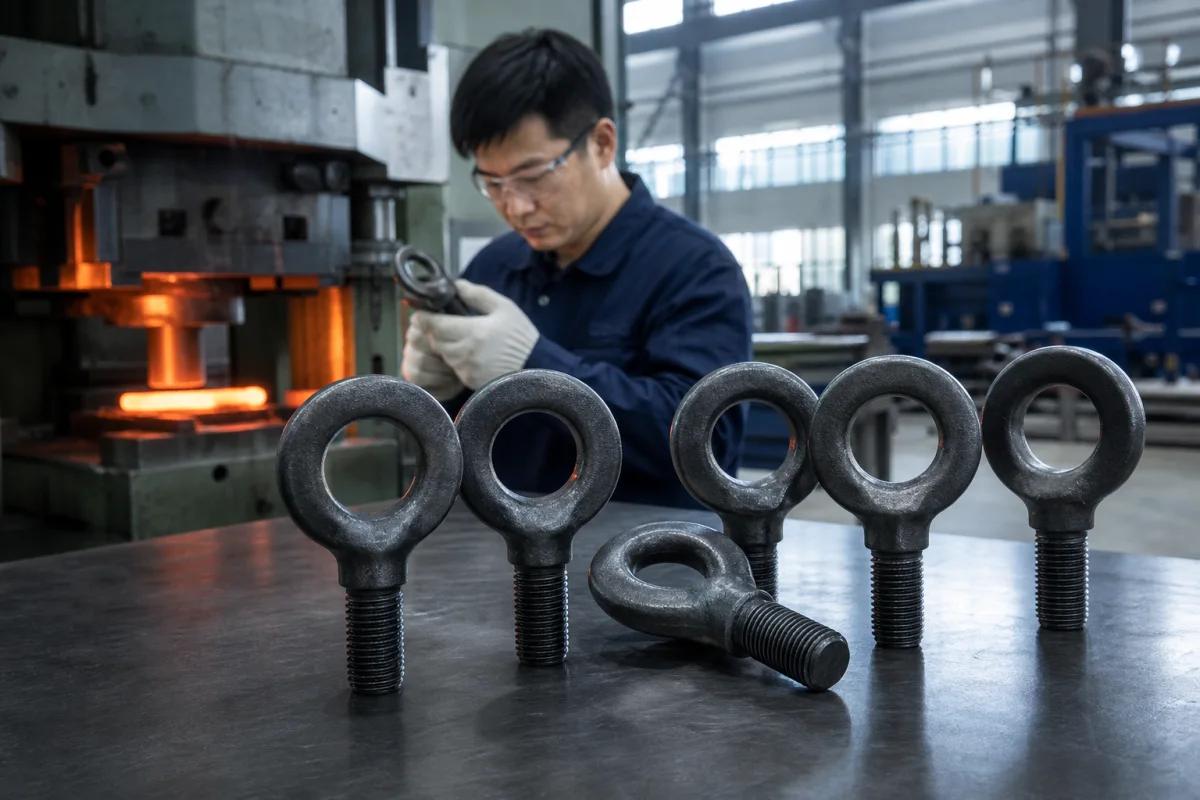
Eye bolts and lifting eyes · Lifting-rated forged vs general hardware, plain vs shoulder pattern, carbon vs low-temperature alloy steel, proof load and marking
An eye bolt is a threaded fastener with a loop at its head, used as an attachment point for slings, ropes, chains or guy wires. Lifting-rated forged eye bolts and general-hardware eye bolts are not interchangeable. Settle three things before ordering: whether the bolt is for overhead lifting and to which specification, the shank pattern and thread, and the steel, heat treatment, finish and markings required.
Forged lifting eye bolts (lifting eyes) and general-purpose eye bolts in carbon, alloy and stainless steel, including shoulder and plain patterns and long eye bolts. Eye nuts, swivel hoist rings, shackles, eye screws for wood and wire-rope fittings are outside this page.
CNFX editorial research · Sources checked October 11, 2026 · 5 sources
ASTM A489 covers weldless forged, quenched and tempered carbon steel threaded lifting eyes (formerly called eyebolts) for overhead lifting, with chemical, mechanical, grain-size and dimensional requirements. It sets proof load, breaking strength, tensile strength, bend, impact, yield point, elongation and reduction-of-area requirements. [1]
A489 warns that lifting eyes made to it from carbon steel, even when liquid quenched and tempered, could have a fracture-appearance transition temperature (50% shear) above the operating temperature; to minimise brittle cleavage failure they should never be loaded above the proof load and should not be used when surface discontinuities exist. [1]
ASTM F541 covers forged, quenched and tempered alloy steel threaded eyebolts with improved toughness, chemically and metallurgically constituted for a low transition temperature to minimise brittle failure, intended primarily for low-temperature service, with thread sizes up to 2.500 in (63.5 mm), in two types. [2]
Editorial note: for overhead lifting, order to a lifting specification such as A489 or F541 and require the rated load and markings on each bolt; a hardware eye bolt without a lifting rating should not be used to lift. [1][2]
Give the supplier the use (overhead lifting, rigging, anchoring, hanging), specification and type, thread size and pitch, shank length and pattern, eye inside diameter, rated working load and loading angle, steel and heat treatment, low-temperature requirement, finish (plain, zinc, hot-dip galvanized, stainless), markings, certificates and proof-test records, and quantity.
02
Set shank pattern, steel and finish
A489 includes two shank patterns — Type 1 plain (straight shank) and Type 2 shoulder pattern — and a Style B short length, all as defined in ASME B18.15. [1]
Linked suppliers list carbon and stainless steel eye bolts in plain and shoulder patterns with zinc plating [3], forged eye bolts in galvanized and 316 stainless steel including long eye bolts for formwork and precast anchoring [4], and forged eye bolts for pole-line hardware with hot-dip galvanizing tested to ASTM A123 or ISO 1461 by market. [5]
Editorial note: state the pattern (plain or shoulder) on the order and ask the supplier for the permitted loading angles and any reduction in rated load at each angle. [1]
03
Compare what suppliers offer
Suppliers linked to this page list eye bolts; each card links to the page reviewed.
The listings reviewed range from general-purpose zinc-plated and stainless eye bolts to forged galvanized and pole-line eye bolts. Ask each whether the product is lifting-rated, to which specification, and for proof-test certificates. [3][4][5]
04
Trace what each feature controls
This is a functional reference built from the sources cited; it is not one maker's specification.
Fill the specification fields with values for your use
An eye bolt quotation needs values for your use. The table explains each field, gives published values where a reviewed source states them, and says what to obtain from the supplier.
Explore company information and manufacturing capabilities, then discuss the scope of your project with a relevant supplier.
Share this page
Compiled and source-reviewed by the CNFX editorial team.
Published product pages show what a company offers, not tested performance. Confirm the legal seller, maker, lifting rating and certificates for your order. How we source and review
· Page last updated 13 October 2026
Buyer questions
Which standard covers forged lifting eye bolts?
ASTM A489 covers weldless forged, quenched and tempered carbon steel lifting eyes for overhead lifting. [1]
What is the difference between plain and shoulder eye bolts?
A489 lists Type 1 plain (straight shank) and Type 2 shoulder pattern, defined in ASME B18.15. [1]
Which eye bolts suit low temperatures?
ASTM F541 alloy steel eyebolts with improved toughness and low transition temperature. [2]
Can a carbon steel lifting eye be overloaded?
A489 says they should never be loaded above the proof load. [1]
Sources and what still needs a direct check
Sources checked 2026-10-11. ASTM A489 and F541 summary pages cover forged lifting eyes and low-temperature eyebolts; the rest are linked suppliers.