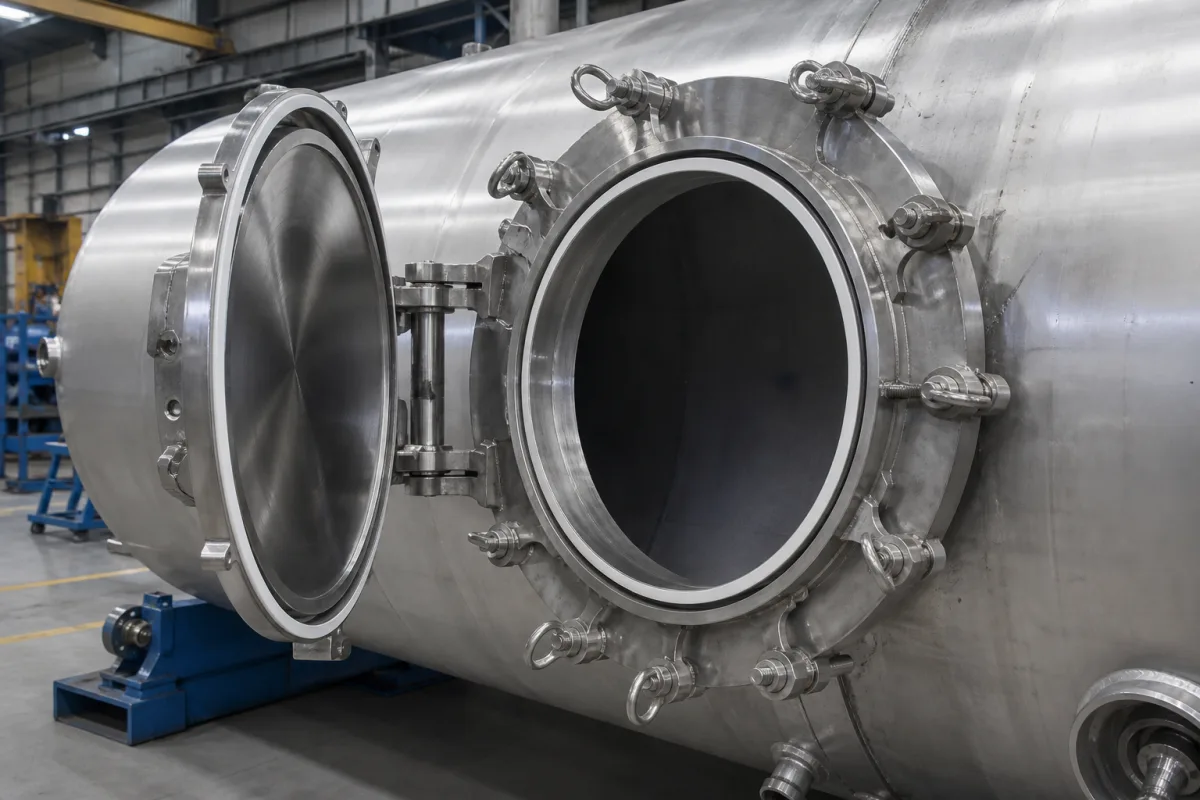
Manway closures for process pressure vessels · Opening size rules, flat, domed and hinged covers, swing bolts and swivel devices
A manway assembly is the bolted-on closure that lets people into a pressure vessel for inspection, cleaning and repair: a flanged nozzle welded into the shell or head, a cover that resists the full design pressure, the gasket between them, the bolting, and on larger covers a hinge or swivel arm to carry the weight when it is opened. The vessel code decides whether a manway is needed and how big; the closure design decides how heavy the cover is and how long it takes to open.
Manway (manhole) closures built onto process pressure vessels, columns and heat-exchanger shells: the nozzle and flange, flat or domed covers, hinged and davit or swivel arrangements, swing-bolt and clamp fastening, and gaskets, specified as an assembly. The vessels themselves are covered on the Pressure vessel page. Hygienic manways with hand-wheel or clamp closures for food, beverage and pharmaceutical tanks are covered on the Sanitary manway page; bulk-handling inspection doors on the Inspection hatches and access ports page; road and pit manhole covers on the Manhole cover and frame page.
CNFX editorial research · Sources checked October 12, 2026 · 4 sources
When a vessel needs a manhole and how small it may be
California's Unfired Pressure Vessel Safety Orders give a concrete example for air tanks. Where an ASME Code tank lacks inspection openings, tanks from 18 to 36 inches inside diameter need a manhole, or at least two handholes or two plugged threaded openings of at least 2-inch pipe size; tanks over 36 inches need a manhole unless their shape or use makes one impractical, when two 4 × 6 inch handholes or openings of equivalent area may replace it. [1]
The same section sets minimum sizes: an elliptical manhole at least 11 × 15 inches or 10 × 16 inches, a circular manhole at least 15 inches inside diameter, and a handhole at least 2 × 3 inches. All access and inspection openings are to be designed under the ASME Code rules for openings. Tanks in systems dried to an atmospheric dew point of −50 °F or lower need no inspection openings. [1]
Editorial calculation: the two elliptical minimums give π/4 × 11 × 15 ≈ 130 in² and π/4 × 10 × 16 ≈ 126 in², against π/4 × 15² ≈ 177 in² for the 15-inch circle, so the round minimum offers about 36% more area than the 11 × 15 ellipse. [1]
Editorial note: these figures are one jurisdiction's rule for air tanks and its reading of the ASME Code; the code edition and jurisdiction named on the vessel order govern the actual minimum, and process needs (internals to pass, entry with breathing apparatus) can call for a larger opening.
State the vessel code and jurisdiction, the vessel inside diameter, the required clear opening, and what must pass through it (people, trays, internals, tools).
02
Flat blind, domed, hinged, swing-bolt and clamp covers
Ward Vessel and Exchanger, a fabricator, notes that the manway is the largest opening on a pressure vessel and therefore can limit the vessel's pressure rating and design details. It describes the flat cover as a rated blind flange, the least expensive closure, but thick and heavy because a flat plate holds pressure less well than a curved one of the same thickness, and slow to remove with a full set of studs and nuts. [2]
Hinged covers come in two forms in Ward's account: flat covers on a hinge, which still need every stud removed and have lower pressure ratings, and domed covers that raise the rating for higher-pressure vessels. Slotted tabs with toggle or swing bolts cut opening and closing time, and winged nuts that can be knocked loose with a hammer let the stud swing aside for the quickest access. [2]
Two other closures in the same account: ID-mounted elliptical covers, used on boilers, that use internal pressure to help seat the gasket, are quick to open but smaller than standard manways and cannot be rated for vacuum; and manway clamp fasteners, which need no bolt holes in flange or cover and can carry relatively high pressure when the clamps are set at close pitch to spread the load on a flat cover. [2]
Editorial calculation: a DN 500 cover at 16 bar (1.6 MPa) acting over a 500 mm diameter carries 1.6 × 10⁶ Pa × π/4 × 0.5² m² ≈ 314 kN, about 32 tonnes-force, before gasket seating load is added. That force is shared by the bolts or swing bolts on the circle, which is why the number and size of fasteners, not the hinge, decide whether a cover can be rated for the vessel.
Name the cover form, the fastening (studs and nuts, swing bolts, clamps), whether vacuum service applies, how often the manway is opened, and the gasket type to be replaced at each opening.
03
DIN 28124 manhole closures: four parts, DN 500 and DN 600, and their status
DIN's Chemical Apparatus Standards Committee (FNCA) prepared DIN 28124 "Manhole closures" in four parts: Part 1 for unpressurized vessels, Part 2 for pressure vessels, Part 3 for covered (clad) pressure closures and Part 4 for swivel devices. DIN now lists the 2010-09 editions of Part 2 and Part 3 as withdrawn. [3][4]
Part 2 applied to closures of carbon, alloy and stainless steels and of surface-protected steels on pressure vessels, for the operating conditions in its Table 1 (per DIN 28032, DIN 28034 or DIN EN 1092-1), with closures designed to the apparatus flange system of DIN 28030-1. DN 500 at PN 10 and PN 16 and DN 600 at PN 10 could also follow DIN EN 1092-1 flanges, at possibly higher weight, and a calculated verification may be needed for the actual construction and duty. [3]
Part 3 allowed parts to be combined across the two documents; DIN's example is a nozzle of 1.4541 stainless steel to Part 2 with a P265GH cover clad in 1.4541 to Part 3. Vessel makers had to meet the essential safety requirements of the Pressure Equipment Directive, for instance through the AD 2000 Code, and AD 2000 Code A5 on access openings is named. [4]
Editorial note: because both parts are withdrawn, a drawing that cites DIN 28124 is a dimensional reference only; confirm which flange standard, pressure class and design calculation the fabricator will use instead.
04
What to send for a pressure vessel manway
Paste it into your enquiry below or into an email to a maker, then replace every bracket.
Vessel: [code; jurisdiction; inside diameter; shell or head location]
Design: [pressure; vacuum; temperature; corrosion allowance]
Opening: [clear diameter or elliptical size]
Cover: [flat blind; domed; hinged; davit or swivel arm]
Fastening: [studs and nuts; swing bolts; clamps]
Materials: [nozzle; cover; cladding; bolting; gasket]
Documents: [calculation; material certificates; pressure test]
Explore company information and manufacturing capabilities, then discuss the scope of your project with a relevant supplier.
Share this page
Compiled and source-reviewed by the CNFX editorial team.
Each manufacturer above links to the page on that company's own website where the product is listed, with the date we checked it. How we source and review
· Page last updated 13 October 2026
Buyer questions
What is the minimum manhole size on a pressure vessel?
One example: California's air-tank rules require at least 15 in inside diameter for a circular manhole, or 11 × 15 in or 10 × 16 in elliptical, with openings designed to the ASME Code. [1]
When must a vessel have a manhole?
Under the same California rules, tanks over 36 in inside diameter need a manhole unless impractical, when two 4 × 6 in handholes may substitute. [1]
Why use a hinged or swing-bolt manway cover?
Ward Vessel and Exchanger notes that flat blind covers are heavy and slow to open; hinged covers with swing bolts or winged nuts cut opening time, and domed covers raise the pressure rating. [2]
Is DIN 28124 still current?
DIN lists the 2010-09 editions of DIN 28124-2 and -3, the parts for pressure vessels, as withdrawn. [3][4]
Sources and what still needs a direct check
Sources checked 2026-10-12. The size rules are a state regulation for air tanks that refers back to the ASME Code; the DIN entries are the standards body's own summaries of withdrawn documents. The cover types come from a vessel fabricator's article and describe its experience, not a code requirement.