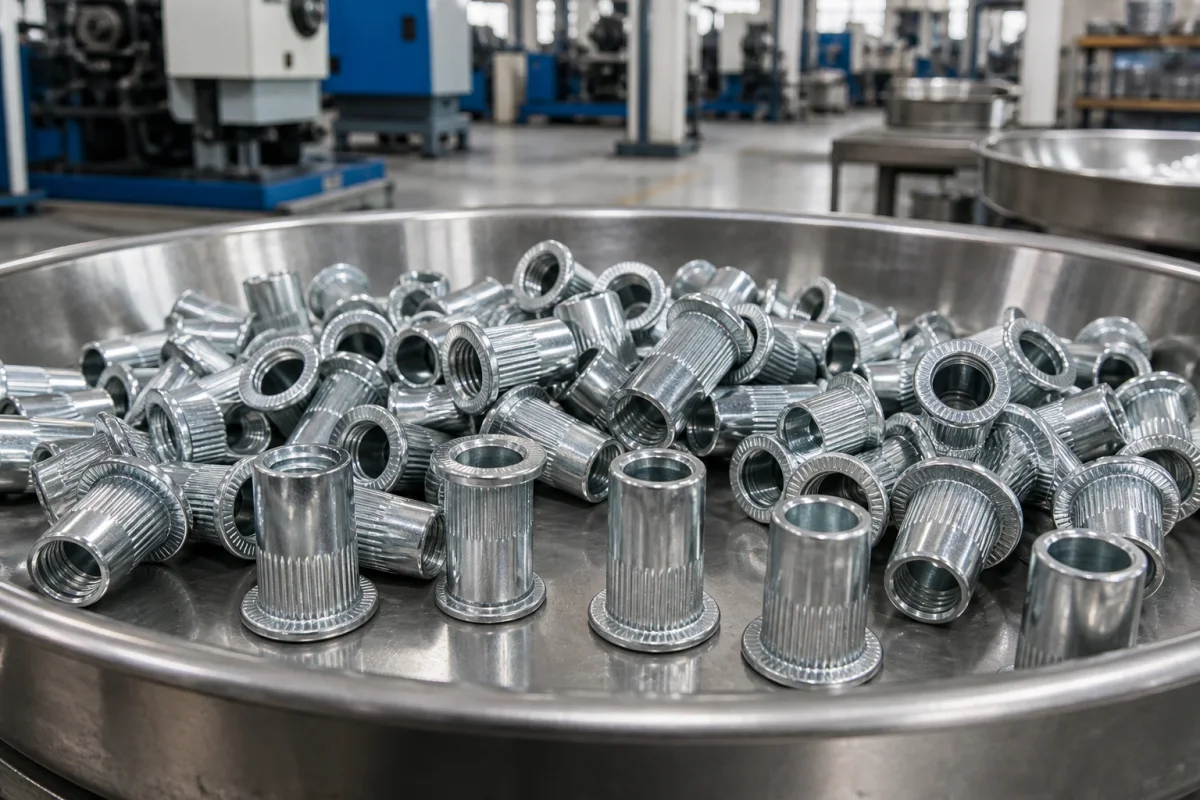
Blind rivet nuts (threaded inserts) · head styles, round, knurled, half-hex and full-hex bodies against spin-out, open and closed ends, steel, stainless and aluminium, high-strength versions for Class 10.9 bolts, and aerospace NAS standards
A rivet nut is an internally threaded insert installed from one side of a sheet, tube or hollow section: an installation tool deforms the body so that it expands and grips the hole, leaving a reusable thread for a screw or bolt. Ask three things first: which head and body suit the material and hole, whether the joint needs an open or closed end, and what thread strength and resistance to spinning the application demands.
Blind rivet nuts (rivnuts, blind threaded inserts) and rivet nut studs in steel, stainless steel and aluminium, metric and unified threads. Blind rivets (a separate product page), clinch and weld nuts, helical and solid threaded inserts for tapped holes, and installation tools sold alone are outside this page except where compared.
CNFX editorial research · Sources checked October 11, 2026 · 4 sources
Hunan Liangang, a rivet nut maker linked to this page, organises its range by head type (flat or large flange, countersunk, reduced or small head, hex head and umbrella head), body type (round smooth, round knurled, half-hex, full-hex and square), end type (through or blind) and material (carbon steel, stainless steel and aluminium), with large flange, reduced head, countersunk and unified standard series. [2]
Sherex, a North American rivet nut maker, lists rivet nuts in steel, stainless steel and aluminium, in M3 to M16 with imperial sizes, in round and hexagonal body styles; its round body nuts include knurled, smooth pre-bulbed, wedgehead, swaging and large and small flange styles, and it says rivet nuts can be installed in steel, plastic, composites and fibreglass and eliminate weld spatter and fumes compared with welded nuts. [1]
Editorial note: a hex or square body needs a matching hex or square hole; confirm the hole shape, size and tolerance and the grip range for your sheet thickness with the supplier's data sheet before tooling is made.
Give the supplier the thread size and pitch (metric or unified), base material and thickness (grip range), hole shape and size, head style, body style (round smooth, knurled, half-hex, full-hex, square), open or closed end and sealing need, material and finish, required torque-out, push-out and thread proof load, installation tool, standard or drawing (including NAS parts for aircraft), quantity and packing.
02
Match thread strength and spin resistance
Sherex states that full hex body rivet nuts perform best and, where a hex hole can be produced, recommends them; its high-strength hex body nuts offer the best performance against spin-out and pull-out, while its round body design uses aggressive knurls and underhead wedges to resist spinning in the base material. Its high-strength line, in hex and round bodies with open or closed (sealed) ends, M5 to M12 and #10-24 to 1/2"-20, is rated for Class 10 / Grade 8 thread proof load for use with Class 10.9 or Grade 8 bolts in high-clamp-load joints. [1]
The FAA's advisory circular on acceptable methods for aircraft inspection and repair (AC 43.13-1B) lists NAS452–453 rivnuts with 100° countersunk and flat heads, and NAS1329 and NAS1330 blind rivet nuts, among aircraft fastener standards. [3]
Editorial note: if a rivet nut must take the full clamp load of a 10.9 bolt, ask for the proof-load rating of the nut and confirm that the sheet can carry the load without the nut pulling through.
03
Compare what suppliers offer
Suppliers linked to this page list rivet nuts; each card links to the page reviewed.
Listings include flat, reduced and countersunk head rivet nuts in round, knurled and hex bodies, and rivet nuts with knurled bodies in carbon steel and stainless steel within wider fastener ranges. Ask each for grip range, hole size, torque-out and push-out data.
04
Ask for grip range and load values for each thread size
Gripwell's data sheet for its G688 rivet nut, in low carbon steel, zinc plated with clear trivalent passivation, with a low-profile head, hexagonal body and open end in M4 to M10, gives a grip range and four performance values for each thread size: maximum torque, pull-out, minimum torque-to-turn and push-out. It says the hexagonal section and bore improve torque-to-turn through form lock when compared with round and splined inserts. [4]
For M6 × 1.0 the sheet lists a 0.70–3.30 mm grip range, 12.4 Nm maximum torque, 6.9 kN pull-out, 8.7 Nm minimum torque-to-turn and 2.4 kN push-out; for M8 × 1.25 it lists the same grip range with 16.4 Nm, 14.8 kN, 11.8 Nm and 2.8 kN. M10 values are marked TBA. [4]
Editorial calculation: at M6, pull-out ÷ push-out = 6.9 ÷ 2.4 ≈ 2.9. Editorial note: the sheet does not state the test panel material or thickness; ask for test conditions with any load values, and check push-out where the load presses the nut into the panel.
Thread
Grip range, mm
Max torque / pull-out / min torque-to-turn / push-out
Fill the specification fields with values for your joint
A rivet nut quotation needs values for your joint. The table explains each field, gives published values where a reviewed source states them, and says what to obtain from the supplier.
Explore company information and manufacturing capabilities, then discuss the scope of your project with a relevant supplier.
Share this page
Compiled and source-reviewed by the CNFX editorial team.
Published product pages show what a company offers, not tested performance. Confirm the legal seller, factory and scope for your order. How we source and review
· Page last updated 13 October 2026
Buyer questions
Which rivet nut body resists spinning best?
Sherex says full hex body rivet nuts perform best against spin-out and pull-out where a hex hole can be made; round bodies rely on knurls and underhead wedges. [1]
Can rivet nuts take high-strength bolts?
Sherex's high-strength line is rated for Class 10 / Grade 8 thread proof load, for use with Class 10.9 or Grade 8 bolts. [1]
What head and body types are available?
Liangang lists flat, reduced, countersunk, hex and umbrella heads and round, knurled, half-hex, full-hex and square bodies, with open or blind ends. [2]
How much push-out load does a steel hex rivet nut take?
Gripwell's G688 data sheet lists 2.4 kN push-out for M6 and 2.8 kN for M8 steel hex rivet nuts, against 6.9 kN and 14.8 kN pull-out; ask for the test conditions. [4]
Sources and what still needs a direct check
Sources checked 2026-10-11. Sherex and Liangang are rivet nut makers describing their own ranges; FAA AC 43.13-1B is a US Federal Aviation Administration advisory circular listing aircraft fastener standards.