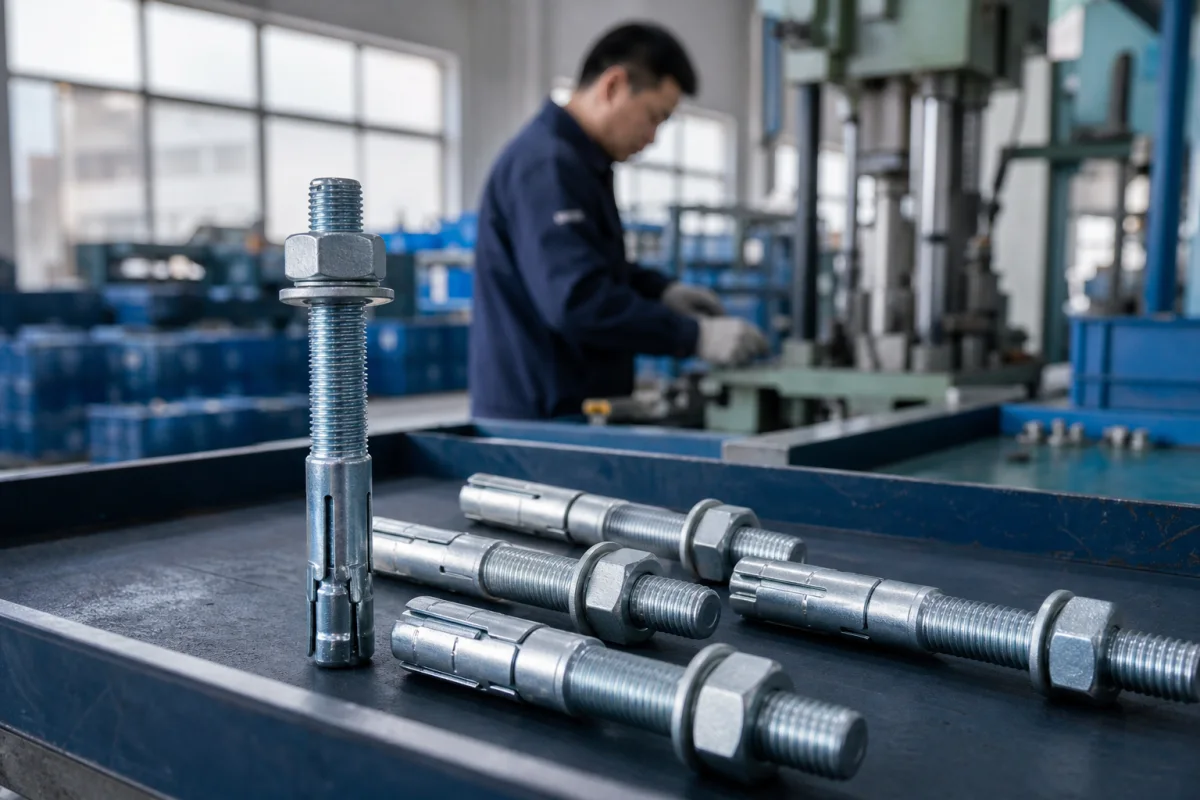
Sleeve anchors · Base material and loads, characteristic versus design versus recommended resistance, spacing and edge distance, installation torque, length and embedment
A sleeve anchor is a torque-controlled mechanical expansion anchor made of a threaded steel bolt or stud with a split expansion sleeve, cone and nut or hex head, zinc plated or in stainless steel, installed through the fixture into a drilled hole in concrete, block or brick and tightened so the sleeve expands against the hole wall. Ask three things first: what base material and condition it goes into and what loads it must carry, which spacing, edge distance and embedment the design allows, and what diameter, length, finish and torque apply.
Sleeve (through-fixing) expansion anchors in steel or stainless steel for concrete, blockwork and brick. Wedge anchors, drop-in anchors, chemical anchors, screw anchors and plastic plugs are outside this page.
CNFX editorial research · Sources checked October 11, 2026 · 4 sources
RS PRO's hex-nut sleeve anchor data sheet gives loads in non-cracked C20/25 concrete as characteristic, design and recommended resistances. For the 12 mm anchor these are 12.6, 6.9 and 5.0 kN in tension and 12.7, 8.4 and 6.0 kN in shear; for the 8 mm anchor 6.6, 3.6 and 2.5 kN in tension; for the 20 mm anchor 17.7, 9.8 and 7.0 kN. The anchor is zinc plated and yellow passivated, with 400 N/mm² ultimate and 280 N/mm² yield strength, for non-cracked concrete, dense blocks, solid brick and some natural stone. [1]
In solid concrete blocks (7 N/mm²) the recommended tensile loads fall to 0.5 kN (8 mm), 1.0 kN (12 mm) and 1.9 kN (20 mm), and in solid brickwork (20 N/mm²) to 0.8–2.5 kN; RS notes that these figures are guidance only because bricks and blocks vary, and recommends one fixing per brick. [1]
Confast's sleeve-anchor guidance states that its published values are average ultimate loads in 2,000 psi concrete and that "a safety factor of 4:1 or 25% is generally accepted as a safe working load", with reference to applicable codes. [2]
Editorial calculation: the 12 mm anchor's recommended tensile load is about 40% of its characteristic resistance (5.0 ÷ 12.6), and in blockwork it is one-fifth of the concrete value (1.0 ÷ 5.0). State the base material and whether loads are characteristic, design or working when comparing suppliers. [1]
Give the supplier the base material and strength (concrete grade, cracked or non-cracked, block or brick type), tension and shear loads and whether static or dynamic, anchor diameter, fixture thickness, required embedment, spacing and edge distances available, head type, material and finish (zinc, hot-dip, stainless), approval required (ETA or ICC-ES) and quantities.
02
Set spacing, edge distance, length and installation torque
RS lists design spacing in C20/25 concrete from 55 mm (8 mm anchor) to 200 mm (20 mm), design edge distance in tension from 45 to 100 mm, and notes that shear loads towards a free edge apply to single anchors where spacing is at least three times the edge distance and do not apply to anchors with reduced embedment. Installation is to drill the correct hole, blow the hole clean, insert the anchor through the fixture and tighten with a torque wrench to the recommended torque; for blocks the tightening torques run from 6 Nm (8 mm) to 40 Nm (20 mm). [1]
Confast gives a rule of thumb of ten anchor diameters between anchors and five diameters from an unsupported edge, more where vibration or impact loads apply, and calculates minimum anchor length as fixture thickness plus minimum embedment plus nut and washer thickness, with the hole drilled at the anchor diameter. [2]
Editorial calculation: by that rule a 12 mm anchor needs about 120 mm between anchors and 60 mm from an edge; fixing a 10 mm bracket with an assumed 50 mm embedment and 10 mm for nut and washer needs an anchor of at least 70 mm. [2]
03
Compare what suppliers offer
Suppliers linked to this page list sleeve anchors; each card links to the page reviewed.
Listings include sleeve anchors alongside wedge, drop-in and other expansion anchors.
04
Check how concrete strength changes pull-through capacity
Ramset's resource-book sheet for the DynaBolt Plus, a medium duty, torque setting expansion anchor, gives data for non-cracked concrete only: reduced characteristic pull-through tension capacity (ϕNup, ϕ = 0.65) at 20, 32 and 40 MPa, steel shear capacity (ϕVus, ϕ = 0.80), torque, edge distance and spacing. To get a working load limit it multiplies ϕNup by 0.51. [4]
Effective depth is the lesser of effective length minus fixture thickness, or five anchor diameters; substrate thickness is twice the effective depth. Finishes include 42 micron hot-dip galvanising and AISI 316 (A4) stainless steel. For shear towards an edge, or where the optimum dimensions cannot be met, the sheet refers to its simplified strength limit state design process. [4]
Editorial calculation: for the 12 mm anchor, 40 MPa concrete gives about 42% more ϕNup than 20 MPa (10.2 ÷ 7.2 ≈ 1.42), and at 32 MPa the working load limit is about 9.1 × 0.51 ≈ 4.6 kN. [4] RS PRO's 12 mm anchor lists 5.0 kN recommended tension in C20/25 concrete [1]; ask each supplier which concrete strength and load basis its figures use.
Ask for an evaluation report where concrete may crack or quake
ICC-ES evaluation report ESR-3260 for DEWALT's Power-Bolt+ heavy duty sleeve anchor covers static, wind and seismic tension and shear loads in cracked and uncracked normal-weight and lightweight concrete with a specified compressive strength of 2,500 psi to 8,500 psi (17.2 MPa to 58.6 MPa), designed to ACI 318-19 Chapter 17, in Seismic Design Categories A through F. [3] The anchors come in 1/2, 5/8 and 3/4 inch (12.7 mm, 15.9 mm and 19.1 mm) diameters in medium carbon steel with a minimum 0.0002-inch-thick (5 µm) zinc plating to ASTM B633. The report limits carbon steel anchors to dry, interior locations and places fatigue or shock loading beyond its scope. [3]
ESR-3260 requires holes drilled with carbide-tipped bits complying with ANSI B212.15 at a diameter equal to the anchor, dust removed with a hand pump, compressed air or a vacuum, the anchor hammered to its nominal embedment and the bolt tightened to the Table 1 torque. Periodic special inspection under Section 1705.1.1 of the 2024 IBC checks drill bit, hole dimensions, cleaning, embedment, spacing, edge distances and tightening torque, and each bolt head is stamped "PB" with a length letter code visible after installation. [3] Editorial note: when a supplier offers a sleeve anchor for cracked concrete or seismic loads, ask for its own evaluation report and these Table 1 values. [3]
Fill the specification fields with values for your fixing
A sleeve anchor quotation needs values for your fixing. The table explains each field, gives published values where a reviewed source states them, and says what to obtain from the supplier.
Explore company information and manufacturing capabilities, then discuss the scope of your project with a relevant supplier.
Share this page
Compiled and source-reviewed by the CNFX editorial team.
Published product pages show what a company offers, not tested performance. Confirm the legal seller, factory, load approvals and scope for your order. How we source and review
· Page last updated 13 October 2026
Buyer questions
How much load can a sleeve anchor take?
In RS PRO's data a 12 mm sleeve anchor has a 5.0 kN recommended tensile load in non-cracked C20/25 concrete but 1.0 kN in a 7 N/mm² concrete block. [1]
How far apart should sleeve anchors be?
Confast cites a rule of thumb of ten anchor diameters between anchors and five from an unsupported edge. [2]
What safety factor applies to ultimate loads?
Confast says that, on its average ultimate values, "a safety factor of 4:1 or 25% is generally accepted as a safe working load", subject to applicable codes. [2]
Can sleeve anchors be used in cracked concrete or for seismic loads?
ICC-ES report ESR-3260 evaluates one heavy duty sleeve anchor for cracked and uncracked concrete of 2,500 to 8,500 psi and for Seismic Design Categories A through F; ask for an equivalent evaluation report for the anchor you buy. [3]
Does concrete strength change a sleeve anchor's capacity?
Yes. Ramset's DynaBolt Plus data gives its 12 mm anchor a reduced characteristic pull-through capacity of 7.2 kN in 20 MPa concrete, 9.1 kN at 32 MPa and 10.2 kN at 40 MPa, all in non-cracked concrete. [4]
Sources and what still needs a direct check
Sources checked 2026-10-11. RS PRO publishes load data for its own anchors and Confast gives general installation guidance; loads for your anchor must come from the supplier's approval or test data.