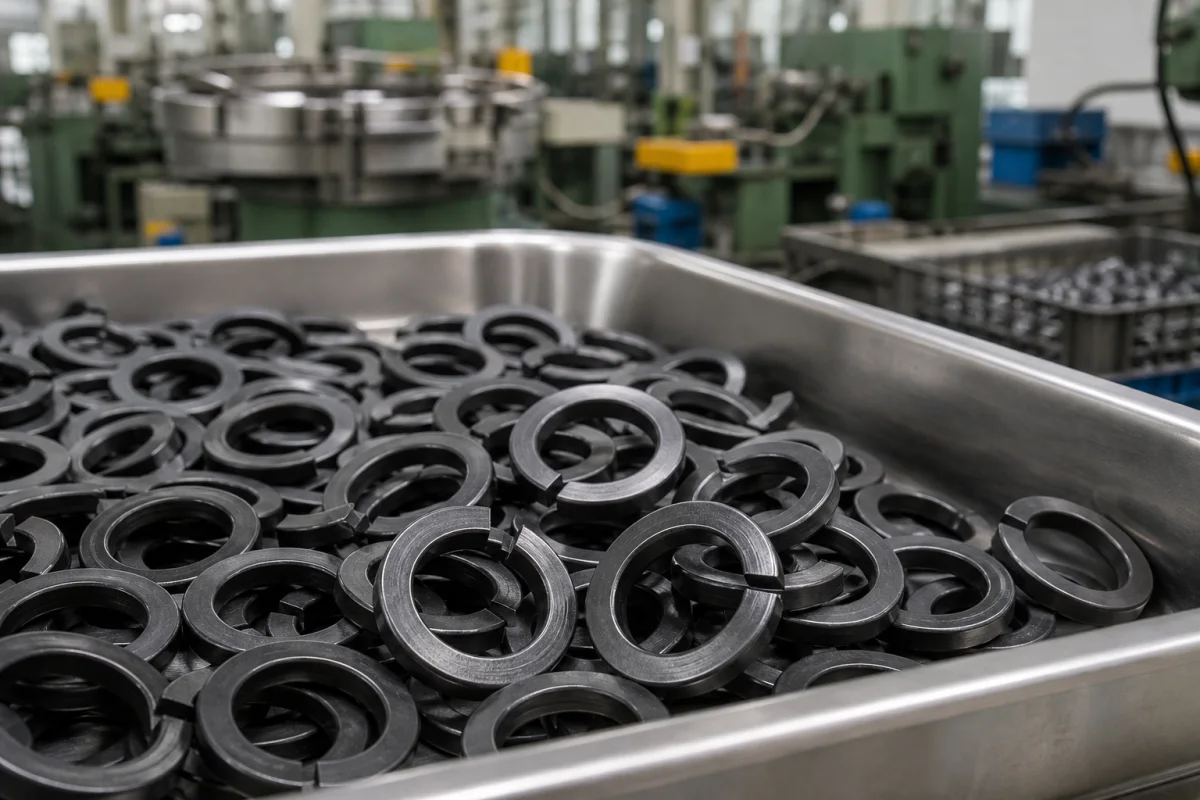
Split (helical spring) lock washers · What they do and do not do once the bolt is tightened, NASA guidance on lock washers, when to choose prevailing-torque, adhesive or mechanical locking instead, materials and ordering
A spring lock washer is a split, helical steel ring placed under a nut or bolt head, traditionally used to resist loosening. Ask three things first: whether the joint actually needs a locking feature, and of what kind, since authoritative guidance says split washers lock little once tightened; what preload and vibration the joint sees; and, if the washer is still specified, which size, material and finish the drawing or standard calls for.
Split (helical spring) lock washers to DIN 127 and similar standards in carbon spring steel, stainless steel and other materials, and their role in bolted joints. Flat washers, Belleville (conical) washers, wedge-locking washer pairs, tooth lock washers and locknuts are outside this page except where compared.
CNFX editorial research · Sources checked October 11, 2026 · 4 sources
NASA's Fastener Design Manual (Reference Publication 1228, 1990) describes the typical helical spring washer as slightly trapezoidal wire formed into one coil, with a free height about twice the thickness of the washer section, made of hardened carbon steel and also available in aluminium, bronzes including phosphor bronze, stainless steel and K-Monel. It acts as a spring while the bolt is tightened, but in the manual's account is flat by the time the bolt is fully torqued, when it is equivalent to a solid flat washer and its locking ability is nonexistent — in the manual's words, useless for locking. Tooth (star) lock washers do bite into the bolt head and mating surface, but the scratches can start cracks in highly stressed parts and raise corrosion susceptibility. [1]
NASA-STD-5020B, Requirements for Threaded Fastening Systems in Spaceflight Hardware (revalidated January 2026), states that free-spinning locking devices depend on preload and so cannot be a secondary locking feature where preload is the primary locking; serrated free-spinning devices perform well but can damage bearing surfaces and lead to cracks and fatigue; free-spinning split lock washers provide minimal, if any, locking; and split lock washers should not be used for secondary locking features. It notes that the Air Force–Navy standard AND10476 limits lock washers to cases where other locking features cannot be used and loosening would not endanger structure or personnel. [2]
Editorial note: these are aerospace documents, but their reasoning applies to any joint where loosening matters; where a split washer is specified by an existing drawing or standard, ask the designer whether a locking feature is required and which one.
Test data in a patent record show the loss in numbers. European patent application EP 0 353 620 A1 (Serrated helical spring lockwasher, 1990) reports a transverse-vibration test of commercially available 3/8 in plain-finish spring lockwashers under 3/8-16 × 2½ in hexagon bolts of grades 2, 5 and 8 on mating surfaces of hardness RB 80–90, recording preload before and after 25, 50 and 100 seconds of vibration. A grade 8 bolt fell from 6,900 lb preload to 1,200 lb after 100 s (17% retained); grade 5 bolts at 4,900–4,950 lb kept 15–29%; and grade 2 bolts at 3,150–3,200 lb kept 7–31%. The applicants describe this vibration resistance as extremely low, and state that earlier testing showed washers need an off-to-on torque ratio above 0.85 for satisfactory holding, against a maximum of 0.82 for the commercial spring lockwashers they tested. [3]
Editorial calculation from that table: across the eight 3/8 in specimens, retained preload after 100 s ranged from 7% to 31%, so between about 69% and 93% of the clamp load was lost; the patent tests the applicant's own serrated design against these washers, so read its comparative claims as the applicant's. [3]
Bolt Science, a UK bolting consultancy, reaches the same conclusion from transverse-vibration (Junker) tests on M8 fasteners: a plain nut self-loosened, and a helical spring washer failed to prevent self-loosening, with tests showing the loosening rate can increase rather than decrease. It cites Gerhard Junker's 1969 paper, which showed that preloaded fasteners self-loosen when relative movement occurs between the mating threads and the bearing surface under transverse joint loading, and that split washers do not stop that rotation. On the second claim made for the washer, a softer joint, Bolt Science writes that with property class 8.8 and higher fasteners such washers "flatten out at between 10% to 20% of the target preload", so any embedding or relaxation reduces preload by about as much as if no washer were fitted; it also observed washers starting to split apart during tightening. It reports that in 2004 DIN published a document explaining why a range of lock washer standards, including helical spring washers, had been withdrawn, and contrasts them with conical spring washers to DIN 6796, which are designed to flatten close to the target preload and so reduce preload loss from settlement. [4]
Give the supplier the standard and size (for example DIN 127 form A or B, M-size or inch), material and hardness (spring steel, stainless), surface finish (plain, zinc, black oxide, other), quantity and packaging — and confirm with the joint designer whether a different locking feature is required.
02
Choose the locking feature the joint needs
NASA-STD-5020B defines a locking feature as a device, chemical or characteristic added to a threaded fastening system to resist vibration-induced loosening or retain the parts against complete disengagement, and groups them as prevailing-torque features (deformed threads, locking patches, self-locking inserts), adhesive locking features (anaerobic adhesives, epoxies) and mechanical locking features (cotter pins, safety wire, safety cable), each with verification by running-torque or visual checks. Prevailing-torque devices can prevent complete separation after preload is lost; with proper cleaning and priming, adhesives can prevent loosening and hold preload better than other features in severe vibration but are not a simple fix; and mechanical features such as safety wire are preferred where loose parts could create critical hazards. [2]
The NASA Fastener Design Manual describes alternatives including deformed-thread and split-beam locknuts that bind the nut thread to the bolt, and Belleville washers that act as springs when not fully flattened but lock only if serrated, at the cost of surface damage. [1]
03
Compare what suppliers offer
Suppliers linked to this page list spring lock washers; each card links to the page reviewed.
Listings include DIN 127 spring lock washers, spring washers with flat washers and nuts, and wedge-locking washers alongside spring washers; ask each for the standard, material and hardness, finish and dimensional inspection, and consider whether a different locking feature suits the joint.
04
Trace the washer specification
This is a functional reference built from the sources cited; it is not one maker's specification.
DIN 6796 type flattens close to target preload; offsets embedding loss. [4]
Standard, size, hardness.
05
Fill the specification fields with values for your joint
A spring lock washer quotation needs values for your joint. The table explains each field, gives published values where a reviewed source states them, and says what to obtain from the supplier.
Field
What it means and published values
Ask the supplier for
Applicable standard
DIN 127 or other; AND10476 limits use; DIN lock washer standards withdrawn, per a 2004 DIN document. [2][4]
Explore company information and manufacturing capabilities, then discuss the scope of your project with a relevant supplier.
Share this page
Compiled and source-reviewed by the CNFX editorial team.
Published product pages show what a company offers, not tested performance. Confirm the legal seller, factory and scope for your order. How we source and review
· Page last updated 13 October 2026
Buyer questions
Do split spring lock washers stop bolts loosening?
NASA's Fastener Design Manual says the washer is flat once the bolt is fully torqued and its locking ability is nonexistent; NASA-STD-5020B says split lock washers provide minimal, if any, locking. [1][2]
What should be used instead of a split lock washer?
NASA-STD-5020B points to prevailing-torque features (locknuts, locking inserts or patches), adhesive locking features or mechanical features such as safety wire and cotter pins. [2]
Do tooth lock washers lock better?
NASA's manual says tooth washers bite and give some locking, but the scratches can start cracks and increase corrosion in highly stressed parts. [1]
How much preload do split lock washers keep under vibration?
In the transverse-vibration test reported in patent application EP 0 353 620 A1, 3/8 in plain spring lockwashers kept 7% to 31% of their initial preload after 100 seconds. [3]
At what preload does a split lock washer go flat?
Bolt Science reports that with property class 8.8 and higher bolts, helical spring washers flatten at between 10% and 20% of the target preload, so they add no spring at the final preload. [4]
Sources and what still needs a direct check
Sources checked 2026-10-11. Two sources are NASA documents written for aerospace hardware, one is a 1990 European patent application reporting vibration tests, and one is a bolting consultancy's Junker test results; they are cited for their findings on lock washer behaviour, which bear on other bolted joints where loosening matters. Product standards such as DIN 127 define dimensions, not locking performance.