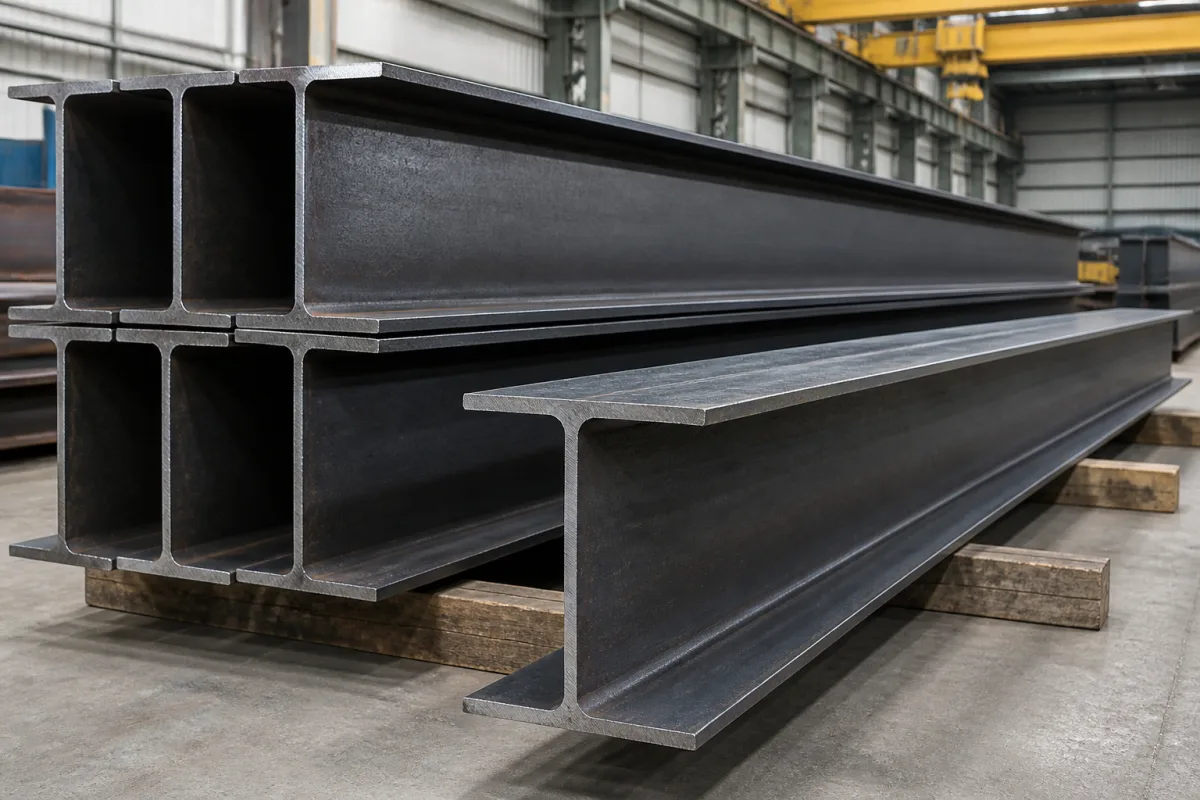
Hot-rolled I sections · Section series and dimension standard, rolling tolerances to EN 10034, steel grade and thickness-dependent yield strength, length and surface
A structural steel I-beam is a hot-rolled section with two flanges joined by a web, used as beams, girders and columns in steel frames. Fix three things before asking for a price: the section series and designation (for example parallel-flange IPE or taper-flange IPN, or a national series), the standard that sets its rolling tolerances, and the steel grade and quality, remembering that the minimum yield strength depends on the thickness of the flange.
Hot-rolled I sections with parallel or tapered flanges, sold by the metre or in cut lengths. Welded plate girders, H-piles, cold-formed sections, channels and angles are outside this page; channels have their own page.
CNFX editorial research · Sources checked October 11, 2026 · 4 sources
ArcelorMittal's sections sales programme lists IPE parallel-flange beams with dimensions to EN 10365:2017 and tolerances to EN 10034:1993, and IPN taper-flange beams (flange slope 14%) with dimensions to EN 10365:2017 and tolerances to EN 10024:1995. [1][2] Its beam tolerance table under EN 10034 sets limits by size: depth +3/−2 mm up to 180 mm, +4/−2 mm above 180 to 400 mm, +5/−3 mm above 400 to 700 mm and ±5 mm above 700 mm; flange width +4/−1 mm up to 110 mm, +4/−2 mm above 110 to 210 mm, +4/−4 mm above 210 to 325 mm and +6/−5 mm above 325 mm. [1]
Thickness limits follow the same pattern. Web thickness is ±0.7 mm below 7 mm, ±1 mm from 7 to 10 mm, ±1.5 mm from 10 to 20 mm and wider above; flange thickness is +1.5/−0.5 mm below 6.5 mm, +2/−1 mm from 6.5 to 10 mm and +2.5/−1.5 mm from 10 to 20 mm. Straightness is 0.0030L for depths above 80 to 180 mm, 0.0015L above 180 to 360 mm and 0.0010L above 360 mm; length is −0/+100 mm and mass ±4%. The table adds that other tolerances are by agreement. [1]
Editorial calculation: an IPE 400 is listed at 66.3 kg/m with h = 400 mm, b = 180 mm, tw = 8.6 mm and tf = 13.5 mm. [1] Under the table above that gives depth +4/−2 mm, flange width +4/−2 mm, web ±1 mm and flange +2.5/−1.5 mm. A 12 m length weighs a nominal 795.6 kg (66.3 × 12), with ±4% allowing about ±32 kg, and a straightness limit of 0.0010 × 12,000 = 12 mm.
Editorial note: a mill certificate shows the grade, not the tolerance class. If your fabrication relies on tighter fit-up than the standard, write the limits into the order, since ArcelorMittal states that its usual rolling tolerances can be reduced only by agreement. [1]
Give the supplier the section series and designation, dimension and tolerance standards, steel grade and quality, lengths and length tolerance, quantity per size, surface condition and any coating, inspection document type, and any ultrasonic or other testing.
02
Set the steel grade and check yield by thickness
ArcelorMittal's table for non-alloy structural steels to EN 10025-2:2019 gives minimum yield strength by nominal thickness: S235 at 235 MPa up to 16 mm and 225 MPa above 16 to 40 mm; S275 at 275 and 265 MPa; S355 at 355 and 345 MPa; and S460 at 460 and 440 MPa. Tensile strength for S355 is 470–630 MPa up to 100 mm, and the JR, J0 and J2 qualities are impact-tested at +20, 0 and −20 °C (27 J). [1]
The same programme offers HISTAR steels at 355 and 460 MPa yield and FRITENAR at 355 MPa; HISTAR uses in-line quenching and self-tempering (QST), is delivered thermo-mechanically rolled under ETA 10/0156 and meets EN 10025-4:2019. It says both can be welded without preheating for heat inputs of 10–60 kJ/cm above 0 °C with low-hydrogen consumables. [1]
Editorial calculation: the IPE 400 flange is 13.5 mm thick, so S355 gives 355 MPa; an IPE 600 has a 19 mm flange, which falls in the above-16-mm band and gives 345 MPa. [1] Use the band that matches the thickest part your design relies on.
A linked supplier page lists I-beam material grades Q235B and Q345B (China), S235JR to S460 (EN) and A36 and A572 Gr.50 (ASTM), referring to GB/T 706-2008, GB/T 1591-2018, EN 10025, EN 10034 and ASTM A6. [3] Name one grade and standard per order rather than an equivalence list.
SteelConstruction.info extends the BS EN 10025-2 yield table to thicker material: S275 has a minimum yield of 275, 265, 255 and 245 N/mm² for t ≤ 16, 16–40, 40–63 and 63–80 mm, and S355 has 355, 345, 335 and 325 N/mm²; minimum tensile strength is 410 and 470 N/mm² for 3–100 mm and 400 and 450 N/mm² for 100–150 mm. It explains that the number in the grade name is the yield for material up to 16 mm thick and that the UK National Annex to BS EN 1993-1-1 allows the minimum yield for the actual thickness to be used as the characteristic value. For design it gives a modulus of elasticity E = 210,000 N/mm², Poisson's ratio 0.3, shear modulus G = E/[2(1 + ν)] (81,000 N/mm²) and a coefficient of thermal expansion of 12 × 10⁻⁶/°C at ambient temperatures, and notes that BS EN 10025 sets mandatory limits on carbon equivalent value (CEV) for weldability. [4]
Editorial calculation: G = 210,000 / (2 × 1.3) ≈ 80,800 N/mm², which the reference rounds to 81,000. With α = 12 × 10⁻⁶/°C, a 12 m beam that warms by 30 °C lengthens by 12 × 10⁻⁶ × 30 × 12,000 ≈ 4.3 mm, about 4 % of the +100 mm length tolerance in the EN 10034 table; the 30 °C change is an assumed example. [4][1]
03
Section heights, lengths and coatings in the supplier listing
The listing reviewed gives I-beam heights of 100–900 mm and standard lengths of 6–18 m, with galvanizing and painting options; ask which mill rolls the section and for the mill certificate.
04
Web, flanges and root radius: what each part of an I-section carries
Section dimensions and rolling tolerances per beam designation
The dimension rows use the IPE 400 from ArcelorMittal's programme as the worked example; for any other designation take h, b, tw and tf from the section table and the tolerance band that matches its depth.
Field
What it means and published values
Ask the supplier for
Depth (mm)
IPE 80–750 and IPN 80–600 series; supplier lists 100–900. [2][3]
Runhua Tianjin lists I-beams in Chinese, EN and ASTM grades, with galvanizing and painting.
Runhua (Tianjin) Technology Development Co., Ltd.
Manufacturing site to be confirmed for the order
Lists structural steel I-beams 100–900 mm high in Q235B/Q345B, S235JR–S460 and A36/A572 grades, 6–18 m standard lengths, with galvanizing and painting.
Explore company information and manufacturing capabilities, then discuss the scope of your project with a relevant supplier.
Share this page
Compiled and source-reviewed by the CNFX editorial team.
Each manufacturer above links to the page on that company's own website where the product is listed, with the date we checked it. How we source and review
· Page last updated 13 October 2026
Buyer questions
What is the difference between IPE and IPN beams?
ArcelorMittal lists IPE with parallel flanges and IPN with a 14% flange slope, both to EN 10365:2017. [2][1]
Which standard sets IPE rolling tolerances?
ArcelorMittal lists IPE tolerances to EN 10034:1993 and IPN to EN 10024:1995. [1]
What straightness can I expect on a large I-beam?
ArcelorMittal's EN 10034 table gives 0.0010 times the length for depths above 360 mm. [1]
Is S355 yield always 355 MPa?
No. ArcelorMittal's EN 10025-2 table gives 355 MPa up to 16 mm and 345 MPa above 16 to 40 mm. [1]
Does S355 steel always have a yield strength of 355 MPa?
No; SteelConstruction.info lists 355 N/mm² up to 16 mm, then 345, 335 and 325 N/mm² for 16–40, 40–63 and 63–80 mm thickness. [4]
Sources and what still needs a direct check
Sources checked 2026-10-11. ArcelorMittal is a section producer publishing its sales programme with section tables, tolerance tables and steel grade tables, and an I-sections page; SteelConstruction.info, the UK steel construction reference run by the Steel Construction Institute and BCSA, gives yield by thickness for thicker sections and the elastic constants used in design; Runhua is a linked supplier.