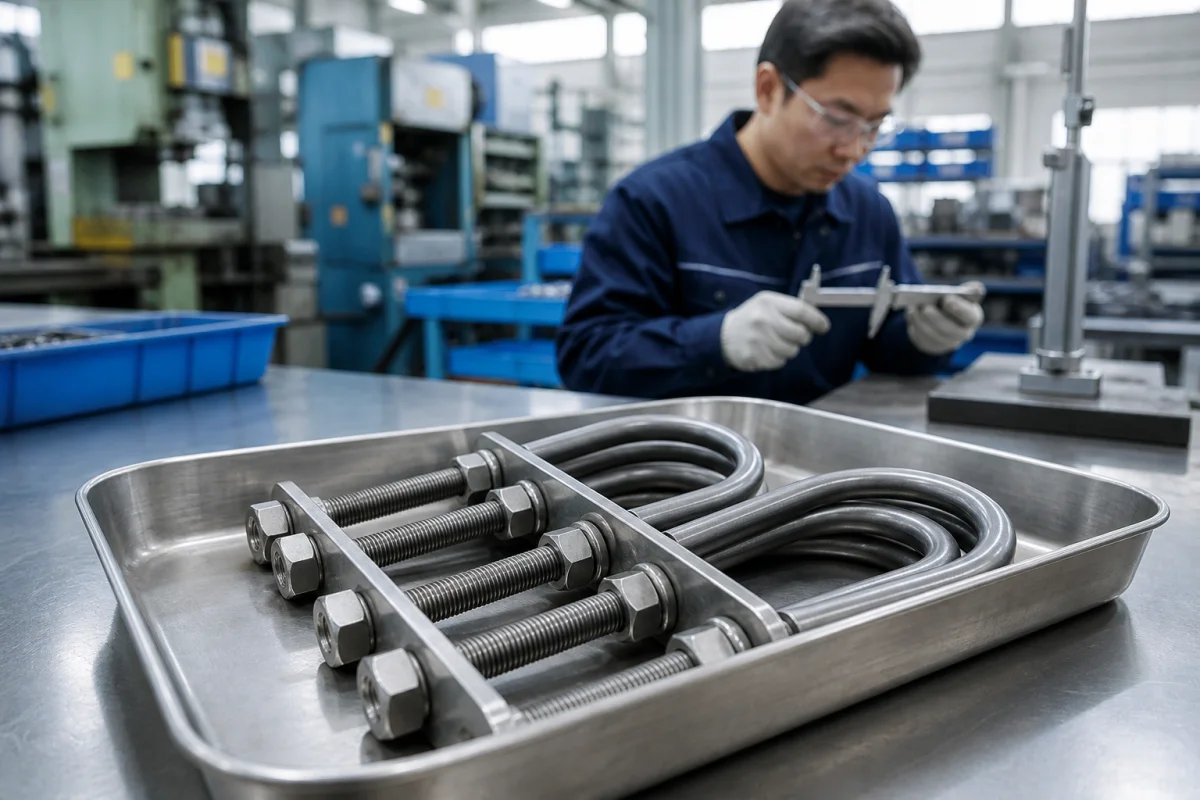
U-bolts for pipes, exhausts, suspensions, beams, conduit and cable trays · diameter and thread, inside width and leg length, round or square crown, carbon, alloy or stainless steel, plain, zinc, hot-dip galvanized or coated, nuts and plates
A U-bolt is a rod bent into a U with threaded legs, fitted over a pipe, tube, axle or beam and tightened with nuts against a plate or support to clamp it in place — in piping, exhausts, vehicle suspensions, structures, conduit and cable trays. Ask three things first: the size and shape of what it clamps, which sets the inside width and crown form; the thread size, leg length and thread length; and the material and finish for the load and environment.
U-bolts and other bent bolts — round- and square-bend, for pipe supports, exhausts, vehicle springs, structures and electrical support — with nuts, washers and plates. Pipe clamps and hangers, threaded rod (separate page), double-end studs (separate page), eye and J-bolts and anchor bolts are outside this page except where compared.
CNFX editorial research · Sources checked October 12, 2026 · 4 sources
Haiyan Bolt, a fastener maker, describes a U-bolt as a curved section forming the U shape with two straight threaded ends; the curve fits around an object, such as a pipe, rod or other cylinder, and nuts on the threaded legs tighten it. It cites uses securing pipes to supports to prevent movement and vibration, attaching exhaust, suspension and drive-shaft parts on vehicles, fastening structural members, and installing electrical conduit and cable trays. It lists U-bolts from 3/8-16 to 1-8 inch diameter and lengths up to 40 inches, specialising in custom U-bolts and other bent bolts made to drawing, and supplies them assembled with hex nuts and a fender washer plate. [1]
Editorial note: send a drawing, or the clamped object's actual outside size and the thickness of the support, plate and washers, so the supplier can set the inside width, crown shape and leg and thread lengths.
Give the supplier the clamped object and its outside size, crown shape (round or square), inside width and leg length, thread size and pitch, thread length, material and grade, finish (plain, zinc, hot-dip galvanized, coated, stainless), nuts, washers and plates, applicable standard, certificates, packaging, and quantity.
02
Choose material, grade and finish
Haiyan says U-bolts are made from carbon steel for strength and durability, stainless steel where corrosion resistance matters outdoors or in wet places, and alloy steel for high-strength needs, and offers plain, zinc, hot-dip galvanized and Xylan finishes and 303 or 316 stainless steel. [1] ASTM A307 covers carbon-steel bolts and studs from 1/4 to 4 inches: Grade A bolts, studs and threaded rod with 60 ksi minimum tensile strength for general applications, and Grade B with 60–100 ksi tensile strength for flanged joints in piping systems with cast-iron flanges; suitable nuts are in ASTM A563. [2] ASTM F2329 covers hot-dip zinc coating of carbon and alloy steel bolts, screws, washers, nuts and special threaded fasteners, centrifuged to remove excess zinc. [3]
Editorial note: A307 does not name U-bolts specifically; if you call it up for a carbon-steel U-bolt, state the grade and how the supplier will test bent parts, and name the coating specification separately.
03
Check the allowable normal and side load for pipe U-bolts
Deepwater Corrosion Services publishes a load table for its NU-BOLT carbon steel pipe U-bolts, supplied with four finished hex nuts in black or galvanized finish for 1/2 in to 36 in pipe, and states compliance with Federal Specification A-A1192A (Type 24), WW-H-171-E (Type 24), ANSI/MSS SP-69 and MSS SP-58 (Type 24). Each pipe size has a rod size and maximum normal load at 650 °F and 750 °F plus a maximum side load at 650 °F: for example 1/4 in rod on 1/2 in pipe, 580 lb / 454 lb normal and 145 lb side; 1/2 in rod on 2 1/2 in pipe, 2,700 / 2,114 lb and 675 lb side; 5/8 in rod on 6 in pipe, 4,320 / 3,382 lb and 1,080 lb side; 7/8 in rod on 12 in pipe, 8,960 / 7,016 lb and 2,490 lb side. Where normal and side loads act together it gives the check Pn/Pna + Ps/Psa ≤ 1, and states that nuts must be snug tight to achieve the listed side loads. [4]
The material and coating standards above set the bolt and zinc properties; this table adds the load the bent bolt may carry on a given pipe. [2][3][1]
Editorial calculation: on a 4 in pipe, a 1,000 lb pipe load with a 300 lb side load gives 1,000/2,700 + 300/675 = 0.37 + 0.44 = 0.81, within the ≤ 1 check; the side-load rating is 25–28% of the 650 °F normal load in the listed sizes.
Pipe size
Rod size
Max normal load 650 °F / 750 °F (lb)
Max side load 650 °F (lb)
1/2 in
1/4 in
580 / 454
145
2 in
3/8 in
1,460 / 1,144
365
4 in
1/2 in
2,700 / 2,114
675
8 in
5/8 in
4,320 / 3,382
1,080
10 in
3/4 in
6,460 / 5,060
1,615
12 in
7/8 in
8,960 / 7,016
2,490
18–36 in
1 in
11,800 / 9,240
Not listed
For pipe supports, give the supplier the pipe size, design temperature, normal and side loads and finish, and ask for the load table of the exact U-bolt figure rather than a generic rating.
04
Compare what suppliers offer
Suppliers linked to this page list U-bolts; each card links to the page reviewed.
Listings include standard and custom U-bolts and bent bolts in carbon, alloy and stainless steels in plain, zinc, hot-dip galvanized and Xylan finishes, supplied with nuts and plates; ask each for dimensional drawings, material certificates and coating thickness.
05
Trace what the order must fix
This is a reference built from the sources cited; it is not one maker's drawing.
Fill the specification fields with values for your project
A U-bolt quotation needs values for your project. The table explains each field, gives published values where a reviewed source states them, and says what to obtain from the supplier.
Explore company information and manufacturing capabilities, then discuss the scope of your project with a relevant supplier.
Share this page
Compiled and source-reviewed by the CNFX editorial team.
Published product pages show what a company offers, not tested performance. Confirm the legal seller, factory and scope for your order. How we source and review
· Page last updated 13 October 2026
Buyer questions
What sizes do U-bolts come in?
One maker lists 3/8-16 to 1-8 inch diameters and lengths up to 40 inches, with custom sizes to drawing. [1]
Which ASTM grade suits carbon-steel bolts?
ASTM A307 Grade A has 60 ksi minimum tensile strength for general use; Grade B (60–100 ksi) is for cast-iron flanged piping. [2]
Which standard covers hot-dip galvanizing of fasteners?
ASTM F2329 covers hot-dip zinc coating of bolts, screws, washers, nuts and special threaded fasteners. [3]
How much load can a pipe U-bolt carry?
Deepwater Corrosion Services lists its carbon steel NU-BOLT at 2,700 lb normal and 675 lb side load at 650 °F for a 1/2 in rod on 2 1/2–5 in pipe, up to 11,800 lb normal for a 1 in rod on 18–36 in pipe. [4]
Sources and what still needs a direct check
Sources checked 2026-10-12. ASTM A307 and F2329 are published standards (scope reviewed). Haiyan Bolt also appears as a supplier on this page.