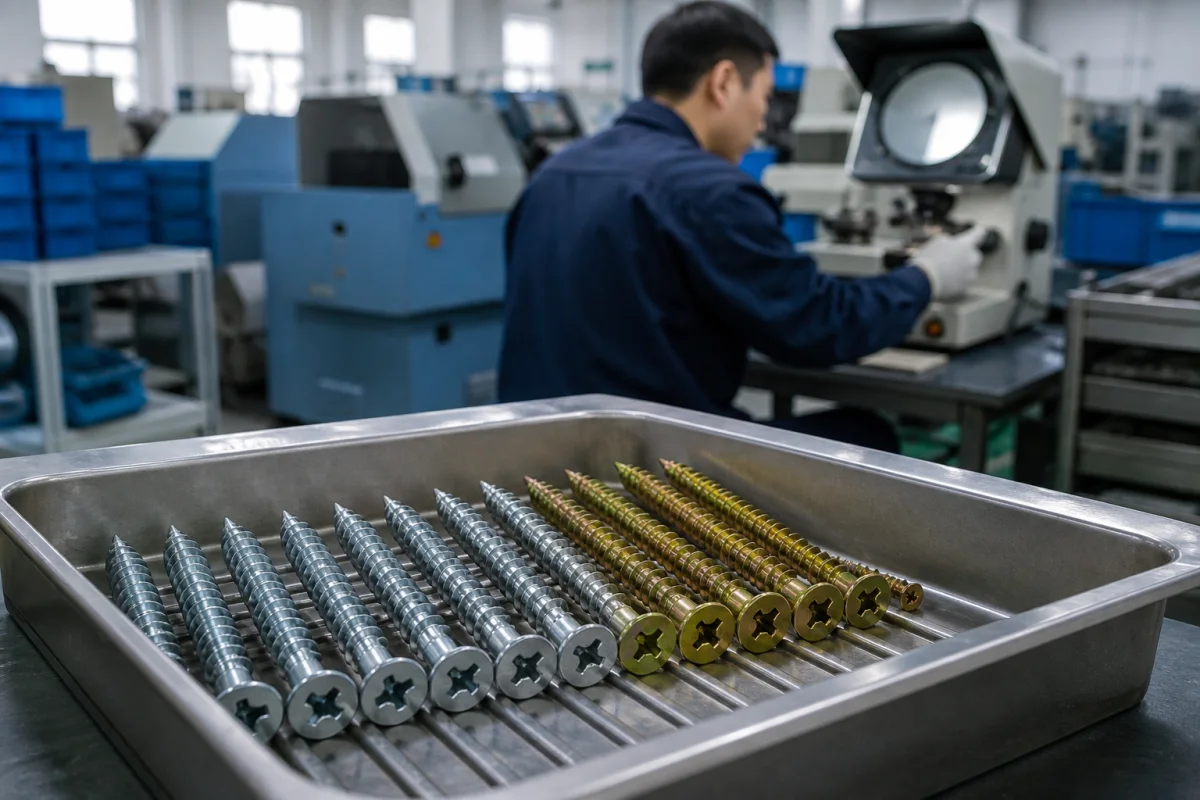
Wood screws · flat, oval, round and hex heads, shank and root diameter, lead holes for softwood and hardwood, withdrawal from side and end grain, tapping and self-drilling screws, materials and finishes
A wood screw is a pointed, threaded fastener that forms its own mating thread in wood as it is turned in, with a head that seats on or into the surface; it holds by the wood fibres gripping its thread. Ask three things first: which head type and size suit the joint, what lead (pilot) hole the wood species needs, and whether the load pulls the screw out or acts across it.
Wood screws with flat (countersunk), oval, round and hex heads, including coach (lag-type) hex wood screws to DIN 571, in steel, stainless steel and brass. Self-tapping screws for metal (a separate product page), machine screws, drywall and chipboard screws as separate types, and nails are outside this page except where compared.
CNFX editorial research · Sources checked October 12, 2026 · 4 sources
The USDA Forest Products Laboratory's Wood Handbook (chapter 8, fastenings) describes wood screw heads as flathead, used where a flush surface is wanted, and ovalhead and roundhead, used for appearance or where countersinking is not wanted. Its principal parts are head, shank, thread and core; it gives the root diameter as averaging about two-thirds of the shank diameter, with the ratio varying by size. It names steel, brass and other alloys as wood screw materials, with finishes such as nickel, blued, chromium or cadmium, and are classified by material, type, finish, head shape and shank diameter or gauge. Tapping screws have threads the full length of the shank, and self-drilling screws have a drill tip that removes the need for a pilot hole. [1]
Haiyan Bolt, a linked supplier, lists hex-head wood screws to DIN 571 in carbon and stainless steel, M6 to M12 and 50 to 200 mm long, cold headed, with zinc-plated or plain finishes. [2]
Editorial calculation: a screw with a 4.2 mm shank has a root diameter of about 4.2 × 2/3 ≈ 2.8 mm by the handbook's rule of thumb. The shank size is an assumed example; use the maker's dimension table for the exact root diameter.
Give the supplier the screw type and head (flat, oval, round, hex), drive type, diameter or gauge and length, thread length, point type, material and finish (for outdoor or treated timber), standard (for example DIN 571), the wood species or board being fastened, quantity and packing.
02
Drill the right lead hole and load the screw properly
The Wood Handbook says the withdrawal resistance of wood screws from the side grain of seasoned wood rises with the square of the wood's specific gravity and, within limits, directly with the threaded penetration and screw diameter, until the screw itself fails in tension; so longer standard screws add little in dense hardwoods. Its withdrawal equation applies when lead holes are about 70% of the thread root diameter in softwoods and about 90% in hardwoods. Screws in end grain average about 75% of side-grain withdrawal load when splitting is avoided, type A tapping screws hold about 10% more than comparable wood screws, and soap or similar lubricant eases insertion with little effect on withdrawal. [1]
Editorial calculation: for the 2.8 mm root diameter above, a lead hole of about 0.7 × 2.8 ≈ 2.0 mm suits softwood and about 0.9 × 2.8 ≈ 2.5 mm suits hardwood, following the handbook's percentages. Check with a trial on your timber, especially near edges where splitting is a risk.
03
Check the pre-drilling hole, spacing and strength on the maker's sheet
Rothoblaas's sheet for its HBS countersunk structural wood screw, certified to ETA-11/0030, covers diameters of 3.5 to 12 mm and lengths of 30 to 600 mm in galvanised carbon steel for service classes 1 and 2. For each diameter it gives a pre-drilling hole, a characteristic withdrawal-resistance parameter fax,k of 11.7 N/mm² and a characteristic tensile strength (table), calculated to EN 1995:2014 for timber density 385 kg/m³ with the thread fully inserted; design values are Rd = Rk × kmod ÷ γm. [4]
Pre-drilling cuts minimum spacing: for load parallel to the grain and density up to 420 kg/m³, spacing along the grain (a1) is 5d with pre-drilling against 12d without, and across the grain (a2) 3d against 5d (spacing values read from the layout of the datasheet's spacing table; confirm against ETA-11/0030); for Douglas fir, spacing and distances parallel to the grain are multiplied by 1.5. [4]
Editorial calculation: an 8 mm HBS screw with an assumed 80 mm of thread in timber gives 11.7 × 8 × 80 ≈ 7,490 N characteristic withdrawal before Eurocode 5 density, angle, kmod and γm factors, below its 20.1 kN tensile strength. Its 5.0 mm pre-drill is 62.5% of 8 mm, and a1 is 40 mm (5 × 8) with pre-drilling against 96 mm (12 × 8) without. [4]
Nominal diameter d1
Pre-drilling hole dv
Characteristic tensile strength ftens,k
3.5 mm
2.0 mm
3.8 kN
5 mm
3.0 mm
7.9 kN
6 mm
4.0 mm
11.3 kN
8 mm
5.0 mm
20.1 kN
10 mm
6.0 mm
31.4 kN
12 mm
7.0 mm
33.9 kN
04
Check DIN 571 hex coach screw head sizes and lengths
Fastenerdata's record for steel metric hexagon coach screws to DIN 571 (American term: lag or wood screw) lists diameters of 4, 5, 6, 7, 8, 10, 12, 16 and 20 mm and lengths from 16 mm to 300 mm, with head dimensions by diameter: for example M8 with 13 mm across flats (s), 14.2 mm across corners (e) and a 5.5 mm nominal head height (k, 5.13–5.88 mm); M10 with s 17 mm and k 7.0 mm; M12 with s 19 mm and k 8.0 mm. It also lists brass and A2 and A4 stainless versions. [3]
Compare these head sizes with the DIN 571 range a supplier lists, and size lead holes and withdrawal loads with the Wood Handbook rules above. [2][1][3]
Editorial calculation: the wrench size for an M10 coach screw is 17 mm, and the 300 mm maximum length is 30 times that diameter; an M8 head's 13 mm across flats is 1.625 times the shank diameter.
d (mm)
s across flats (mm)
e across corners (mm)
k head height, nominal (mm)
6
10
10.89
4.0
8
13
14.20
5.5
10
17
18.72
7.0
12
19
20.88
8.0
16
24
26.17
10.0
20
30
33.00
13.0
Give the supplier the diameter, length, material (steel, A2, A4 or brass) and finish, and confirm the across-flats size for your driving tools.
05
Compare what suppliers offer
Suppliers linked to this page list wood screws; each card links to the page reviewed.
Listings include hex-head DIN 571 wood screws, wood screws with chipboard and self-tapping screws, and wood screws from fastener trading companies. Ask each for standard, dimensions, material, finish and packaging.
06
Trace the screw parts
This is a functional reference built from the sources cited; it is not one maker's specification.
Fill the specification fields with values for your joint
A wood screw quotation needs values for your joint. The table explains each field, gives published values where a reviewed source states them, and says what to obtain from the supplier.
Explore company information and manufacturing capabilities, then discuss the scope of your project with a relevant supplier.
Share this page
Compiled and source-reviewed by the CNFX editorial team.
Published product pages show what a company offers, not tested performance. Confirm the legal seller, factory and scope for your order. How we source and review
· Page last updated 13 October 2026
Buyer questions
What size pilot hole should a wood screw have?
The USDA Wood Handbook bases its withdrawal values on lead holes about 70% of the root diameter in softwoods and 90% in hardwoods. [1]
Do screws hold as well in end grain?
No; the handbook says end-grain withdrawal averages about 75% of side-grain values when splitting is avoided. [1]
What is the root diameter of a wood screw?
The Wood Handbook gives it as averaging about two-thirds of the shank diameter, varying by size. [1]
What sizes do DIN 571 coach screws come in?
Fastenerdata lists DIN 571 hex coach screws in 4–20 mm diameters and 16–300 mm lengths, in steel, brass and A2/A4 stainless; an M10 takes a 17 mm spanner. [3]
What pre-drilling hole does a structural wood screw need?
Rothoblaas's HBS sheet lists 2.0 mm for a 3.5 mm screw up to 7.0 mm for a 12 mm screw, for example 5.0 mm for an 8 mm screw. [4]
Sources and what still needs a direct check
Sources checked 2026-10-12. The Wood Handbook is a US Forest Service (Forest Products Laboratory) reference, cited from an Internet Archive copy of the 2010 edition; Haiyan Bolt is a fastener supplier describing its own screws.