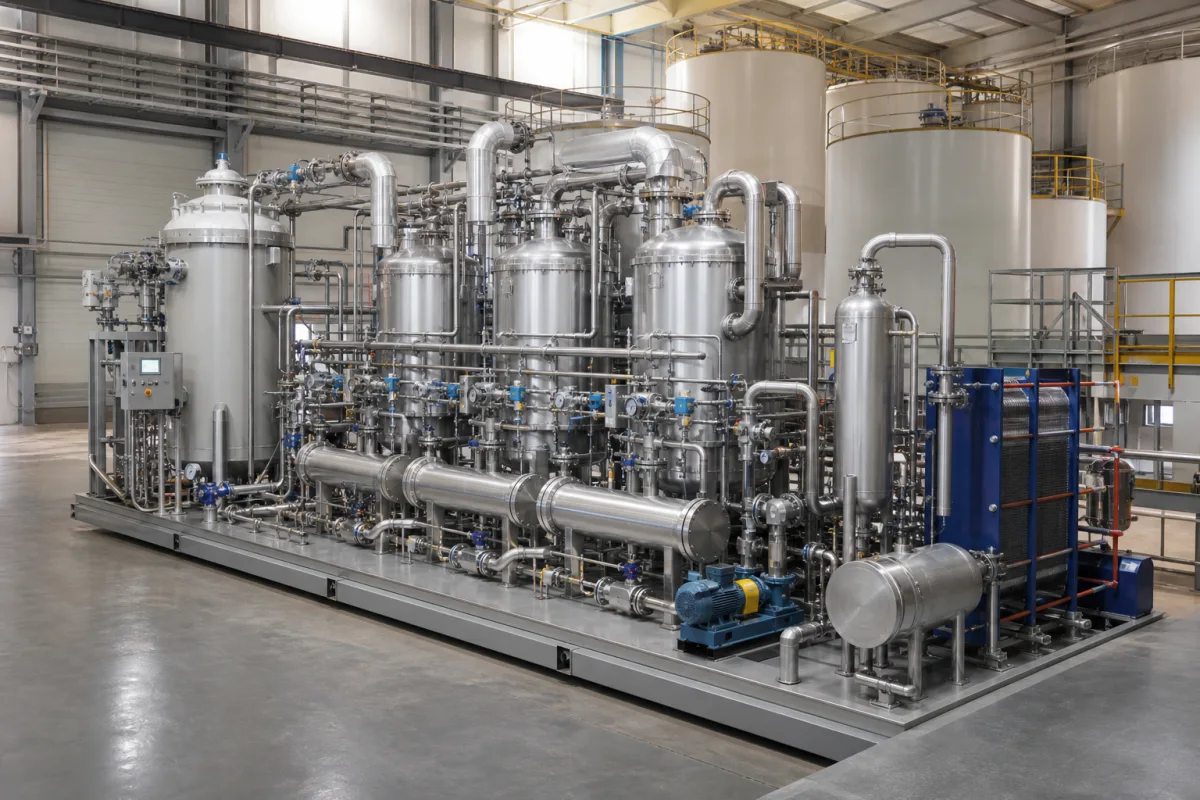
Ammonium nitrate melt production and concentration system
AN solution/melt equipment: battery limits, heat recovery and emissions evidence
An ammonium nitrate solution/melt system supplies the liquid intermediate to downstream product-making equipment. Specify the delivered neutralisation, concentration, utilities and abatement boundary against the plant’s product requirement and independently engineered safety design.
Neutralisers and evaporators or concentrators that produce ammonium nitrate solution and melt, with their melt additive and emission control equipment. Nitric acid plants, prill towers, granulators and urea plants have their own pages except where compared.
CNFX editorial research · Sources checked October 18, 2026 · 4 sources
Define the liquid-intermediate and downstream boundary
EPA’s AP-42 process description separates solution formation/concentration from solid-product formation, finishing and shipping. A plant selling solution and a plant feeding a solid-product line therefore have different equipment boundaries; a neutraliser/evaporator package is not the whole finishing plant. [1]
The Fertilizers Europe booklet describes different downstream processes accepting different water contents. Define the required liquid-product specification with the selected downstream equipment, rather than assigning one concentration to every plant. No process recipe or general safe operating setpoint is established by those historical examples. [3]
02
Compare the neutraliser delivery and heat-integration scope
The industry booklet and the European reference document describe different neutraliser arrangements and integration with evaporation. Ask the supplier to identify the equipment and controls actually delivered, their interfaces to feed preparation and utilities, and responsibility for the integrated process design. [3][4]
The European reference’s conclusions discuss recovery and use of reaction heat, generated steam and residual heat, together with reliable process control. A heat-recovery claim must identify the source and recipient duty and the site utility boundary; it is not a stand-alone guaranteed consumption figure for an unspecified package. [4]
03
Include vapour purification and condensate management
Fertilizers Europe describes evaporation equipment together with vapour entrainment removal, ammonia treatment and contaminated-condensate handling. Identify whether the quoted package includes those systems and their interfaces, rather than treating the evaporator vessel alone as a complete concentration plant. [3]
Define the condensate destinations, recycle responsibilities and residual water-treatment duty. The European reference addresses process-water reuse and treatment of the remainder; recovery within the process does not eliminate the need to characterize residual discharges. [4]
Keep electrical energy, steam consumption and any exported steam on an agreed product and plant boundary. The booklet distinguishes solution-only facilities, solid-product facilities and retrofits; those figures cannot be transferred to a new supplier quotation without their scope and conditions. [3]
04
Distinguish historical reference values from a permit guarantee
The 2000 Fertilizers Europe booklet gives achievable steady-state new-plant values for specified emission points. For AN production without insoluble solids, its “other individual emission points” row gives 30 mg/Nm³ particulates and 50 mg/Nm³ ammonia, separately from its prill-tower/granulator row. Its scope excludes transient peaks during start-up, shutdown or emergencies. [3]
The 2007 European reference reproduces industry emission information but its AN/CAN BAT conclusions explicitly say the available data were insufficient to draw conclusions on air emissions from neutralisation, evaporation and the listed finishing operations. The industry booklet’s achievable values and the BREF’s lack of such conclusions are different statements; neither is presented here as the current permit limit for a site. [4]
EPA’s AP-42 chapter is an emission-factor document, dated July 1993 and reformatted January 1995. Its uncontrolled/controlled factors serve emissions estimation within the stated process and control assumptions, not a measured outlet guarantee or a legal concentration limit. Require the applicable permit, reference conditions, averaging basis, measurement method and supplier guarantee for the actual emission points. [1]
05
Keep substance hazards separate from equipment operating limits
The ILO/WHO safety card identifies ammonium nitrate as an oxidizer that can intensify combustion and warns about heating, confinement and contamination. It explicitly concerns pure ammonium nitrate and says fertilizer properties vary with composition. Do not transfer a historical fertilizer classification or a nominal physical property into a complete process-safety conclusion. [2]
The industry booklet gives 169 °C for the melting point of pure solid AN, while the ICSC lists 170 °C. These source-specific physical-property entries are retained separately; neither is a confirmed maximum operating temperature or a decomposition-safe threshold for a hot solution or melt system. [3][2]
Require the supplier’s documented hazard review, materials/contamination controls and independently verified protection philosophy for the actual plant. The cited chemical card and historical process descriptions do not validate an individual equipment design or its commissioned operating envelope. [2][4]
06
Allocate the process, utilities and abatement equipment
Identify the supplied neutralisation and concentration units, feed/utility interfaces, vapour-treatment equipment, condensate routing, instrumentation and connection to downstream product formation. Assign each system and its commissioning responsibility explicitly. [1][3]
Check whether quoted guarantees cover just the liquid-intermediate package or include the downstream solid-product plant. Historic process descriptions cover both boundaries; equipment lists and utility guarantees must match the actual purchase scope. [1][3]
07
Agree the guarantee boundary and supporting evidence
Provide the intended product route, plant battery limits and site utility interfaces. Obtain the approved process/equipment documents, residual-discharge basis, utility balance, supplier guarantees and responsibilities for integration, commissioning and safety validation. [3][4]
Keep historical achievable emissions, emission factors, current permit conditions and measured acceptance results separate. The supplier’s evidence must identify which of these is being quoted and the equipment and operating boundary it covers. [1][4]
08
Send the product, capacity and site data together
Paste it into your enquiry below or into an email to a maker, then replace every bracket.
Products: [low/high-density prills; granules; solution]
Capacity: [t/day]
Melt: [concentration; water %; temperature]
Feeds: [ammonia; nitric acid strength]
Neutraliser: [stages; pressure]
Evaporator: [type; atmospheric or vacuum]
Utilities: [steam; electricity; cooling water]
Emissions: [air and water limits]
Codes: [applicable]
Explore company information and manufacturing capabilities, then discuss the scope of your project with a relevant supplier.
Share this page
Compiled and source-reviewed by the CNFX editorial team.
Each manufacturer above links to the page on that company's own website where the product is listed, with the date we checked it. How we source and review
· Page last updated 13 October 2026
Buyer questions
Does the industry booklet’s achievable-emission row define a current site permit?
No. It is historical steady-state guidance with specified process and emission-point conditions. The applicable permit and supplier guarantee must identify their own reference and averaging conditions. [3][4]
Are AP-42 emission factors measured outlet guarantees?
No. They support estimation under the chapter’s process/control assumptions and are separate from a current permit concentration or an equipment acceptance result. [1]
Does a listed melting point establish a safe process temperature?
No. The industry booklet and ICSC give source-specific pure-material melting points. Neither validates the safety of a hot process solution, melt or confined equipment. [3][2]
Sources and evidence scope
Sources checked 2026-10-18. Historical EPA, industry-association and European technical references are distinguished from the ILO/WHO substance-hazard card. They identify equipment and evidence boundaries; current site permits and engineered safety limits require separate confirmation.