Editorial Technical Reference

Automated Food Ingredient Blending and Mixing System

This page explains how Automated Food Ingredient Blending and Mixing System is classified within Manufacture of Other Food Products. Technical values and manufacturer relationships are research references; confirm the current specification and supplier evidence for each order.

Technical Definition & Core Assembly

Industrial-scale automated system for precise blending of multiple food ingredients.

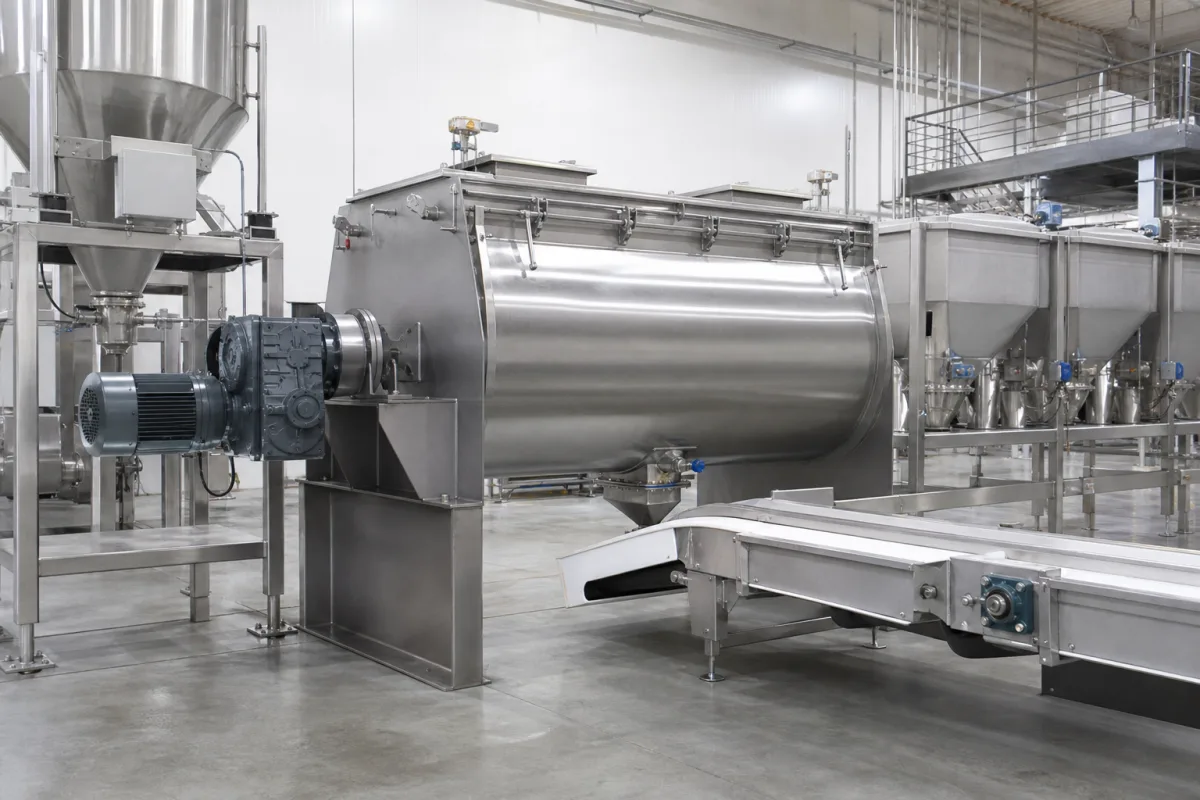
Automated Food Ingredient Blending and Mixing System in a manufacturing environment
Representative product image. Confirm appearance and specifications with the manufacturer.

Product Specifications

Technical details and manufacturing context for Automated Food Ingredient Blending and Mixing System

Definition
This system is a fully integrated production line designed for the controlled blending of dry, liquid, and semi-solid food ingredients. It ensures batch-to-batch consistency, precise recipe adherence, and hygienic processing for manufacturers of sauces, dressings, bakery pre-mixes, and seasoning blends. The system integrates material handling, weighing, sequencing, and mixing modules into a coordinated workflow, reducing manual labor and contamination risks while optimizing production throughput for B2B food manufacturing. Key components include storage silos or hoppers, precision weigh scales, a central mixing vessel with mechanical agitation, and downstream transfer to packaging or processing. The system is constructed with food-grade materials such as Stainless Steel 316L, Food-Grade Polyurethane, and Sanitary-Grade Silicone, ensuring compliance with hygiene standards. Typical specifications include a maximum batch capacity of 1000–5000 kg, mixing time per batch of 5–20 minutes, 8–24 ingredient feed stations, weighing accuracy of ±0.05 grams (OIML R76), system throughput of 2–10 batches per hour, agitator power of 7.5–45 kW, operating pressure of 1.0–1.6 MPa, operating temperature of -10 to 60°C (up to 90°C optional), relative humidity ≤95% non-condensing, ingress protection rating IP54–IP65 (IEC 60529), electrical supply 380–480 V AC (3-phase, 50/60 Hz, IEC 60038), control voltage 24 V DC ±10%, material grade 304/316L (ASTM A240), and footprint of 20–80 m². These values are reference ranges and must be verified with the manufacturer for specific models. The system is designed for B2B food manufacturing and is not a consumer product. Always confirm model-specific specifications and standards with the legal manufacturer or supplier before procurement.
Working Principle
Ingredients are conveyed from storage silos or hoppers to precision weigh scales, then sequentially or simultaneously discharged into a central mixing vessel where mechanical agitation ensures homogeneous blending before transfer to downstream packaging or processing. The system operates in batches, with each cycle involving loading, weighing, mixing, and discharging. The control system manages the sequencing of ingredient addition and mixing duration to achieve target homogeneity. The mixing vessel is equipped with an agitator powered by a motor rated at 7.5–45 kW. The system is designed to operate within specified pressure, temperature, and humidity ranges, and the electrical and control systems are configured for industrial environments. The process is automated, reducing manual intervention and contamination risks.
Common Materials
Stainless Steel 316L, Food-Grade Polyurethane, Sanitary-Grade Silicone
Technical Parameters
ParameterTypical rangeNotes & selection driver
Maximum Batch CapacityRequired1000–5000 kgTotal weight of ingredients per complete mixing cycle
Mixing Time per BatchRequired5–20 minutesTypical duration to achieve target homogeneity
Ingredient Feed StationsRequired8–24 countNumber of independent ingredient input points
Weighing AccuracyRequired±0.05 gramsPrecision of individual ingredient dosing scalesOIML R76
System ThroughputRequired2–10 batches/hourMaximum operational cycles per hour including load, mix, and discharge
Agitator Power7.5–45 kWRated power of the main mixing motor
Operating Temperature-10–60 °CProcess temperature up to 90°C optional
Relative Humidity≤95 %Non-condensing
Ingress Protection RatingIP54–IP65Higher on requestIEC 60529
Electrical Supply380–480 V AC3-phase, 50/60 HzIEC 60038
Control Voltage24 ±10% V DCFor sensors and PLC
Material Grade304/316LFood contact surfacesASTM A240
Footprint20–80 Depends on configuration

Ranges are indicative industry figures for RFQ preparation, not a supplier commitment. Confirm every value and standard with the legal manufacturer before ordering.

Components / BOM

Industry Taxonomies & Aliases

Commonly used trade names and technical identifiers for Automated Food Ingredient Blending and Mixing System.

Industrial Ecosystem & Supply Chain Structure

Complementary Systems
Downstream Applications
Specialized Tooling

Application Fit & Sizing Matrix

Operational Limits
pressure: Up to 3 bar (max system pressure)
flow rate: 100-5000 L/hr (per mixing line)
batch size: 50-5000 L capacity
temperature: 5°C to 80°C (operating range)
mixing accuracy: ±0.5% by weight
slurry concentration: Up to 70% solids by weight
Media Compatibility
✓ Powdered ingredients (flours, spices, additives) ✓ Liquid food additives (oils, syrups, flavorings) ✓ Granular materials (sugar, salt, grains)
Unsuitable: Highly corrosive acidic media (pH <2.0) or abrasive slurries with >70% solids
Sizing Data Required
  • Required batch volume (L) and production rate (batches/hour)
  • Number of distinct ingredients to be blended simultaneously
  • Required mixing precision (% tolerance by weight) and homogeneity specifications

Reliability & Engineering Risk Analysis

Failure Mode & Root Cause
Bearing fatigue and contamination failure
Cause: Ingredient abrasives (e.g., salt, sugar crystals) infiltrating bearing seals, combined with cyclic loading from start-stop operations and potential misalignment from agitator imbalance.
Seal degradation and leakage
Cause: Chemical attack from acidic or caustic ingredients, thermal cycling during cleaning processes (CIP/SIP), and mechanical wear from shaft runout or improper gland packing tension.
Maintenance Indicators
  • Unusual high-frequency vibration or rhythmic knocking from the mixer drive assembly, indicating potential bearing failure, imbalance, or foreign object ingress.
  • Visible product leakage at shaft seals or flange gaskets, or audible hissing/whistling suggesting seal failure and cross-contamination risk.
Engineering Tips
  • Implement a predictive maintenance program using vibration analysis and ultrasonic testing to detect early bearing wear and misalignment, complemented by strict seal integrity checks after each cleaning cycle.
  • Upgrade to food-grade, chemically resistant seals and bearings, and establish a rigorous lubrication schedule with compatible, high-purity greases to prevent washout and contamination.

Indicative industry ranges for design and RFQ preparation. Confirm the exact figures and applicable standard with the manufacturer before specifying.

Compliance & Manufacturing Standards

Applicable Standards
ANSI/NSF 2-2020 - Food equipment CE - Machinery Directive 2006/42/EC

Quoted from the published standard.

Manufacturing Precision
  • Ingredient proportioning accuracy: +/- 0.5% by weight
  • Mixing uniformity: 95% homogeneity across batch
Quality Inspection
  • Cleanability verification (ATP swab testing)
  • Material composition verification (XRF analysis)

Manufacturers of Automated Food Ingredient Blending and Mixing System

Manufacturer profiles associated with Automated Food Ingredient Blending and Mixing System.

Sourcing Automated Food Ingredient Blending and Mixing System from China?
Tell us your specification and target quantity — we will match it against manufacturer records and come back with the factories that fit.
Request manufacturers We manufacture this

Manufacturer listings support early research and capability understanding. They are not certification, ranking, or transaction guarantees.

Share this page
Technical documentation
Request current drawings, revision history, and a signed specification sheet.
Manufacturing capability
Verify equipment lists, process limits, capacity, and representative production evidence.
Inspection readiness
Confirm test methods, calibrated equipment, sampling plans, and traceable reports.
Supplier transparency
Check the legal entity, factory address, ownership, certifications, and direct contacts.

CNFX does not score or rank suppliers. Buyers must verify all claims and documents with the legal manufacturer before ordering.

Frequently Asked Questions

What is the typical batch capacity of this system?

The maximum batch capacity is listed as 1000–5000 kg per complete mixing cycle. However, this is a reference range and the actual capacity depends on the specific configuration and model. Always confirm with the manufacturer.

What materials are used in food contact surfaces?

Food contact surfaces are made of Stainless Steel 304/316L, as per ASTM A240. Other materials used in the system include Stainless Steel 316L, Food-Grade Polyurethane, and Sanitary-Grade Silicone. Verify material grades with the supplier for your application.

What is the weighing accuracy of the ingredient scales?

The weighing accuracy is ±0.05 grams, according to OIML R76. This ensures precise dosing of individual ingredients. However, actual accuracy may vary with installation and calibration, so confirm with the manufacturer.

What are the electrical requirements for this system?

The electrical supply is 380–480 V AC, 3-phase, 50/60 Hz, per IEC 60038. The control voltage is 24 V DC ±10%. Ensure your facility meets these requirements and verify with the manufacturer for specific models.

Data Basis

Editorial classification, named public sources where available, and source-reviewed manufacturer records.

Preliminary Technical Classification
This page supports structured research, RFQ preparation, and supplier evaluation. It does not replace buyer-led supplier qualification, standards review, or technical approval.
Buyer enquiry

Request manufacturing insight for Automated Food Ingredient Blending and Mixing System

Ask for use case, specification boundaries, supplier type, and RFQ preparation information for this product.

Where it goes
Straight to the CNFX editorial desk, and to the manufacturer if this product is linked to a claimed profile. Nothing is broadcast to a supplier list.
Your details stay here
We do not sell or rent enquiry data, and we do not add you to a mailing list. Used only to answer this request.
No commission, no middleman
CNFX is a directory. We take no cut of any order and never negotiate on a supplier's behalf.
What we don't claim
A listing is not an endorsement. Qualify every supplier and verify every figure yourself before ordering.

Your business information is used only to process this request.

Thank you! Your message has been sent. We'll respond within 1–3 business days.
Sorry, we couldn't send your message. Please try again, or email us at [email protected].

Need to Manufacture Automated Food Ingredient Blending and Mixing System?

Compare manufacturer profiles with relevant product and process capability.

Previous Product
Food-Grade Sanitary Gasket
Last Product
Get QuotesChat