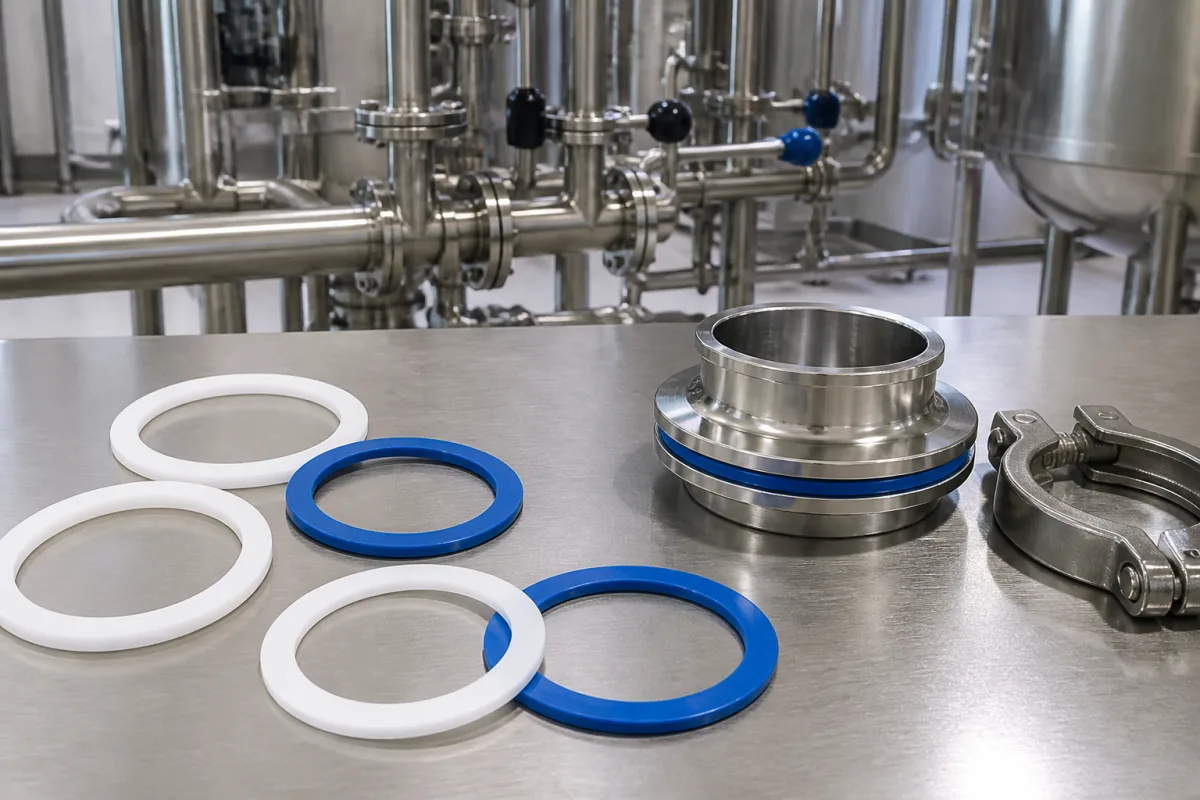
Gaskets for hygienic clamp and flange joints in food and beverage plants · Elastomer and fluoropolymer choice, FDA 21 CFR 177.2600 extractive limits for repeated-use rubber, PTFE under 177.1550, steam and CIP limits, storage and shelf life, and compliance documents
A food-grade sanitary gasket seals a hygienic joint, such as a clamp ferrule or flange, between pipes, valves and equipment that carry food or beverage. It touches the product and goes through every cleaning and sterilising cycle, so its material, food-contact compliance and temperature limits matter as much as its size. Ask three things first: which joint standard and size it fits, which material suits the product, cleaning chemicals and steam, and what regulation the supplier's compliance statement refers to.
Gaskets for hygienic clamp, flange and union joints in food, dairy and beverage process lines, in elastomers (EPDM, FKM, silicone and others) and fluoropolymers such as PTFE. Tube fittings and ferrules (see sanitary fittings), moulded silicone gaskets for other uses (see high-precision silicone gasket), O-rings for pumps and mechanical seals are outside this page except where compared.
CNFX editorial research · Sources checked October 11, 2026 · 4 sources
US FDA regulation 21 CFR 177.2600 covers rubber articles intended for repeated use in producing, processing, transporting or holding food, made from natural or synthetic polymers and listed adjuvants. For repeated-use rubber in contact with aqueous food, the food-contact surface in its finished form, extracted with distilled water at reflux, must yield total extractives of no more than 20 mg per square inch in the first 7 hours and 1 mg per square inch in the next 2 hours; for fatty foods, extracted with n-hexane at reflux, no more than 175 mg/in² in the first 7 hours and 4 mg/in² in the next 2. Finished articles must be thoroughly cleansed before first use. [1]
Fluoropolymer gaskets are a different case: 21 CFR 177.1550 covers perfluorocarbon resins made by homopolymerisation or copolymerisation of hexafluoropropylene and tetrafluoroethylene, and copolymers of perfluoropropylvinylether and tetrafluoroethylene, with its own extractive limits. [2]
Editorial note: ask the supplier which section its compliance statement refers to for the exact compound supplied (177.2600 for rubber, 177.1550 for perfluorocarbon resins), whether the test was on the finished gasket, and for the food type (aqueous or fatty) that applies to your product.
Give the supplier the joint type and size standard (clamp ferrule, flange, union), the product and its fat content, process and cleaning temperatures, CIP chemicals and concentrations, steam-in-place duty, pressure, required regulation and certificates, colour or detectability needs, lot traceability, and the storage conditions at your site.
02
Match the material to temperature, steam and chemicals
One sanitary gasket supplier's product pages give EPDM gaskets a low-pressure steam range of -30°F to 300°F and state that they resist animal and vegetable oils, ozone, strong chemicals and oxidising chemicals, and should not be used with mineral oils, solvents or aromatic hydrocarbons. Its FKM gaskets are rated from −30°F to 400°F with excellent compatibility with strong acids, but the supplier does not recommend them for continuous use in steam-in-place procedures. It notes that service life must be considered and a preventive maintenance programme put in place. [3][4]
The same pages give a shelf life of 10 years from cure date when stored in original packaging in a clean, dry warehouse out of direct sunlight, more than 6 ft from electric motors, at 65°F to 85°F, and list compliance claims including FDA 21 CFR 177.2600, USP Class VI and 3-A Sanitary Standards. [3]
Editorial calculation: −30°F to 300°F is about −34°C to 149°C, and 400°F is about 204°C; compare these with your steam and CIP temperatures, and ask for the supplier's own limits for the exact compound. [3]
03
Joint standard, compound and food-contact section behind each gasket
Gasket dimensions, compound ratings and compression set
Only the temperature ratings and food-contact sections have published values here; dimensions, hardness and compression set depend on your ferrule standard and the supplier's compound.
Field
What it means and published values
Ask the supplier for
Inner Diameter (mm)
Matches tube bore.
Drawing.
Outer Diameter (mm)
Matches ferrule or flange.
Drawing.
Thickness (mm)
Compression in the joint.
Value.
Temperature Range (°C)
E.g. EPDM −34 to 149°C; FKM to 204°C (one supplier). [3][4]
Explore company information and manufacturing capabilities, then discuss the scope of your project with a relevant supplier.
Share this page
Compiled and source-reviewed by the CNFX editorial team.
Each manufacturer above links to the page on that company's own website where the product is listed, with the date we checked it. How we source and review
· Page last updated 13 October 2026
Buyer questions
What does FDA 21 CFR 177.2600 limit for rubber gaskets?
Total extractives from the finished food-contact surface: 20 mg/in² in 7 h with water for aqueous foods, 175 mg/in² with n-hexane for fatty foods. [1]
Is a PTFE gasket covered by 177.2600?
No; perfluorocarbon resins made from tetrafluoroethylene and related monomers are covered by 21 CFR 177.1550. [2]
Can EPDM or FKM gaskets take steam?
One supplier rates EPDM for low-pressure steam up to 300°F and does not recommend FKM for continuous steam-in-place. [3][4]
Sources and what still needs a direct check
Sources checked 2026-10-11. 21 CFR 177.2600 and 177.1550 are US FDA food-contact regulations; the supplier pages state one company's ratings and compliance claims, which are not independent certification.