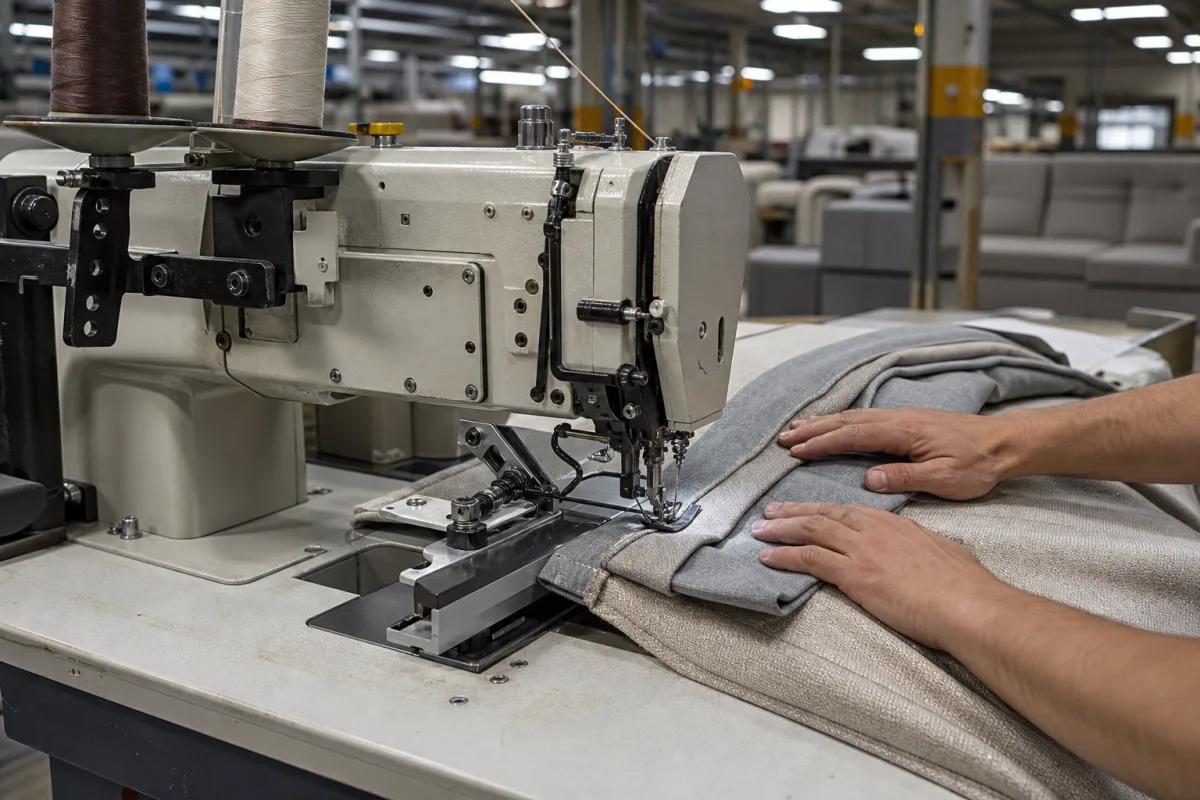
An upholstery lockstitch machine must feed the actual layered cover and maintain the required seam. For the flat-bed compound-feed machines considered here, check bottom feed, needle feed and alternating top feet together, then test the required seam, thread and access on the real upholstery build-up.
Single- and twin-needle unison-feed (compound-feed, walking-foot) lockstitch machines for furniture, car seats and similar heavy work. Domestic machines, cylinder-bed and post-bed machines, long-arm quilting machines and automatic sewing units are outside this page.
CNFX editorial research · Sources checked October 18, 2026 · 4 sources
Check the feed arrangement on the actual layered seam
Kinglead describes its KD-4400 as bottom feed, needle feed and walking-foot top feed, with a large vertical-axis hook and a safety clutch. Its stated upholstery applications include sofas and car interiors. Confirm the complete machine subclass and seam sample rather than treating any walking-foot label as proof of identical feed action. [3]
JUKI’s LU-2810N/LU-2860N supplement identifies unison-feed lockstitch machines for medium/heavy materials, car seats and furniture. It lists box feed, timing-belt top/bottom feed actuation and 1–9 mm alternating vertical movement. This movement is a different setting from the height reached when the presser is lifted for loading. [1]
02
Separate stitch length, alternating movement and lifted clearance
For the LU-2810N, the manual lists 9 mm maximum forward/reverse stitch length, 10 mm hand lift and 20 mm knee lift, with 347 × 127 mm space under the arm. Those clearances do not by themselves guarantee that a material stack of the same thickness can be sewn through a seam crossing. [1]
The LU-2810N entry gives maximum 3,000 stitches/min and refers to the standard-model sewing-speed table. The separately listed maximum stitch length is not evidence that the machine can sew continuously at both maxima together. Do not convert their product into a measured seam production rate. [1]
Kinglead’s KD-4400 product table lists 2,000 r.p.m., 0–9 mm stitch length and 8 mm hand/16 mm knee lift. Its needle entry is DP×17, sizes 18–23; JUKI’s LU-2810N entry is Groz-Beckert 135×17, Nm 125–180. Keep each system and size notation with its own model. [3][1]
03
Choose the bed geometry before comparing machine specifications
The Dürkopp Adler Goldline page describes cylinder-arm triple-feed machines for tubular and three-dimensional workpieces. That is a different bed geometry from this page’s flat-bed upholstery scope; its drive, air and weight figures must not be imported into a flat-bed machine quotation. [4]
Compare how the actual cover can be moved around the needle, its seam access and support. A shared description of bottom feed, needle feed and alternating top feet does not make a cylinder-arm machine and a flat-bed machine interchangeable. [4][3]
04
Identify the exact model and options in a sofa-seam quotation
JUKI’s LU-2800V-7 catalogue distinguishes its machine subclasses, hook capacity, trimming and needle arrangements. The catalogue specifically describes the LU-2860V-7 as a two-needle system with maximum 12 mm pitch for sofa topstitching. This does not assign that stitch length to every LU-2800 variant or to the LU-2810N manual example. [2]
The KD-4400 page separates its basic model from KD-4400D with automatic thread trimming, and also names separate twin-needle models. Confirm the actual ordered designation, motor/control package and trimming equipment. [3]
05
Match feed, hook and needle equipment to the seam
The feed mechanism moves the layers; the hook/bobbin and needle/thread combination form the lockstitch. JUKI’s different subclasses use different hook and needle arrangements, so an example needle or hook specification cannot be copied across the entire series. [1][2]
Kinglead lists automatic lubrication and a hook safety clutch on its named model. These features do not replace the operating manual or demonstrate successful sewing on the buyer’s thickest layer crossing. [3]
06
Specify the seam trial and the complete supplied machine
Give the supplier the material stack, structural/topstitch seam, thread designation, required needle count, layer crossing, workpiece handling and trimming/backtack needs. Ask for permitted speed at the selected stitch and alternating-foot settings, with a sewn sample from the actual material. [1][2]
Record foot movement, lifted clearance, arm/bed dimensions, needle system and thread notation separately. Require the exact motor, controller, table, electrical supply and any pneumatic option for the ordered model; the cylinder-arm comparison does not supply missing flat-bed installation values. [3][4]
07
Send the material, seam and machine data together
Paste it into your enquiry below or into an email to a maker, then replace every bracket.
1 company lists this product among what they make. Company figures are quoted from each
company's own website; every card states where the relationship came from.
Kinglead
TBC
Official KD-4400/KD-4400D page identifies flat-bed compound-feed walking-foot upholstery machines; trimming depends on the designation. Confirm the actual seam, machine subclass and complete motor/table package.
Explore company information and manufacturing capabilities, then discuss the scope of your project with a relevant supplier.
Share this page
Compiled and source-reviewed by the CNFX editorial team.
Each manufacturer above links to the page on that company's own website where the product is listed, with the date we checked it. How we source and review
· Page last updated 13 October 2026
Buyer questions
Is presser-foot lift a guaranteed sewable material thickness?
No. Lifted clearance and alternating movement are separate specifications. Confirm sewing through the actual compressed stack and seam crossing at the intended settings. [1][3]
Does every LU-2800 machine provide a 12 mm stitch?
No. The cited catalogue specifically describes the two-needle LU-2860V-7 with a maximum 12 mm pitch. The LU-2810N manual example lists a maximum 9 mm stitch. [2][1]
Can maximum speed and maximum stitch length establish seam throughput?
No. They do not establish simultaneous permitted settings or measured output. Follow the applicable sewing-speed table and test the actual seam and workpiece handling. [1]
Sources and evidence scope
Sources checked 2026-10-18. JUKI’s model supplement and catalogue and Kinglead’s product table describe different machine designations. The Dürkopp Adler cylinder-arm page is retained only to explain a separate bed geometry.