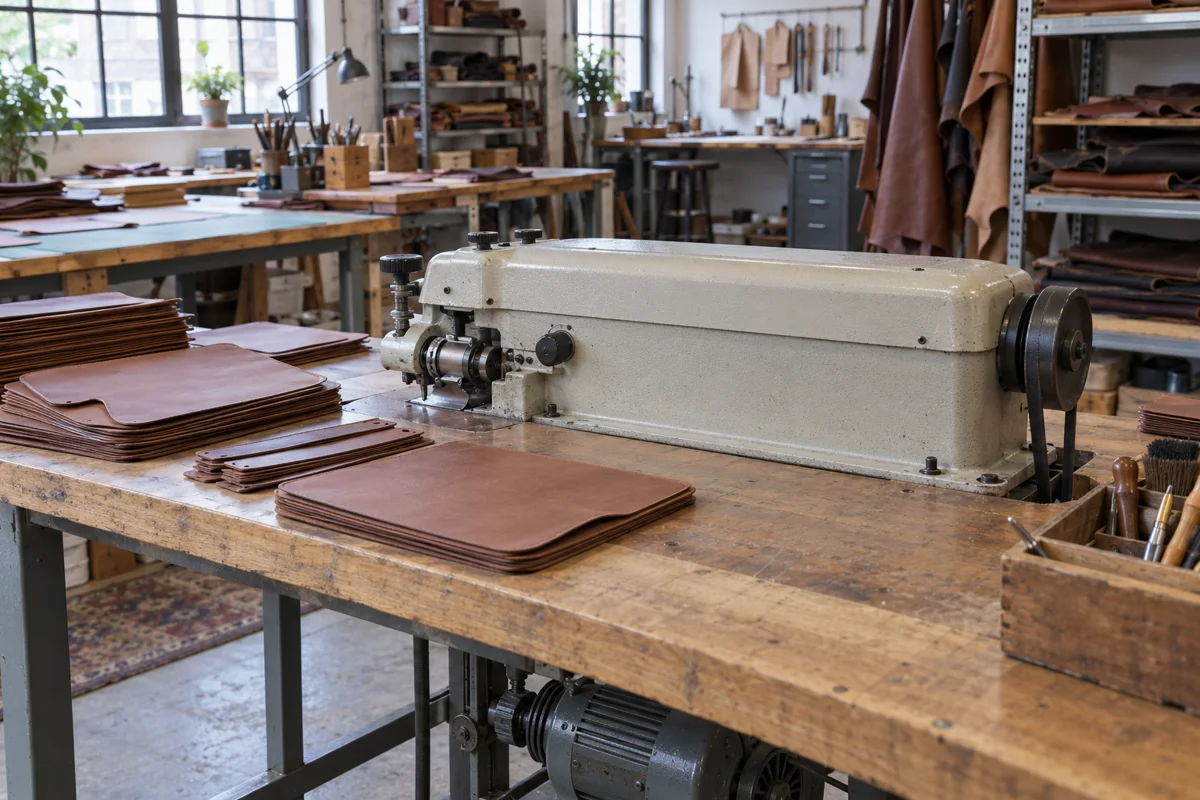
Start with the edge you need to fold or join: its remaining thickness, skived width and profile. A bell-knife skiver combines the knife, feed roll and presser foot to produce that edge. Compare the machine and tooling together, then test your actual leather or synthetic material.
CNFX editorial research · Sources checked October 12, 2026 · 6 sources
The feed roll presents the leather to the knife under the presser foot
The foot sets the thickness and angle; the roll feeds the material into the cutting area. NIPPY describes these as replaceable tooling, chosen for the material and machine type. Fortuna describes its bell knife as capable of in-process sharpening, but the grinding controls differ by model. [4][5][2]
Functional assembly / BOM reference
What it does
What the sources establish
Bell knife and main shaft
Remove material from the selected edge. The knife position and condition belong to the cutting setup.
NP-201 has a collet-type main shaft; NIPPY identifies its bell-shaped knife in the grinding-wheel notes. No blade alloy, diameter or replacement fit for FX801 is established here. [3][6]
Feed roll and drive
Advance the workpiece into the machine. Roll choice changes with material and presser foot.
NP-201 lists three feed speeds without numerical rates. NIPPY lists abrasive grades plus separate rubber and steel rolls; these are not a generic rubber-coated-steel assembly. [3][5]
Presser foot / roller foot
Set the skive thickness and angle and support the selected profile at the cut.
NIPPY lists hardened standard feet and non-hardened options for custom processing; no steel grade is given. A roller foot is a tooling option, not evidence that every machine has a pressure-roller system. [4]
Thickness, width and angle adjustments
Position the working setup for the required edge geometry.
NIPPY describes adjustment of the machine and replacement of the foot. These sources do not establish a separate calibrated depth gauge or numerical thickness accuracy. [4]
Grinding wheel and engagement control
Sharpen the bell knife using the matched wheel and the model’s grinding mechanism.
NP-201 has a grinder on/off control; FX801 lists a grind-knife clutch. NIPPY identifies 416R red standard and 416W white hard wheels for its own knives. [3][1][6]
Scrap ejector / removal arrangement
Clear removed material from the working area.
NP-201 lists a scrap ejector and FX801 automatic chip removal. NIPPY recommends vacuum removal to prevent winding onto the feed roll; neither listing proves that a vacuum unit or a particular plastic extraction port is supplied. [3][1][5]
This is a sourced functional breakdown, not a manufacturing parts list. Obtain the model-specific knife, roll, foot and grinding-wheel references before ordering spares; shared part names do not establish interchangeability.
02
Compare skiving width, angle and drive
Fortuna distinguishes edge skiving from whole-piece splitting in its brochure. FOXSEW also advertises surface skiving, but its FX801 width is only up to 50 mm. A quotation for broad sheet splitting is a different machine selection. [2][1]
Angle matters as much as width
The brochure gives NG 6 and NG 3 widths of 0–18 mm and angles of 0–33°; 34 S-AG/M is 0–11 mm and 0–45°. The listed 34 mm and 50 mm versions have 0–20° ranges. These are model envelopes, not a universal width-to-angle law or a promise that every width/angle combination suits your material. FX801 states no angle range. [2][1]
Materials
FOXSEW lists leather, synthetic leather and rubber for shoes, belts, bags and gloves. Fortuna lists broader applications and reinforced versions according to material. Match the exact machine and tooling to a sample; a category application list does not qualify every model for every material. [1][2]
NIPPY says roll selection depends on the material, foot and machine type. Read the following tooling choices as guidance for its own equipment; part numbers and adjustment notes do not establish cross-brand fit. [5][4]
Order tooling with the machine
Send the part drawing or sample with its required remaining edge thickness, width and profile. Ask the supplier to identify the fitted foot and roll and the alternatives included. Fortuna describes configuring machines through combinations of feet and rolls; that does not establish that one tooling set covers all of your parts. [2]
Presser feet
Set skiving thickness and angle; different feet give standard, slant, stepped, flat or grooved skives [4]; Fortuna lists shapes from V-skiving to folding groove [2]
Roller presser foot
NIPPY’s own note calls for a 2–4 mm rightward knife-edge offset with its roller presser foot. Confirm the applicable foot, knife and adjustment procedure in the selected machine’s manual; do not transfer that setting to FX801 solely because it also uses a bell knife. [4]
NIPPY #46 rough or steel roll
Two listed choices for hard and rough leather; the steel option is separate from the #46 abrasive grade. [5]
Soft leather; #180 where #120 does not feed well [5]
Rubber feed roll
NIPPY lists rubber for soft material or where material winds onto the feed roll; it also recommends vacuum removal for winding. Confirm the chosen roll and extraction arrangement together. [5]
04
Keep the bell knife cutting
Separate a worn or poorly sharpened knife from feed and scrap problems. The sources describe different controls and matching consumables, rather than one grinding interval that applies to all machines.
Grinding wheel
NIPPY lists 416R red standard and 416W white hard wheels. Its warning about poor cutting despite sparks or heat concerns wheels used with NIPPY bell knives; it is not a test proving that another brand’s wheel is unsuitable for its own knife. [6]
Grinder control
FX801 has a knife-grinder clutch [1]; NP-201 an on/off grinder switch [3]
Scrap removal
FX801 lists automatic chip removal and NP-201 a scrap ejector. NIPPY’s roll page recommends vacuum removal to avoid winding. Check what is included, how scrap is collected and the selected machine’s clearing procedure. [1][3][5]
Spares
NIPPY labels feet, rolls and wheels as consumable parts. Record the exact compatible references, replacement instructions and supplier stock for the quoted machine. [4][5][6]
05
Specify the finished edge before accepting a catalogue number
Input leather thickness, removed thickness and remaining edge thickness need separate entries in a trial or quotation. The published model values below establish only part of the specification.
Field
Published evidence
What to settle in the quotation
Skiving width · mm
FX801 and NP-201: maximum 50 mm. Fortuna’s listed models have different width and angle ranges. [1][3][2]
Required edge width, angle and profile on the actual part; specify separately if whole-piece splitting is needed.
Thickness · mm
NIPPY describes foot/machine adjustment but publishes no universal residual-thickness range on these pages. [4]
Incoming thickness, remaining edge thickness and allowed variation; include soft/compressible material samples.
Motor power · W
FX801 table: 370 W. NP-201 requires a separately arranged clutch motor but gives no rating here. [1][3]
Motor/drive supplied, its rating and whether extraction is separately powered.
Feed speed · m/min or selected setting
NP-201: three feed speeds, no rates. FX801: “Speed 1100/1200” with no unit or shaft/feed identity. [3][1]
Ask what each speed refers to. Do not turn 1100/1200 into m/min or rpm without confirmation.
Separate net head, assembled workstation and packed mass; the combined column does not resolve them.
Power supply · V / Hz / phases
No electrical supply specification on the cited FX801 or NP-201 pages. [1][3]
Destination supply, motor/controller version, protection and plug/wiring.
Skiving accuracy · mm
NP-201 describes knife axial runout quality without a numerical tolerance. [3]
Residual thickness tolerance, measurement locations and sample acceptance; shaft runout is not a finished-leather tolerance.
Blade diameter / spare identity · mm / part no.
The cited listings establish a bell knife but not a shared diameter or cross-brand fit. [2][6]
Exact knife reference, dimensions and matching grinding wheel.
Operating temperature · °C
No rated ambient-temperature range found in these sources.
Obtain the selected drive/machine rating for the workshop.
Noise · dB(A)
No measured noise value or test condition found in these sources.
Request the machine’s declared noise value and measurement conditions, including extraction if supplied.
Protection / guarding
No IP rating established by the cited model pages.
Obtain the model’s guarding and electrical documentation. IP54 and general safety compliance cannot be inferred from a catalogue description.
Installation dimensions are separate from packing dimensions. NP-201 lists a 380×535×395 mm machine and requires a table/stand/motor; FOXSEW’s 610×420×440 mm figure is explicitly packing size. Request the assembled work area, operator access and scrap collection layout. [3][1]
06
Send an edge sample and a tooling schedule with the enquiry
Paste it into your enquiry below or into an email to a maker, then replace every bracket.
Product: bell-knife edge skiver; quantity [ ]
Material and surface finish: [ ]; incoming thickness [mm]
Part drawing/sample: [ ]; edge width [mm]; remaining thickness and tolerance [mm]
Edge profile: [flat / bevel / step / groove / other]; required angle [degrees]
Trial: [parts/material batches]; measurement positions and acceptance [ ]
Machine/drive: [model]; supply [V/Hz/phases]; speed meaning and settings [ ]
Included: table [ ]; stand [ ]; motor [ ]; scrap/vacuum collection [ ]
Tooling: foot references [ ]; roll grades/types [ ]; spare knife and wheel references [ ]
Documents: operating/adjustment manual [ ]; parts list [ ]; electrical/guarding information [ ]
Assembled dimensions and net mass [ ]; packing dimensions and gross mass [ ]
Delivery destination/date [ ]; installation/training and consumable support [ ]
Manufacturers of Industrial Leather Skiving Machine
1 company lists this product among what they make. Company figures are quoted from each
company's own website; every card states where the relationship came from.
FOXSEW
Taizhou, Zhejiang, CN
FOXSEW lists FX801 for edge and surface skiving of leather, synthetic leather and rubber, with up to 50 mm width, a 370 W motor, chip removal and grinding clutch. Its speed unit and combined gross/net-weight entry remain unclear. Request the edge sample, fitted tooling and complete workstation specification; this source does not establish wide splitting capability.
Product scope checked 2026-10-10
Listed on the company's own website · profile compiled by CNFX from public sources
Explore company information and manufacturing capabilities, then discuss the scope of your project with a relevant supplier.
Share this page
Compiled and source-reviewed by the CNFX editorial team.
Each manufacturer above links to the page on that company's own website where the product is listed, with the date we checked it. How we source and review
· Page last updated 13 October 2026
Buyer questions
How wide can a leather skiving machine skive?
FX801 and NP-201 each list a maximum 50 mm width. Fortuna’s brochure lists model ranges from 0–11 to 0–50 mm. Those values describe the skived region, not a broad-sheet splitting width. [1][3][2]
What sets the skiving angle?
NIPPY describes setting thickness and angle through the foot and machine adjustment. Fortuna lists different angle envelopes by model: up to 33° for NG 6/NG 3 and 45° for 34 S-AG/M; other listed versions reach 20°. Confirm the required profile on a sample. [2][4]
Which feed roll for soft leather?
For its own tooling, NIPPY lists #120 for soft leather and #180 when #120 feeds poorly; it also lists rubber for soft material or winding. The correct roll still depends on the foot and machine type. [5]
Why does my bell knife not cut after grinding?
NIPPY warns that an unsuitable wheel can cause poor cutting with its bell knife despite sparks or heat. Check the specified knife/wheel pairing and the model’s adjustment procedure; that warning alone does not diagnose every poor cut. [6]
Sources and what still needs a direct check
Sources checked 2026-10-12. Standards bodies and regulations define the requirements; manufacturer pages show published ranges for those models only. CNFX does not certify products or suppliers.
FX801 angle range, residual-thickness capability, meaning/unit of 1100/1200 and separate gross/net weights remain unconfirmed.
Confirm the exact machine, foot, feed roll and knife references together; NIPPY tooling notes do not establish compatibility with FX801.
The brochure’s Fortuna model ranges are reference data, not confirmation of current availability or trial performance. No machine certificate or workshop noise/IP claim was independently verified.
Buyer enquiry
Request manufacturing insight
for Industrial Leather Skiving Machine
Ask for use case, specification boundaries, supplier type, and RFQ preparation
information for this product.
Where it goes
Straight to the CNFX editorial desk, and to the manufacturer if this product is
linked to a claimed profile. Nothing is broadcast to a supplier list.
Your details stay here
We do not sell or rent enquiry data, and we do not add you to a mailing list.
Used only to answer this request.
No commission, no middleman
CNFX is a directory. We take no cut of any order and never negotiate on a
supplier's behalf.
What to include
Share your product specifications, quantity, destination and target delivery date.
Need to Manufacture Industrial Leather Skiving Machine?
Compare manufacturer profiles with relevant product and process capability.