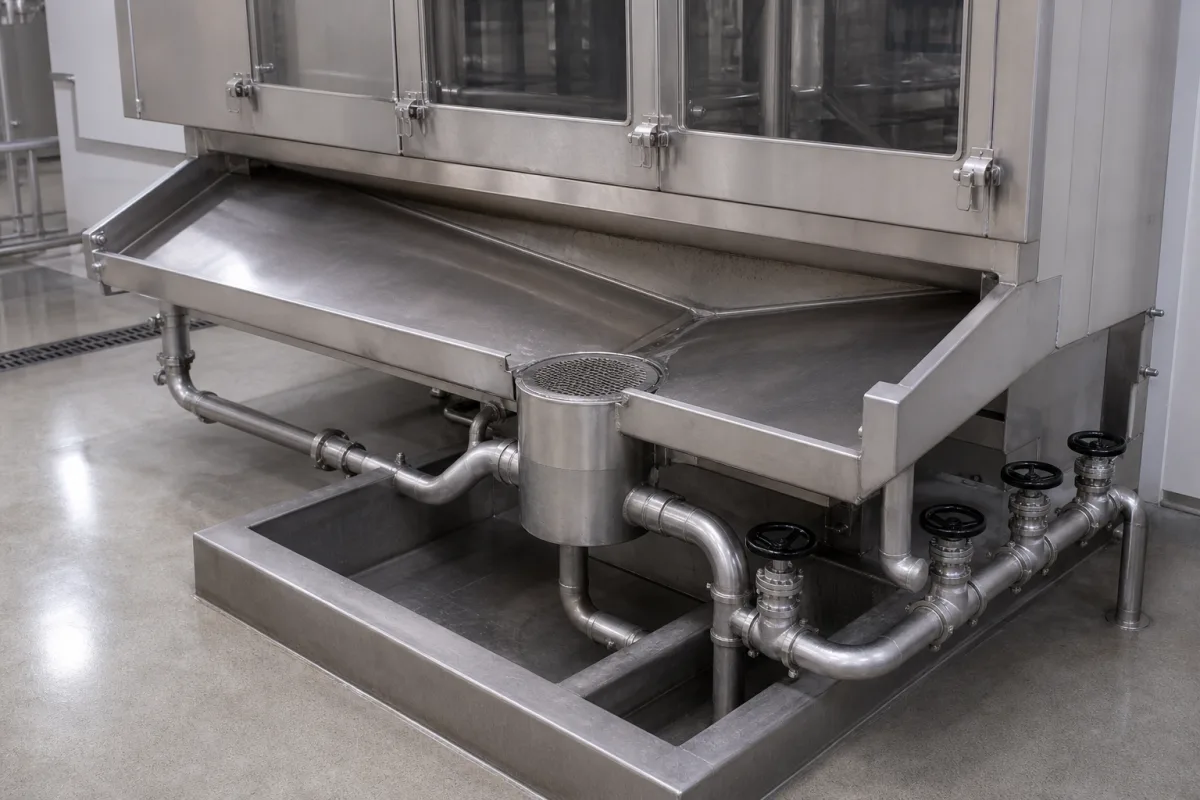
Hygienic drainage system for washdown and sanitation areas in food plants
Stainless gullies, channel drains and drip trays that carry washdown and sanitizing effluent away from food and beverage equipment · flow per gully, silt baskets, falls, radii and seal rubbers
Every washdown, CIP rinse or sanitizing cycle ends on the floor or in a drip tray, and from there it has to leave the room without pooling or carrying contamination back. A hygienic drainage system is the stainless gully, channel or tray, its grating, silt basket and trap, and the pipe connection below: designed so that it empties completely, can be cleaned like a food-contact surface and still carries the peak flow the cleaning programme releases.
Floor gullies, slot and tray channels, equipment drip trays and their gratings, silt baskets, traps and seals for wet processing and sanitation areas in food, dairy, beverage and similar plants. The clean-in-place units that supply the cleaning solutions are covered on the CIP (clean-in-place) system page, and combined CIP/SIP units on the Automated CIP/SIP system page. Rainwater and roof drainage, building soil-pipe systems, bathroom drains and medical wound drainage are different products and outside this page.
CNFX editorial research · Sources checked October 12, 2026 · 3 sources
Litres per second per gully, and what the silt basket takes off
ACO's hygienic drainage catalogue gives minimum flow rates, measured to EN 1253 without a silt basket, by gully size and outlet. It states that with an empty silt basket the flow is about 15% lower than the values listed. [1]
Editorial calculation: taking off 15% for the silt basket, a vertical 157 gully drops from 3.5 to about 3.0 l/s and a vertical 218 gully from 5.0 to about 4.3 l/s; 5.0 l/s is 18 m³/h. The silt baskets hold 0.6 l (vertical 157), 0.3 l (horizontal 157), 1.4 l (vertical 218) and 0.7 l (horizontal 218) — small volumes to check against the solids the washdown carries. [1]
Blücher lists its HygienicPro drains with horizontal and vertical outlets in 1.5 mm acid-pickled stainless steel, quality-tested with a 0.5 bar leak test, designed to EN 1253. [2]
Size from the largest simultaneous discharge in the room: hose stations running together, CIP rinse dumped to drain, and tank or equipment emptying, then add the silt basket loss.
02
No standing water and no crevices: falls, radii, joints and seal rubbers
ACO states that its hygienic drainage applies the design principles for food-contact surfaces from EN 1672, EN ISO 14159 and EHEDG Document 8, with all-stainless construction of minimum grade 304 (304 or 316 available), a fully drainable gully sump, internal radii of 3 mm or more and no overlapping metal-to-metal contact surfaces. Its channels have a V-shaped bottom for widths up to 300 mm and are fully pickled and passivated. [1]
Blücher's HygienicPro channel is made from 2 mm acid-pickled stainless steel with a longitudinal fall of 1% and a cross fall of 160° to 170°, with rounded corners and a slope towards the outlet as EHEDG guidance recommends. [2] Editorial calculation: a 1% fall over a 6 m channel is 60 mm of depth difference from end to outlet.
The seal ring in the gully decides which effluents it tolerates. ACO lists EPDM for waste water without oil or petrol residues, NBR where petrol or oil residues are present (not resistant to solvents and high temperatures), and FPM (Viton) where oil, solvents and strong acids are present, and gives temperature figures of −50 / +130 / +150 °C for EPDM, −30 / +80 / +100 °C for NBR and −20 / +200 / +300 °C for FPM. [1]
03
Floor drainage and backflow in US food plant rules
Under 21 CFR 117.37(b), plumbing in a US food plant must provide adequate floor drainage in all areas where floors are subject to flooding-type cleaning or where normal operations release water or other liquid waste on the floor, and must prevent backflow or cross-connection between waste or sewage piping and piping that carries water for food or food manufacturing. [3]
The same section requires plumbing to convey sewage and liquid disposable waste from the plant and not to be a source of contamination to food, water supplies, equipment or utensils. [3] For grating choice, ACO lists load classes to EN 1253 from L 15 (light vehicular traffic) through R 50 and M 125 to N 250 for heavy-duty areas with forklift traffic, naming food processing areas as an N 250 example. [1]
04
Room and effluent data for a drainage enquiry
Paste it into your enquiry below or into an email to a maker, then replace every bracket.
Effluent: [water, CIP solutions, sanitizers, fats, solids; pH range; maximum temperature]
Peak flow: [hose stations running together; CIP dump; tank emptying, in l/s]
Layout: [gullies, slot or tray channels, equipment drip trays; outlet positions; falls]
Floor: [resin, tile or concrete; membrane; finished floor build-up]
Load: [foot traffic, pallet trucks, forklifts; EN 1253 load class]
Material: [stainless grade 304 or 316; finish]
Accessories: [silt baskets; traps; seal material EPDM, NBR or FPM]
Compliance: [EN 1253; EHEDG design; local plumbing code]
Explore company information and manufacturing capabilities, then discuss the scope of your project with a relevant supplier.
Share this page
Compiled and source-reviewed by the CNFX editorial team.
Each manufacturer above links to the page on that company's own website where the product is listed, with the date we checked it. How we source and review
· Page last updated 13 October 2026
Buyer questions
How much flow does a stainless floor gully take?
ACO lists minimum flow rates of 2.8 to 5.0 l/s for its 157 and 218 gullies to EN 1253, about 15% lower with an empty silt basket. [1]
What fall does a hygienic channel drain have?
Blücher builds a 1% longitudinal fall and a 160° to 170° cross fall into its HygienicPro channel. [2]
Which seal suits drains carrying oil and solvents?
ACO recommends FPM (Viton) where oil, solvents and strong acids are present, and NBR where only petrol or oil residues are present. [1]
Sources and what still needs a direct check
Sources checked 2026-10-12. Flow rates, basket volumes, seal data and load classes are ACO's for its HygieneFirst range (catalogue July 2016); channel falls and leak test are Blücher's for HygienicPro; the plumbing requirements are US FDA rules for food plants.